.png)
.png) 1 month ago
17
1 month ago
17


Published Jun 12, 2026, 2:10 PM EDT
Daniel Trock is a Contributor at DualShockers specializing in PC games, lists, and reviews. He has been writing professionally since 2018 and covering games since 2020, with previous work spanning guides, news, lists, and reviews across multiple publications.
Before joining DualShockers, Daniel contributed guides to GamerJournalist and lists to TheGamer. He currently covers tech topics for SlashGear and BGR. He holds a Bachelor’s Degree in Psychology from Marist College and a Master of Fine Arts in Creative and Professional Writing from Western Connecticut State University.
Sign in to your DualShockers account
The 2000s were a very formative period for the gaming industry. It was a new millennium, and the sixth generation of consoles had just kicked off. Games were getting more elaborate, with more intricate mechanics and better quality-of-life. Every genre benefited from this, of course, but arguably, JRPGs got it the best.
 Related
10 Game Boy Advance JRPGs That Are Fun from the Start
A compact fantasy world in the comfort of your pocket.
Improved standards in both presentation and localization meant that JRPGs weren’t just a weird little offshoot of traditional role-playing games anymore, they were a fully established genre with its own norms and standards. It shouldn’t be surprising that some of the most iconic JRPGs in the genre’s history emerged during this formative period. Admittedly, most of it occurred during the early 2000s, before the entire industry was subsumed by the brown shooter era in the late 2000s, but that doesn’t diminish the monumental impact that these games left in their wake, especially since they helped tide the genre over until things could really kick off in the next decade.
10 Fire Emblem: Path of Radiance
I Like Ike

Fire Emblem: Path of Radiance
The very first Fire Emblem game came out in Japan exclusively in 1990, with the series not coming west until the release of The Blazing Blade (or just “Fire Emblem”) in 2003. It was thanks to that release, not to mention the presence of Marth and Roy in Super Smash Bros. Melee, that got western players interested in the series, so it was the perfect time to release Fire Emblem: Path of Radiance, the series’ first mainline console title since 1999.
Path of Radiance upped the production value in a big way, introducing players to Ike and his awesome sword-spinning skills as the first Fire Emblem game presented in 3D with voice acting. As a tactical JRPG, it was an obvious outlier from its contemporaries in the genre, doubled with the series’ signature use of character permadeath (Ike notwithstanding, of course). It had the same general vibe of most JRPGs, but a more intensive gameplay loop that forced you to really think your moves through, and it left quite the lasting impression on both old and new fans of the series.
9 Pokémon Platinum
Giratina-Approved

Pokémon is a series that needs no introduction, with anyone of a sufficient age having ample memory of the Poké-Mania of the ‘90s. It was after Poké-Mania started to subside in the 2000s, though, that the series really needed to start flexing its range and show us what it could bring to the table, proving it wasn’t just a toy fad from a bygone age. The Pokémon game that did that varies depending on who you ask, but for my money, it was Pokémon Platinum.
The Diamond and Pearl duo were already a pretty big jump in quality for the Pokémon series, as the first games on the Nintendo DS, improving the quality of the sprites and beginning to incorporate 3D elements into the presentation. As the definitive version of the generation, Platinum took everything that worked in Diamond and Pearl and refined it even further. This included merging the two instances of the Sinnoh Dex into one massive undertaking, tweaking the new online play elements further, and adding everyone’s favorite post-game feature back from Emerald, the Battle Frontier.
8 The World Ends with You
Style and Substance Combined

Speaking of the Nintendo DS, that ol’ sandwich of a handheld was home to some of the most ambitious and experimental JRPGs to date, thanks largely to its implementation of its touch screen. It was in this highly experimental environment that we received one of Square Enix’s most memorable JRPG experiments, The World Ends with You.
The World Ends with You was a fascinating marriage of both style and substance, with the hip and modern streets of Shibuya as its contemporary setting paired with a novel two-member, ability-centric combat system. That system definitely had a bit of a learning curve to it, requiring you to juggle drawing patterns on the touch screen and making inputs on the face buttons, and more than a few people bounced off of it as a result. For those who stuck around, though, it had a very unique story to tell on the nature of life and death, and did so in a remarkably stylish fashion with an excellent soundtrack.
7 Mother 3
I’m Not Crying, You’re Crying

I know it probably seems odd to include a Japan-only release for a list like this, but you need to understand the kind of impact that Mother 3 had, as well as the reason that people like me won’t stop begging Nintendo to finally give us an official localization and end its Japan-exclusivity. Earthbound, of course, set the standard for quirky, off-kilter JRPGs, but those that got to experience Mother 3, either on its home platform of the GBA or through… other means were forever changed by it.
It’s difficult to put Mother 3’s special sauce into words. It has mostly the same general gameplay system as Earthbound, but with several critical differences, like being able to dash in the overworld and the rhythm-based attack system in combat. The linchpin, however, undoubtedly remains the game’s story. If your first exposure to Lucas was in Super Smash Bros. Brawl, you may have thought him nothing but a timid little kid, but trust me when I say that that timidity comes from a valid place, and experiencing his and his friends’ trials will leave you genuinely sad when it comes to an end.
6 Paper Mario: The Thousand-Year Door
A Consistent Joy Throughout

Paper Mario: The Thousand-Year Door
2000’s Paper Mario was a surprising hit for the N64, a spiritual follow-up to Super Mario RPG that served as an excellent jumping-off point for those new to the JRPG genre with Mario as a familiar fixture. While the game was well-liked, though, the reception received by its 2004 sequel, Paper Mario: The Thousand-Year Door, was several orders of magnitude higher, and for good reason.
Thousand-Year Door still maintained the colorful and accessible vibe that gave the original its appeal, but added unexpected layers of depth and system that made it consistently fun to engage with. The speccing potential of your badges, the abilities of your partners, and good old-fashioned reaction commands kept combat varied and interesting, while fights were also quick and simple enough so as not to become repetitive. The game was also consistently charming and funny, with lovable and memorable characters and even the occasional surprising plot beat. It also knew how to lean into its paper aesthetic without beating you over the head with it, a stylistic lesson that the series’ current handlers could really stand to re-learn.
5 Tales of Symphonia
The First 3D Tales Game

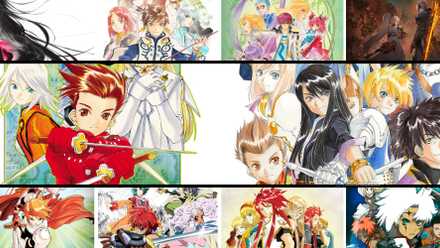
Like many JRPGs that weren’t Final Fantasy, the Tales series had a rather small presence in the west in its early life. The games did come out in English for the PlayStation, and did just fine, but they didn’t amass any particular broad acclaim. Whether due to good timing or the new elements it brought to the table, 2004’s Tales of Symphonia was the series’ major turning point.
 Related
Every Tales Of Game, Ranked
A new tale to tell in every entry.
Symphonia was the first 3D Tales game, and it made use of that via the “Multi-Line Linear Motion Battle System” that allowed it to be in 3D while still controlling in 2D during battle. It had an absolutely massive world map full of places to visit and monsters to battle, a surprisingly large cast of unique party members, and a deep stat and gear system you could absolutely lose yourself in. One of the game’s biggest selling points was its initial exclusivity on the GameCube, where it was quite possibly one of the most elaborate games on the entire system, requiring two discs to play the whole thing.
4 Dragon Quest VIII: Journey of the Cursed King
Finally Caught the West’s Attention

Dragon Quest games have been released in the United States since near the beginning of the franchise. However, compared to the series’ status as a major icon in Japan, the reception was always a bit muted on this side of the world. The games were liked well enough, but they just didn’t convey the same star power. That changed in earnest with the release of Dragon Quest VIII, the game that finally conveyed just how big of a deal this series was to western players.
Dragon Quest VIII featured numerous tweaks to the series’ existing story and combat frameworks to make them much more flashy and cinematic, not to mention a little more user-friendly, adding elements like the Alchemy Pot for free item-crafting and the tension system for building up strength mid-combat. I wonder if perhaps Dragon Quest VIII’s release was a matter of good timing, as many kids who grew up watching Dragon Ball Z were now old enough to recognize and appreciate Akira Toriyama’s artwork in other spaces. Well, coincidence or not, the game was a smash hit, and is still a high-ranker amongst the series’ newer entries.
3 Final Fantasy X
A High Bar of Production

Compared to Dragon Quest, Final Fantasy had a much bigger presence in the west, to the point that it was more or less considered the definitive face of the JRPG genre ‘round these parts. The release of Final Fantasy VII in 1997 helped to cement that image further, with VIII and IX going even further with it. Final Fantasy X, however, was a positively monumental jump in quality across the board.
Final Fantasy X was the first mainline game to feature full voice acting, which tied in well with its generally higher production budget and larger scale. Whether or not the cast is your favorite is largely a matter of opinion, but at least in practical terms, the game’s cast offered a diverse array of abilities and attacks that you could use to format your battle team to your liking, while adding important quality-of-life elements like freely switching characters mid-fight. It was also the first game to return to the traditional turn-based format after several games with the ATB system, which is just something I personally appreciated, as I like to take my time with these kinds of games.
2 Kingdom Hearts II
Still the One to Beat in its Series

The release of the original Kingdom Hearts was quite possibly one of the biggest bolts from the blue that the gaming industry had ever seen. A combination of Final Fantasy and Disney, by all accounts, should not have worked, but this spunky young game managed to chain it all together into something halfway cohesive. Kingdom Hearts II then had the unenviable position of needing to follow up on this once-in-a-lifetime act, but not only did it manage to follow up, it surpassed the original in almost every conceivable regard, and remains the gold standard of the entire series to date.
Kingdom Hearts II began the more elaborate aspects of the series’ worldbuilding and storytelling, chaining together both the events of the original and its GBA interquel to create something more dramatic and of a larger personal scale for its characters. More than that, compared to the first game, the combat is much faster, more responsive, and wonderfully high-flying. Where combat in the first game made you feel like a little kid swinging a sword above his weight class, Kingdom Hearts II really started to make Sora feel like a magical superhero capable of the kinds of stunts you’d normally see in Shonen anime.
1 Persona 4
Inching Closer to Perfection

The Megami Tensei franchise had basically no presence anywhere but Japan in its earlier life. The mainline Shin Megami Tensei series didn’t even start releasing in America until Nocturne in 2004. However, prior to that, one of MegaTen’s spin-off series, Persona, had gotten its foot in the door in 1999, and the landmark release of Persona 3 in 2007 was what really got interest firing off. Why is Persona 4 in this spot instead of Persona 3, then? Because while Persona 3 set the precedent, Persona 4 moved it closer toward perfection.
Persona 4 took the building blocks of its predecessor, including its contemporary supernatural setting, its hybrid turn-based combat and life-sim aspects, and ensemble cast, and refined it even further. Persona 4 improved on 3’s gameplay in just about every metric, particularly in adding the ability to directly control your party members rather than simply praying they acted to your advantage (and then casting Marin-Karin again). Most of the updates added in Persona 4 would be reverse-engineered into Persona 3 with the release of Persona 3 Portable on the PSP; that’s how influential it was. Prior to the release of Persona 5, Persona 4 was the face of the series, and a big component of Persona splitting off from the wider SMT franchise.
 Next
Next
10 Most Addictive PS2 JRPGs
These PS2 JRPGs aren't just fun, they sink their claws into you and never let go.




![ELDEN RING NIGHTREIGN: Deluxe Edition [FitGirl Repack]](https://i5.imageban.ru/out/2025/05/30/c2e3dcd3fc13fa43f3e4306eeea33a6f.jpg)
 English (US) ·