.png)
.png) 1 month ago
45
1 month ago
45


Published Jun 8, 2026, 2:26 PM EDT
Daniel Trock is a Contributor at DualShockers specializing in PC games, lists, and reviews. He has been writing professionally since 2018 and covering games since 2020, with previous work spanning guides, news, lists, and reviews across multiple publications.
Before joining DualShockers, Daniel contributed guides to GamerJournalist and lists to TheGamer. He currently covers tech topics for SlashGear and BGR. He holds a Bachelor’s Degree in Psychology from Marist College and a Master of Fine Arts in Creative and Professional Writing from Western Connecticut State University.
Sign in to your DualShockers account
Obviously, JRPGs existed well before the sixth generation of consoles, but it was with the sixth generation, and especially the PS2, that something kind of started to change with the genre. Landmark titles on the PS1 served as proof positive that JRPGs could be dynamic and eye-catching, not to mention more diverse than the usual sword-and-sorcery settings. It was on the PS2 that we saw JRPGs that weren’t just generally high quality, but grabbed hold of you with interesting settings and addictive gameplay loops, and never let go.
 Related
10 PS1 JRPGs Still Trapped on Original Hardware
Some are in dire need of a port, I would say, simply because I want to replay them.
It was the PS2’s JRPGs that really got me invested in the genre as a whole, even if I was bad at them, because they started to explore the ideal intersection between gameplay and presentation that could keep you staring at a screen for hours on end. I should know, I lost multiple consecutive afternoons to a handful of PS2 JRPGs, such as the following.
10 Mega Man X: Command Mission
As Fast-Paced as its Parent Series

Mega Man X: Command Mission
When you’re talking about fast-paced, white-knuckle games, the classic Mega Man titles spring to mind with their pinpoint platforming and sudden, spike-induced deaths. Obviously, you can’t carry exactly that kind of experience into a JRPG with turn-based combat, but in spite of that, Mega Man X: Command Mission still manages to carry both a flashy and climactic experience reminiscent of its namesake.
Thanks in part to the mildly absurd encounter rate, combat occurs very consistently in this game, though it also keeps you invested by being very quick. Rather than long lists of abilities, most of your party’s functions are consolidated into a main attack, two sub-attacks, and a charging special move. The addiction factor lies in the surprising number of ways you can use this relatively simple system to cook up different strategies and playstyles with the party members you have. It’s more about selective targeting and weakness exploitation than multi-turn min-maxing, and it’s a nice, snacky alternative to more elaborate JRPG experiences.
9 Shadow Hearts
It’s All in the Timing

Since the concept was established with Super Mario RPG on the SNES, action commands have lent an extra tinge of interactability and agency to many JRPGs, putting a little flavor onto what would otherwise just be picking options from a menu in combat. A simple, yet succinct example of this kind of gameplay can be seen in Shadow Hearts.
The linchpin to Shadow Hearts’ combat system is the Judgement Ring, a circular glyph that appears when using attacks and abilities. You have to time button presses to hit the different sections of the ring to ensure your attacks land, and to improve their overall efficacy. It’s nothing fancy, but it keeps you engaged, and the fun and flashy attack animations do the rest of the work to keep combat sufficiently addictive. The game also encourages you to resolve fights quickly with its novel sanity system, where battles against the unspeakable gradually wear down your party members’ minds, something I don’t think I’ve ever seen in another series.
8 Star Ocean: Till the End of Time

Star Ocean: Till the End of time
The sixth console generation marked the gradual move toward real-time combat in JRPGs rather than the usual turn-based, menu-focused affairs. The Star Ocean series, for instance, was almost exclusively a menu-fest in its formative years, but Star Ocean: Till the End of Time put a little more pep in its step.
Star Ocean’s systems are designed to keep you engaged with both its combat and its general goings-on as much as possible. In the former case, the Fury gauge encourages you to strategically ration out your attacks and movement, while the Bonus Battle System nudges you toward decisive, consecutive combat victories in order to maximize your spoils. Outside of fights, the game has an extensive item creation system that’s a lot of fun to futz around with, especially since, after you make something, you can patent it and rake in cash from continuing to create it. It’s a game full of fun, violence, and economic education!
7 .hack//G.U.
“RENGEKI!”

.hack//G.U. Vol. 1//Rebirth
MMORPGs are rarely as climactic as they are in stories specifically about MMORPGs like the .hack series. I’ve certainly never gotten as invested in one as I have into .hack//G.U., though maybe that’s because the latter is much faster-paced and includes allies that specifically take orders rather than real players who just run off and do whatever they want while I get stomped.
G.U. has a couple of major elements that help to keep you engaged with its core systems. First, aside from plot-critical dungeons, every other dungeon you enter can be customized using keywords, allowing you to tweak the specifics of monsters and spawning items, which in turn helps to tailor your experience. Second, in combat, you only control Haseo, but you’re still encouraged to give orders and strategies to your CPU teammates, as coordinating attacks into combos culminates in a big, flashy Rengeki attack (paired with a voice shouting “RENGEKI” which always makes me smile).
6 Tales of the Abyss
Sing a Little Song

The sixth console generation was when the Tales series of JRPGs really hit the big time in the west, with games like Tales of Symphonia on the GameCube and Tales of the Abyss on the PS2. Tales of the Abyss in particular is one of the more fondly-remembered entries thanks to a few choice modifications to the series’ established combat systems.
General combat is just as fast-paced and fun as its immediate predecessors and sequels, though it also added both the new free run mode for moving in any direction and a variety of modifiers to combat skills like AD Skills and the Field of Fonons. These additions encourage you not just to mix up and develop different Artes, but have your teammates work more in tandem with one another. It was also a good excuse to drag your friends into playing co-op with you, even if it meant letting you do all the world-exploring, puzzle-solving stuff.
5 Dragon Quest VIII: Journey of the Cursed King
Like a Warm Blanket of JRPG Goodness

Dragon Quest is the bedrock of the JRPG genre, the soup base from which all other JRPGs have sprung forth. Compared to its contemporaries, it hasn’t always been the flashiest or most feature-rich game, but somewhat paradoxically, it’s in that relatively simpler presentation that addictive gameplay can be found, and we see this clearly in Dragon Quest VIII.
Compared to the game that immediately preceded it, Dragon Quest VIII is definitely a more flashy game, moving away from the series’ then-traditional first-person, sprite-based combat encounters into full 3D arenas with more elaborate character animation. This cranks the flash factor just enough to keep you invested in a fight, but the basic mechanics are still very familiar. Whenever you were burnt out with more complex JRPGs on the PS2, Dragon Quest VIII gave you an experience that was exactly what it was advertised as: good ol’ fashioned JRPG fun. It’s addictive in the same way that wrapping yourself in your childhood blanket and napping on the couch is addictive.
4 Shin Megami Tensei III: Nocturne
Delicious, Delicious Pain

Shin Megami Tensei: Nocturne
I don’t typically seek out difficulty in the games I play, but a healthy dose of it definitely helps to keep things interesting. The notorious difficulty curve in Shin Megami Tensei III: Nocturne, though, is different in that regard. It is hard, and it makes no apologies for being hard, but it is within that difficulty that a distinct kind of addiction can be found.
Rather than trying to brute-force your way through major combat encounters, Nocturne is all about the scientific method. This includes recruiting new demons, optimizing their skills, fusing away what you don’t need, and when you get to a major encounter, trying stuff to see what works and continuing to refine your approach. It’s not a fast system, and you will get your face kicked in more than a few times. But that eureka moment when you finally have a boss’s patterns down and catch them in your rhythm? Now that’s an addictive rush worth enduring the pain for.
3 Final Fantasy X
Especially if You Like Blitzball
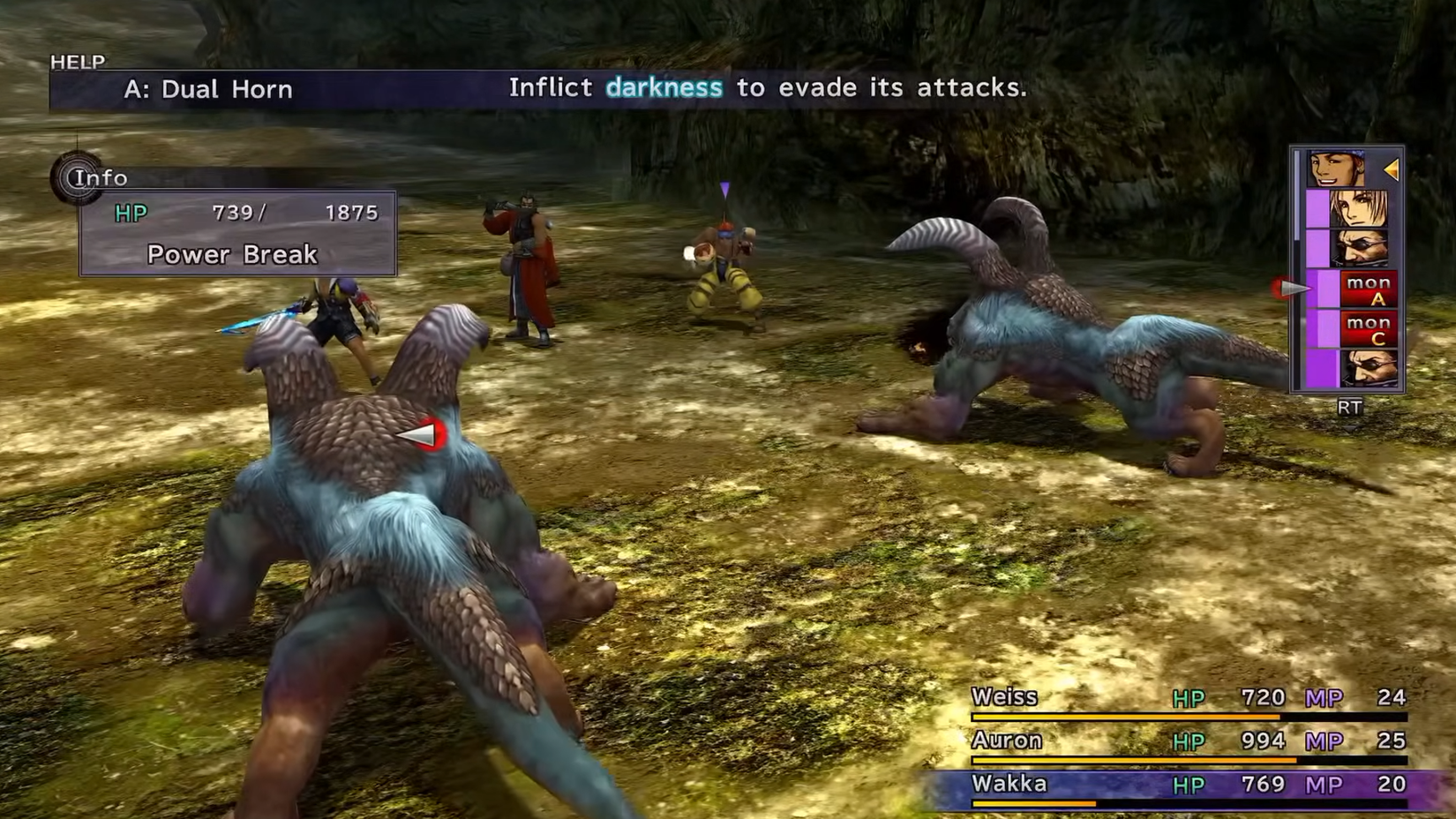
Final Fantasy X was one of the first JRPGs I ever really got invested in as a kid, and it’s not hard to see why. While some aspects of it haven’t aged the best, for its time, it was an incredibly cinematic game with a multitude of interesting systems to wrap your head around.
For one thing, it marked the return to traditional turn-based combat rather than the then-standard ATB system, which ironically made the combat flow a little better since you weren’t rushing to make decisions. Besides that, though, it felt like a game where every party member was there for a reason. Lulu does magic, Wakka hits airborne targets, Rikku steals stuff, and so on. Getting invested in the combat is like fixing something with a tool kit, understanding every character’s role and knowing exactly when to tag them in. The game’s also packed with side content to keep you invested between story and combat beats, and while I still don’t completely get how to play Blitzball, I have had people tell me it gets equally addicting when you understand it.
2 Kingdom Hearts II
The Gold Standard of the Series

Through the series’ entire run to date, no other Kingdom Hearts game has reached quite the same cosmos-surfing highs as Kingdom Hearts II. It was an enormous glow-up over the previous game, both in its story and gameplay, but there’s also a very distinct secret sauce to it that I have not seen another game completely replicate, in or out of its series.
I think the best descriptor for Kingdom Hearts II’s combat would be “high-flying.” It’s fast-paced, acrobatic, and encourages snap decisions and quick inputs. The introduction of the Reaction Command system was downright genius, as it always had you looking for opportunities to mix things up while wailing on enemies with combos and magic. The combat is so consistently fun that, even after you beat the game, you don’t get tired of it, which is good, because there’s a boatload of endgame superbosses and whatnot you can test your mettle against. This goes double for the Final Mix release, which added both more bosses and refined the combat and ability systems even further. It was a genuine bolt of lightning, one of the definitive reasons to own a PS2.
1 Persona 4
One More Day, One More Turn

If there were a single JRPG series to definitively master the ways of insidiously addictive gameplay, it’d be Persona. When the series was revitalized with the original release of Persona 3, it was a major game-changer, but Persona 4 was when things really started taking shape.
In both its life-sim and dungeon-crawling aspects, Persona 4 makes you keep on saying “just one more.” Just one more day hanging out with friends and exploring Inaba. Just one more delve into a dungeon to get closer to the boss. It’s so simple and clean-flowing, you never realize just how much time is slipping away from you. You get a similar vibe from the combat, where the 1 More system that gives you an extra turn for striking weaknesses pushes you into optimizing your teams and Personas to speed things up as much as possible. It also helps that, while not to the same extent Persona 5 would eventually reach, Persona 4 had a very clean UI and UX, so you weren’t fumbling around trying to figure out systems past the initial tutorials. It is a game that wants to be played, and you want to play it.
 Next
Next
10 JRPGs That Shaped Modern Gaming More Than Players Realized
The release of some JRPGs had massive, rippling effects, both in the genre and outside it.



![ELDEN RING NIGHTREIGN: Deluxe Edition [FitGirl Repack]](https://i5.imageban.ru/out/2025/05/30/c2e3dcd3fc13fa43f3e4306eeea33a6f.jpg)
 English (US) ·