.png)
.png) 1 week ago
10
1 week ago
10


Published Jul 20, 2026, 2:30 PM EDT
Kevin Christopher Sullivan is a writer for DualShockers based in Cincinnati, Ohio, with gaming industry coverage experience dating back to 1999. He has previously written for Uproxx, Sportskeeda, TheSportster, How-To Geek, and Cultured Vultures, and is also a former Managing Editor for Austin.com.
Kevin currently focuses on list coverage, gaming history, trends, and humor-driven gaming features. Over the years, he has covered E3, Austin Comic-Con, and Retro Game Fest, bringing decades of gaming experience and a wide-ranging writing background to his work.
Sign in to your DualShockers account
Let's be fair here. In the days of the Nintendo Famicom/Entertainment System, JRPGs on a home system was an ambitious concept on its own. Think of how it was, decades later, when critics insisted that First-Person Shooters couldn't work on consoles. Still, it didn't take long for either of those concepts to be proven wrong. It took even less time for developers to start pushing what could be done in the genre. Even the game that really kicked off console JRPGs in the West, Final Fantasy, tinkered around with the format before coming here.
JRPGs may not have become the phenomenon in North America that Nintendo had hoped (at least, not under their watch, anyway), but that didn't stop developers from trying new stuff. Today, we're going to look at ten different JRPGs released for the NES that all tried something ambitious — to wildly varying results.
10 The Legacy of the Wizard
The First JRPG Family Sitcom - Fridays This Fall on NBC.

|
Nihon Falcom |
|
Broderbund Software |
|
May 1989 |
In Japan, Legacy of the Wizard was actually known as the 4th entry in the Dragon Slayer series. Even in its native country, however, these games produced by Yoshio Kiya usually bucked the typical JRPG trends. These titles tended to focus more on action, which makes the fact that more of these games weren't ported to the west all the more interesting. This particular one was, though, and it was certainly different from anything else in the western market at the time.
The "Legacy" in Legacy of the Wizard involved three different generations of a clan headed by, you guessed it, a wizard. Two wizards, at that. This is the Dralse (which is, appropriately, — according to my research, anyway — short for "Dragon Slayer"), all of whom live above a dungeon. Because of course they do. Four of the family members, along with the family pet, take turns venturing into the depths to discover four crowns. Each family member has their own strengths and weaknesses, and all five of them are ridiculous. Just be careful who you pick for which run, or you might just find yourself stuck because your character can't jump high enough or something.
It's because of this ridiculousness that the game still kind of holds up today. At the time, though, it was a pretty ambitious concept.
9 The Magic of Scheherazade
No, There's No Bonus For Pronouncing That Correctly

|
Culture Brain |
|
Culture Brain |
|
January 1990 |
Any time a JRPG that wasn't set in some medieval fantasy was released, regardless of the country, people took notice. When it comes to The Magic of Scheherazade (which I will be referring to as Magic from here on out for reasons you can probably imagine), its Arabian setting wasn't the only thing unique about it compared to other JRPGs at the time. Far from it, as a matter of fact.
Magic told the tale of the love interest of the princess *sigh* Scheherazade, who finds herself captured as part of an evil plot to rule the world. This young man was unsuccessful at his first attempt, and the evil wizard responsible for all this chaos punished him by erasing his memory and sending him back in time. What follows is a mish-mash of action and turn-based RPG elements, time travel, and even weather effects. Honestly, there's a lot going on here.
The game itself buckles a bit under all its ambition, but it still manages to pull off what it set out to do. Totally worth playing today if you can find it.
8 Faria: A World of Mystery and Danger!
It Has an Exclamation Point in the Title, so You Know It's Exciting

Faria: A World of Mystery and Danger!
Faria: A World of Mystery and Danger! plays quite a bit with the first impressions it provides. It certainly seems like your typical JRPG adventure, with a top-down map not unlike the one you find in Dragon Warrior. In fact, you'll come across random battles much the same way as you explore this land. It's when these encounters happen, however, that Faria throws its first curveball — it's a baseball game!
OK, no, I'm kidding. It's still a fantasy RPG, but the battles are actually live action bouts set in an arena. That means you can move about all you want, swinging your sword, shooting arrows, or whatever else you have up your armored sleeve. It's a concept not exactly common at the time, even though it was released in the west in 1991, around the time the SNES was.
That armor also covers up another secret. Throughout the game, you (and everybody else in Faria) assume this warrior is a dude. There must be time travel involved in this game, too, because in a plot twist from all the way from 1987, it turns out our hero is a lady. At least you don't need to wait until the end of the game to discover it, as it has a bearing (somewhat) on the game's story.
7 Ghost Lion
Quite Possibly the Weirdest Licensed Game Ever

|
Kemco |
|
Kemco |
|
October 1992 |
We need to begin this section by pointing out the absolutely bat-guano insane story behind this game. In 1989, director Koichi Nakajima released Piramiddo no Kanata Ni: White Lion Densetsu (regardless of the title, it had nothing to do with the band that performed the theme to the animated Transformers movie). While it's a Japanese production, it was entirely in English and only had American and African cast members. Two years — two years later, Kemco published a NES JRPG based on the movie.
And you know what? It's pretty good. I don't know how it compares to the movie, as I can't bring myself to watch it without Rifftrax being involved. Like the movie, Ghost Lion (aka Legend of the Ghost Lion) involves a young girl venturing out into the African wilderness to find her parents after a mysterious ghostly white lion attacks her village. Despite what the game's cover would have you believe, Maria doesn't actually attack enemies herself. Instead, she summons spirits to protect her. These spirits have their own stats and skills, but can only be summoned if Maria has enough Spirit Points. It's a whole thing.
Don't let that jumble of weirdness scare you off. Ghost Lion is a strange but ultimately entertaining JRPG.
6 Zelda II: The Adventure of Link
This Is a JRPG. Change My Mind
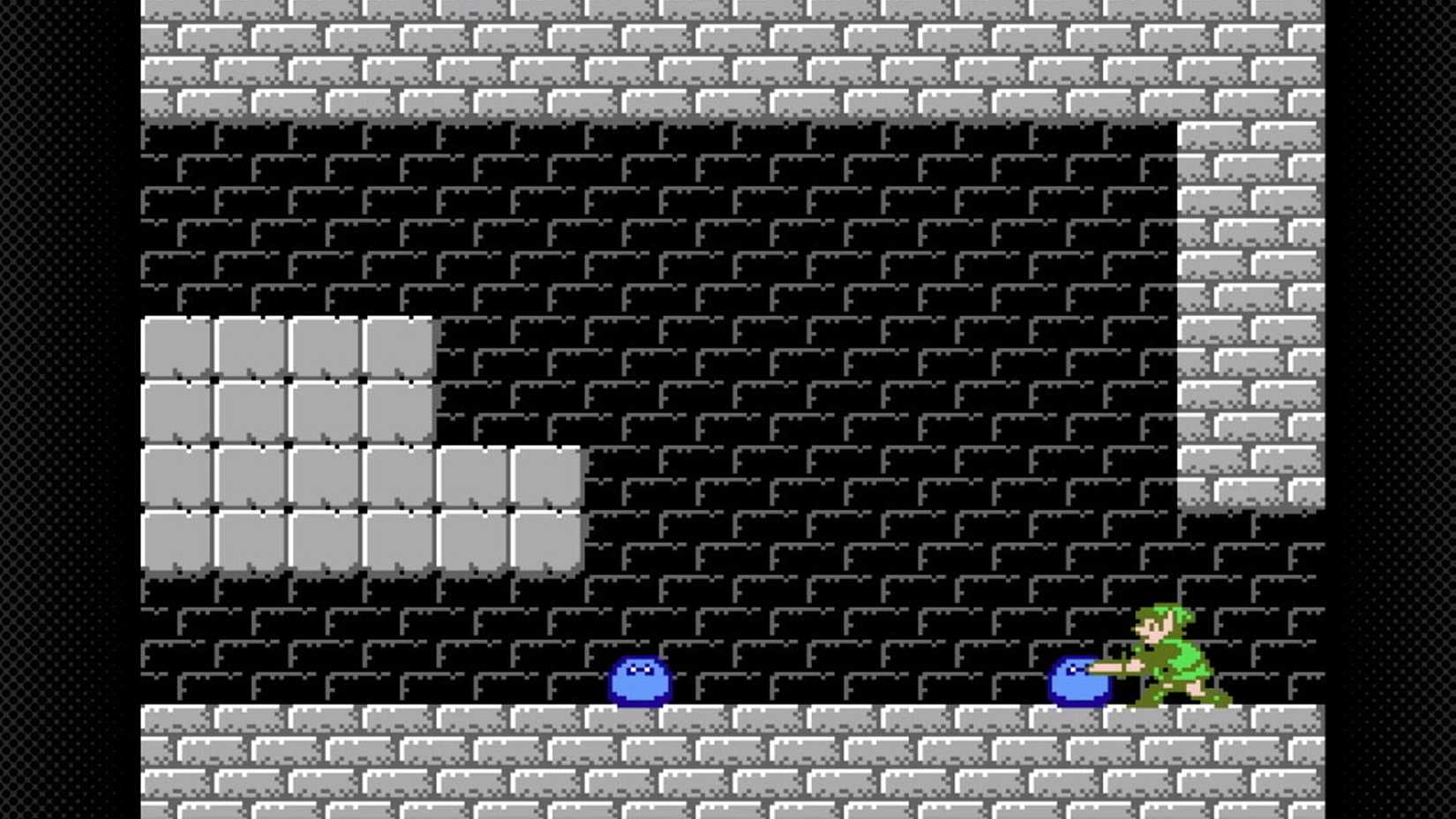
Zelda II: The Adventure of Link
I know there's been an argument for decades regarding whether the Legend of Zelda games can be classified as RPGs. Of course, there's also been the similar but no less stupid argument over Zelda II being an actual Zelda game. Well, the answer to both is "Who cares?" and "Yes." And if any Zelda game is going to be classified as an RPG, it's going to be this one. Because, come on, look at it.
For the majority of the Zelda games, Link's progression came from either obtaining new items or upgrading existing ones. While Zelda II certainly had its share of items to collect, Link got stronger by leveling up. That's RPG stuff right there. Of course, certain design choices, like losing all of your XP and getting sent to the very start of the game upon a Game Over certainly irritated both RPG and Zelda fans.
That being said, they were certainly trying to make these RPG aspects more palatable, since making games that anybody can play is sort of their thing. And they almost pulled it off, too.
5 Crystalis
Sci-Fi Zelda

One of my favorite things in fiction, no matter the medium, are post-apocalyptic stories set in years that we, as the audience, have already lived through. Like, for example, the setting of our next game, Crystalis (released in 1990), where a terrible nuclear war (as opposed to a wonderful nuclear war, I guess) ravaged the Earth in the far future year of... 1997. I know I was busy graduating from high school that year, but you think I would have noticed something like that.
Well, what SNK lacked in foresight, they more than made up for in ambition, as Crystalis is incredible. The story — about a robotic warrior thawed out after centuries and tasked with saving what's left of civilization — is partially told with cutscenes that flow smoothly between gameplay. That gameplay consists of real-time action, including a charging gauge for your weapon. Think the same mechanic used in games like Secret of Mana, except instead of waiting for a meter to auto-refill after a swing, you manually hold down the button to charge up. That and also years earlier. Huh. Maybe SNK had a bit more foresight than we gave them credit for.
4 Dragon Warrior III
I Totally Missed Out On This At The Time

Despite the fact that I was one of the twelve (give or take) people in the United States that owned a copy of Dragon Warrior — I actually received mine via renewing my Nintendo Power subscription — I never played another game in the series after that. Well, at least not until Dragon Quest VIII on the PS2 in 2005. In fact, I had simply assumed the sequels were never released outside of Japan. Well, as usual, I was wrong. And, boy, did I miss out.
Dragon Warrior II through IV all saw release in North America between the years 1990 and 1992. To be fair, any of the three of them could make this list, but I'm sticking with the third one. It was the first game in the series that allowed players to build their party from the ground up. You could name them, pick their genders, and decide what class they were. In, more specifically, what job they had. Yep, Dragon Warrior III had a job system. Take that and also throw in a day/night cycle — and one much better implemented than in Simon's Quest — and you not only have a great, ambitious JRPG but a pretty valuable cartridge if you managed to hang on to it.
3 Destiny of an Emperor
No, This Isn't One of Those Koei Games. We Checked

Here's some ambition for you. By 1989, Koei was already pretty well known for their dense, statistics-heavy historical tactical RPGs (talk about cornering a market), like Romance of the Three Kingdoms and Nobunaga's Ambition. Capcom (of all people) looked at those and said, "We can make those way easier! And more fun, too!" (presumably, anyway). And, boy howdy, did they.
Every army needs its generals, and Destiny of an Emperor had 150 of them to choose from. Defeating a general in combat opened up an opportunity to bring them over to your side. Kind of like Pokémon but with military strategists — and years earlier. Your armies' Hit Points were represented by how many soldiers it had. Easy-peasy. However, so many gamers saw a title like Destiny of an Emperor and immediately assumed it was one of Koei's extreme spreadsheet titles and noped out. It's still worth a play today, if you can find it.
2 Faxanadu
Climb the World Tree

|
Hudson Soft |
|
Nintendo |
|
August 1989 |
As we mentioned at the top of this list, Legacy of the Wizard was originally released in Japan as part of the Dragon Slayer series. In fact, it was the fourth entry: Dragon Slayer IV: The Drasle Family. Two entries before that? Dragon Slayer II: Xanadu. Faxanadu is a spin-off of that game. Its title a combination of "Famicom" and "Xanadu" — a portmanteau, if you will. While Legacy of the Wizard was a port, Faxanadu was an attempt to bring the series directly to consoles.
It was around the time of Faxanadu's release that Nintendo of America was really trying to make JRPGs in the United States a thing. They put a lot of marketing muscle behind games like Final Fantasy and Dragon Warrior. They were so certain that Falcom and Hudson Soft had a hit on their hands that Nintendo actually published the game for them. That's right, Faxanadu is technically a first-party Nintendo game.
What players got was a huge, sprawling adventure inside the massive World Tree. A tree so huge that climbing up it even revealed villages, adding to the scale. Another innovative feature involved the character sprite. Rather than a static design, the hero's look would change according to his equipment. That's right, every suit of armor, shield, and weapon was represented on screen as part of your character. Doing that in an 8-bit game was mind-blowingly ambitious.
1 Final Fantasy
A Misnomer if There Ever Was One

It's easy to forget — considering how ubiquitous the series is now — just how different the original Final Fantasy game was to other JRPGs at the time. You didn't play as a stoic singular hero, but rather as a group of adventurers you customized yourself. During battles, you see both your enemies and your party members, rather than the first-person viewpoint provided by games like Dragon Quest/Warrior. Your quest involves more than just rescuing a princess from a villain. I mean, that is in this game — it's how it starts, for Pete's sake. But that's just a tiny fraction.
We all know the story at this point, about how series creator Hironobu Sakaguchi was going to leave the business if this game wasn't successful. Well, if that's true, he certainly didn't play it safe with this one. Everything about this game, from the gameplay mechanics to the character design to the story itself — it all screamed "ambition." And it paid off.
We don't usually rank these lists in any particular order unless it warrants it, and that's still the case for this one. Still, when listing ten of the most ambitious JRPGs for the Nintendo Entertainment System, it seems appropriate to wrap it up with the granddaddy of them all, Final Fantasy.



![ELDEN RING NIGHTREIGN: Deluxe Edition [FitGirl Repack]](https://i5.imageban.ru/out/2025/05/30/c2e3dcd3fc13fa43f3e4306eeea33a6f.jpg)
 English (US) ·