.png)
 3 months ago
26
3 months ago
26

Published Apr 9, 2026, 8:00 AM EDT
They aren't just overpowered — they break the game
 Image: Wizards of the Coast
Sign in to your Polygon.com account
But, while overpowered, was Vivi truly “broken” as many suggested in the lead up to its banning?
Seldom in Magic do cards genuinely break the rules of the game. And I’m not talking about official rules printed on the cards but the real fundamental aspects of how this game works: mana is a limited resource, drawing cards takes time, and you don’t ever really have access to your full deck. These represent the gist of how Magic works.
Yet there are cards out there who totally demolish those preconceived notions about Magic. Here are the 10 most broken Magic cards of all time.
10 Lurrus of the Dream-Den
 Image: Wizards of the Coast
Every game of Magic starts the same way: players draw seven cards. The Companion mechanic alone broke that, allowing players to access a card from their sideboard as long as their deck met the right conditions. In the case of Lurrus of the Dream Den (easily the best of the 10 Companions), every permanent card in your deck has to have a converted mana cost of two or less. Originally, once that condition was met, your Companion just slid right into your hand.
Except Lurrus was so effective that Wizards of the Coast had to rewrite the rules of Companion, making it so that you have to pay three colorless mana to put your Companion into your hand. Even after a rewrite, players packing Lurrus technically have access to the Companion from the very start of the game.
What makes Lurrus so good? A three-cost 3/2 with lifelink is already a solid creature, but with his bottom ability, Lupus lets you cast one permanent from your graveyard with converted mana cost of two or less — which is every permanent in your deck. That essentially means you can keep playing your cheap creatures even after they’re killed or destroyed without any real limitations. The same goes for any of your artifacts or lands, including fetchlands.
The loopholes led to Wizards banning Lurrus across multiple formats, including for a time in Vintage, the format where players normally go wild with access to the game’s strongest cards ever.
9 Hogaak, Arisen Necropolis
 Image: Wizards of the Coast
Hogaak, Arisen Necropolis is one of the strangest cards to ever exist: An 8/8 with trample that costs seven mana, but you can’t spend mana to cast it? You spend mana to cast every kind of spell in the game, which is why Magic focuses so much on resource management. Yet Hogaak simply opts out of that fundamental rule. Hence, very broken.
Instead, you have to sort of cheat him onto the board using both convoke and delve. With the former, each creature you tap generates one mana you can use to cast him. With the latter, each card you exile from your graveyard generates one mana you can use here. You can even cast Hogaak from the graveyard with no other limitations.
In practice, Hogaak becomes a free creature with the right convoluted deck strategies that leverage lots of cheap creatures and milling strategies that fill up your graveyard. You just keep punching through with Hogaak, and even if he dies, you just cast him again the same way. One particularly powerful strategy involved Altar of Dementia. With it, you can sacrifice Hogaak to mill eight cards to fill up your graveyard, then play him again, eventually doing the same maneuver to mill your opponent(s) to death. Hi, purist here: This is not how Magic is supposed to work!
8 Mental Misstep
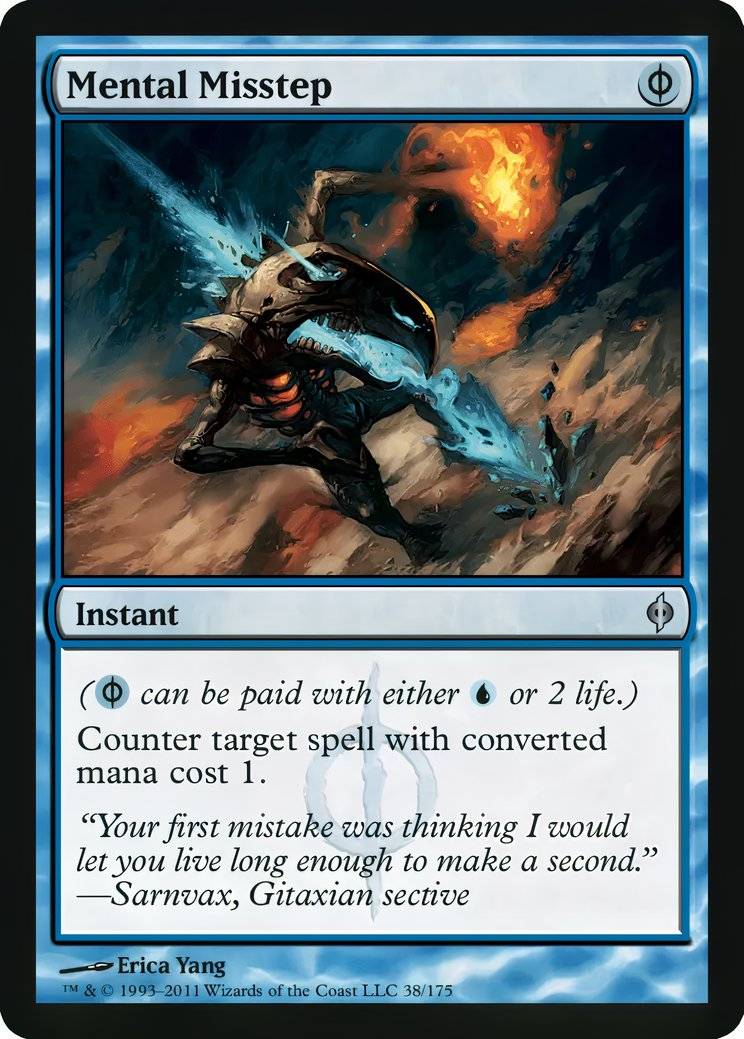 Image: Wizards of the Coast
Counterspells are pretty much exclusively a blue thing in Magic, and they always cost mana to play. The whole point is to spend your resources to stop your opponent from doing something. But Mental Misstep is banned in Standard, Vintage, and Legacy precisely because it subverts that concept entirely by letting you pay two life to counter any one-cost spell.
For a brief, miserable stretch in 2011, entire formats warped around this single card. Printed in New Phyrexia, Mental Misstep immediately took over Legacy, where it showed up in a huge percentage of decks regardless of archetype. It countered the format’s most important early-game spells — Ponder, Brainstorm, Swords to Plowshares — for zero mana, turning early turns into fights over Misstep itself. Within months, players were running it just to stop opposing Missteps, and it was banned in Legacy that September.
7 Skullclamp
 Image: Wizards of the Coast
Back in 2004, equipment cards were still a very new thing and, at face value, Skullclamp didn’t look all that flashy. It gives the equipped creature +1/-1 and has its owner draw two cards when the creature dies, and it has an equip cost of one mana. But as long as you have cheap creatures on the board, this ultimately translates to “pay one mana to draw two cards.” As soon as players realized how powerful this was, it quickly came to dominate the vast majority of deck strategies.
Shortly after Skullclamp’s inevitable June 2004 ban, Wizards of the Coast’s Aaron Forsythe referred to it as a sort of “black hole—invisible, yet its tug so strong as to drag everything around it into a swirling vortex.” He noted that the top eight decks at both of the then-recent Ohio Valley Regionals and German Nationals contained 58 out of a total possible 64 Skullclamps. “Never in my memory have I ever seen a card show up in those numbers.
It’s one thing to break the game’s fundamental rules, converting mana directly into card draw, but it’s another when a card is so broken that it essentially forces every competitive player to use it…or lose. That just speaks to an unhealthy meta.
6 Oko, Thief of Crowns
 Image: Wizards of the Coast
Oko, Thief of Crowns is a powerful Planeswalker that is way too cheap. If he cost five mana, he would still be one of the strongest Planeswalkers ever. And yet he costs three mana and very quickly takes control of the entire board.
Oko starts out with four loyalty counters — already high compared to other Planeswalkers, but he comes with two abilities that add loyalty counters rather than remove them. He either gains two to create a food token or one to transform any artifact or creature into a 3/3 elk. With this ability, Oko has all the energy of Oprah giving away cars: “You get an elk! YOU get an elk! YOU GET AN ELK!”
Then his bottom ability allows him to steal any artifact or creature with power three or less and replace it with one of your artifacts or creatures. In practice, you can force-feed your opponent one of your food tokens and steal one of their creatures, probably an elk that used to be the best creature in their deck — before Oko got to it.
When Throne of Eldraine released in 2019, Oko quickly took over Standard, then Modern, then pretty much every format it was legal in. Deck diversity collapsed as players either adopted Oko or built decks specifically to beat it. Even traditionally powerful cards like artifacts and large creatures simply stopped mattering if Oko was there to wave his fingers and transform them into elks, dismantling whatever other plans opponents may have had.
Oko was banned across multiple formats pretty quickly and remains banned in almost every format.
5 Necropotence
 Image: Wizards of the Coast
The summer of 1996 is sometimes referred to as the Sweatless Summer. Plenty of areas throughout the United States didn’t break 90 degrees even on the hottest July days. But Magic players? They were sweating buckets during what’s remembered as the “Black Summer” or “Necro Summer,” and it was all because of Necropotence.
Originally released in June 1995 with Ice Age, Necropotence is an enchantment that costs three black mana. You skip your draw step and exile any cards you discard. These effects alone mess with the natural order of things. But then you can pay one life to exile the top card of your library face down then put it into your hand at the beginning of your next end step. So you basically just pay as much life as you want to draw that many cards.
Most cards see you juggling resources to execute combos. But Necropotence turns life into the only thing that matters.
In a game where starting at 20 life is supposed to matter, Necropotence proved that life totals are often just a suggestion. Players quickly realized that having 1 life and a full hand is a lot better than having 20 life and no options.
It didn’t just break the card draw — it rewrote how players thought about the game.
4 Yawgmoth’s Will
 Image: Wizards of the Coast
Graveyard recursion is intrinsic to the identity of black cards in Magic. Your creature is killed, and you get to resurrect it as an undead. But a card that just completely opens up your graveyard — like unlocking the gates of hell — would be totally broken. Yet that’s what we got with Yawgmoth’s Will, originally printed as part of 1998’s Urza’s Saga set.
This three-cost black sorcery has had its language adjusted in the years since, but it allows you to play cards from your graveyard for the rest of the turn. And if a card would be put into your graveyard during this turn, it gets exiled instead. It’s not exactly the kind of card you’d play early in the game for a big splash. Instead, it’s one that can demolish opponents in the late game with a single explosive turn — especially if you work in mana burst cards like Dark Ritual and Black Lotus.
Yawgmoth’s Will does require that you build around it to an extent, but some of the combos are absurdly powerful, especially with the Storm mechanic that copies a spell based on the number of spells played before it that turn. Naturally, it’s banned in every competitive format.
3 Tinker
 Image: Wizards of the Coast
Every card that puts a big creature onto the battlefield for a much cheaper cost feels a little bit like cheating. A lot of players even talk about the mechanic as a way to “cheat a creature onto the board.” None is more offensive in the history of Magic than Tinker.
For two colorless and one blue mana, Tinker has you sacrifice an artifact to search your deck for any artifact, then put that card into play. With the right initial hand, you can play a single island on turn one followed immediately by a Mana Crypt and then Tinker to pull this off right away. Blightsteel Colossus is one of the best options here as a 12-cost 11/11 with trample, infect, and indestructible. But there are a lot of expensive artifacts out there that are really strong. Krang, Utrom Warlord from the Teenage Mutant Ninja Turtles set comes to mind here.
Tinker compresses the entire arc of a game into a single play with virtually no ways to effectively counter it, which explains why it’s banned in every signal format except for Vintage, where it’s restricted to a single copy per deck.
2 Ancestral Recall
 Image: Wizards of the Coast
One mana. Draw three cards. That’s it. That’s the whole card. There are perhaps hundreds of cards in the history of Magic that help you to draw more cards out of your deck, but they’re almost always either expensive or require some kind of sacrifice like discarding one or more cards. Yet Ancestral Recall simply pumps your hand full of cards for absurdly cheap.
Other versions of this same effect — like Treasure Cruise or Dig Through Time — have extra hoops to jump through. Both of those spells come with Delve, allowing you to exile cards from your graveyard to reduce the increased cost.
Ancestral Recall is part of two major groupings from Magic history: the Power Nine and the Boon Cycle. The latter is a cycle of five cards from the game’s Alpha, each focused on one of the game’s colors and the number three as related to a typical effect associated with the color. Red’s Lightning Bolt simply does three damage to a target, for instance. Ancestral Recall is the only Boon that’s also part of the Power Nine, a set of nine cards from the early days of Magic considered so powerful they’re pretty much universally banned.
1 Black Lotus
 Image: Wizards of the Coast
The most expensive Magic card to ever sell at auction was a mint Black Lotus from the game’s Alpha that fetched a price of $3 million in 2024. At that high a price, I doubt it’s showing up in somebody’s deck, but there’s a good reason why Black Lotus is the holy grail of Magic cards.
Like Ancestral Recall, Black Lotus is part of the Power Nine. It’s a zero-cost artifact with one ability: tap and sacrifice Black Lotus to generate three mana of any one color. Magic’s most sacred rule is that mana is the limiting factor. It represents the magical life force that powers all magic. Black Lotus, a humble little flower, destroys that idea outright.
For zero mana, you get three. Immediately. No setup, no drawback that matters, no delay. As long as it’s in your opening hand, you suddenly have three mana to burn. Pick blue mana, and you can cast Tinker to draw out any artifact in your deck. Pick black and play Dark Ritual, then suddenly you’re sitting on a pool of five mana right out of the gate.
Black Lotus empowers early-game turns that simply aren’t supposed to happen. With it, players can cast spells multiple turns ahead of schedule and chain together combos before the opponent can even play their first land. Everything else on this list bends the rules. Black Lotus breaks the most important rule that the entire game is built on. Luckily, very few people own it. Even if they do, it’s illegal to play, except for Vintage, where you can run a single copy.







![ELDEN RING NIGHTREIGN: Deluxe Edition [FitGirl Repack]](https://i5.imageban.ru/out/2025/05/30/c2e3dcd3fc13fa43f3e4306eeea33a6f.jpg)
 English (US) ·