.png)
.png) 3 months ago
22
3 months ago
22


Published Apr 14, 2026, 2:57 PM EDT
Daniel has been playing games for entirely too many years, with his Steam library currently numbering nearly 750 games and counting. When he's not working or watching anime, he's either playing or thinking about games, constantly on the lookout for fascinating new gameplay styles and stories to experience. Daniel has previously written lists for TheGamer, as well as guides for GamerJournalist, and he currently covers tech topics on SlashGear.
Sign in to your DualShockers account
The basic format of Pokémon games was clearly established with the original Red and Blue versions: catch ‘em all, beat all the Gym Leaders, beat the Elite Four, become a Pokémon Master. Simple and straightforward. Of course, “simple and straightforward” doesn’t create the most profitable IP on the face of the planet, and that is why Pokémon games have iterated, innovated, and just otherwise thrown massive curveballs over the decades.
Related
Every Mainline Pokemon Generation, Ranked By Story
While the Pokemon games are more known for their characters and mechanics, it doesn't mean there aren't some great stories in there.
While most of the mainline Pokémon games more or less stick to that tried and true formula, numerous Pokémon spin-offs have taken the franchise in previously wholly unexpected directions, focusing on different gameplay frameworks and different aspects of the Pokémon world. Each time one of these games is announced and released, the overall fan reaction can range from a mildly enthused “huh” to a majorly confused “WHAT?”, but no matter what the overall scope of the reaction was, it’s safe to say we hadn’t seen it coming.
We’re specifically focusing on the degree to which these games diverge from established Pokémon formulas; the actual quality of the games in question isn’t as important here.
10 Pokémon Trading Card Game
A Game of a Game of a Game

Pokemon Trading Card Game
Alongside the release of the original games and premiere of the anime, the early days of Pokémon saw the first wave of the Pokémon Trading Card Game. I have fond memories of seeing these cards all over my elementary school cafeteria, though admittedly, none of us actually knew how to play the game. Even so, we were content to have the TCG be its own thing, wholly independent of the games. At least, that’s how it was until I spotted Pokémon Trading Card Game for the Game Boy.
Pokémon Trading Card Game is, well, exactly what it sounds like: a digital version of the TCG playable on the Game Boy Color. TCGs, at least by my recollection, were only just picking up steam in the States back in the 90s, so we were still coming to terms with playing a game with little slabs of cardboard. To see a digital version of this game on the same platform as the actual games was quite a head-trip.
The Game Boy game features cards from the first three waves, and even has a simple story, with you as a fledgling player traveling around and challenging other players. Amusingly, Pokémon don’t exist in this world, just the TCG, which makes everyone’s obsession with it even sillier.
9 Pokémon Conquest
Pokémon Plus Nobunaga’s Ambition Equals… Profit?

Pokémon doesn’t really do crossovers, at least outside of Nintendo-specific stuff like Super Smash Bros. The Pokémon Company prides itself on a squeaky-clean brand image, and that’s difficult to facilitate when you’ve got other IPs intermingling that you can’t control. However, in the mid-2000s, Pokémon did get a crossover… of sorts with Tecmo Koei’s Nobunaga’s Ambition series, resulting in Pokémon Conquest.
Nobunaga’s Ambition, being a strategy game series about the life and times of feudal Japanese warlord Oda Nobunaga, has never had much presence here in the States. Pokémon games aren’t much for the strategy genre either, so it’s about the furthest from what anyone had expected of Pokémon’s rare crossover. I wouldn’t have been surprised if it had stayed a Japan-exclusive, but no, it made it west the same year, and nobody quite knew how to react.
Those who played the game liked it fine, with Pokémon making for a surprisingly good mix with feudal Japanese warfare, but it still remains a major oddity in the scope of the larger franchise. It’s kind of shocking that The Pokémon Company would ever sign off on Pokémon in any kind of warfare setting, though I suppose there have been wars alluded to in the mainline games.
8 Hey You, Pikachu!
Every Kid Wanted a Pikachu of their Own

A big element of Pokémon’s initial global conquest was the infinite marketability of Pikachu as a mascot and character. Pikachu got its own dedicated game version, it was Ash’s first Pokémon in the anime, and advertising for both of those and pretty much all other merchandise was plastered with its image. Every kid wanted a Pikachu of their own, but while there were plenty of plushies and the like, Hey You, Pikachu on the N64 was something next-level.
The very idea of a video game you could control with your voice (in a meaningful capacity, I mean) was completely unheard of in 2000. We couldn’t even conceive of the idea of actually being able to talk to a living Pokémon, with the closest analog being a plushie with an audio sensor in it. It was the real deal, though with a dedicated microphone peripheral for the N64 to make it all work.
Well, I say “the real deal,” but in actuality, the real game was a bit… middling in quality. The technology wasn’t quite there yet, and it certainly wasn’t going to be the N64 of all things that facilitated it. Still, it successfully threw every Pokémon-loving kid out there for a loop, and that’s commendable.
7 Pokémon Sleep
I Have Always Wanted to Sleep on a Snorlax

For the vast majority of Pokémon games, you can generally get a pretty good idea of what the game will entail from the title alone. The spin-offs, especially, will usually have fairly indicative titles. I clarify this in order to make clear that, back when Pokémon Sleep was first announced, we had absolutely no idea what to expect.
There was a very long stretch between when Pokémon Sleep was announced and when it actually got concrete gameplay details, so all we could really do was speculate. The only thing clear from the start was that it was a phone game, and it involved sleeping somehow. Obviously, Pokémon have, like, engaged in the act of sleeping in plenty of games, but how do you build a game around such a thing?
What it ultimately ended up being was a sort of hybrid game and sleep-tracking app, in which you leave your phone on next to your bed, and it tracks the quality of your nightly snoozing. The better your sleep, the more Pokémon come to visit you. It was a very strange concept, but I guess being something we didn’t expect in the slightest is technically the same thing as being different from what we expected.
6 Pokémon Snap
Gotta Frame ‘Em All

By 1999, Poké-Mania was in full swing, with every Game Boy in America loaded up with a Pokémon cartridge. None of us had any particular expectations that Pokémon would migrate away from the handheld and onto the N64, but not only did that end up happening, it happened in a completely different format from what we were used to: Pokémon Snap.
Rather than traveling around JRPG-style and catching every Pokémon, Pokémon Snap had us rolling around on rail-shooter-style courses, trying to snap the best possible Pokémon research photos. It wasn’t battling, it wasn’t an RPG, and perhaps most notably, it was the first time many Pokémon were rendered in 3D rather than pixel art, anime art, or trading card art. It was one of the first real glimpses we got of Pokémon in a natural environment, which helped the world feel even realer than before.

Related
Pokémon Snap also opened our eyes to the wonders of inter-brand cooperation. Nintendo teamed up with Blockbuster Video to provide kiosks where you could bring your cartridge and print out stickers of your Pokémon photos. You better believe my sister and I plastered our school supplies with those things.
5 Pokkén Tournament
We Don’t Take Turns in This House

Battling has always been a core component of the Pokémon concept. The whole reason you were collecting these critters was to smack them against each other, after all. However, most of the time, this combat was depicted as it was originally, in a strictly turn-based format with moves represented as abstract animations. One of the first, flashiest times that Pokémon really got into the spirit of punch-ups was in Pokkén Tournament.
Originally released for the Wii U, then ported and updated on the Switch, Pokkén Tournament was the first and, to date, only Pokémon fighting game. Fans had tinkered with the idea in an unofficial capacity prior to this, of course, using platforms like M.U.G.E.N. to create homebrew fighting games, but this was the genuine article, and with a page taken out of the Tekken series of all things.
Rather than a traditional 2D or 3D fighting game, Pokkén Tournament featured an odd proprietary system where moves would vary based on Pokémon positioning. Part of the gimmick was that one player played on the Wii U gamepad, which allowed both sides to have an over-the-shoulder camera angle a little reminiscent of battling in the regular games. It was quite a left hook of a game, and with a very strange system, but it was definitely interesting if nothing else.
4 Pokémon Mystery Dungeon: Blue/Red Rescue Team
Forget Catching, You Are the Pokémon

Pokemon Mystery Dungeon: Red Rescue Team
Returning to the subject of crossovers, the Mystery Dungeon series, originally established by Chunsoft in 1993, has dabbled heavily in the concept, with its very first game actually being a crossover with Dragon Quest. Considering the number of major franchises this series has crossed over with, it’s not that strange for Pokémon to be in the running. What really caught everyone’s eye, though, was the story of the resulting game, Pokémon Mystery Dungeon.
Rather than a Pokémon Trainer, Pokémon Mystery Dungeon has you assume the role of a Pokémon yourself, specifically a human that has been inexplicably polymorphed into a Pokémon and isekai’d into a Pokémon-run world. This game saw Pokémon at their most talkative to date, speaking in complete sentences rather than babbling their own names or random bursts of static.
In a wholly different way from Hey You, Pikachu, which was more like a Trainer trying to achieve basic communication with a Pokémon, Mystery Dungeon gave us a full glimpse into a Pokémon society and how they view themselves relative to each other. It helps that the game itself was also a lot of fun, but I don’t think it’d be unreasonable to say it’s the story concept that really took everyone by surprise.
3 Pokémon Go
Brought Us Out in Droves

Socializing has always gone hand-in-hand with the Pokémon experience, all the way back to the beginning. Every time I went on vacation, I’d bring my Game Boy Color, my copy of Pokémon Blue, and a link cable, just on the off chance I met a kind soul who wanted to play. Outside of the games, though, the wider Pokémon community was mostly an unofficial one. That changed in a big way in the 2010s with the release of Pokémon Go.
Pokémon Go had a simple, yet incredibly clever design philosophy, having you physically walk around with your smartphone and visiting local landmarks in your town in search of rare Pokémon to catch and Trainers to challenge. Not only did it get a lot of people out of the house, it made the Pokémon community feel more real than ever before, with players old and young meeting up in unprecedented droves.
Not long after the game was released, a friend and I walked around town looking for Pokémon, and we ran into two other friend groups doing the same, all of us young adults laughing and playing together like we were kids again. We didn’t stick with it for that long, but it was still a pretty magical thing when it first started.
2 Pokémon Colosseum
Don’t Act Like You Never Tried to Steal a Pokémon
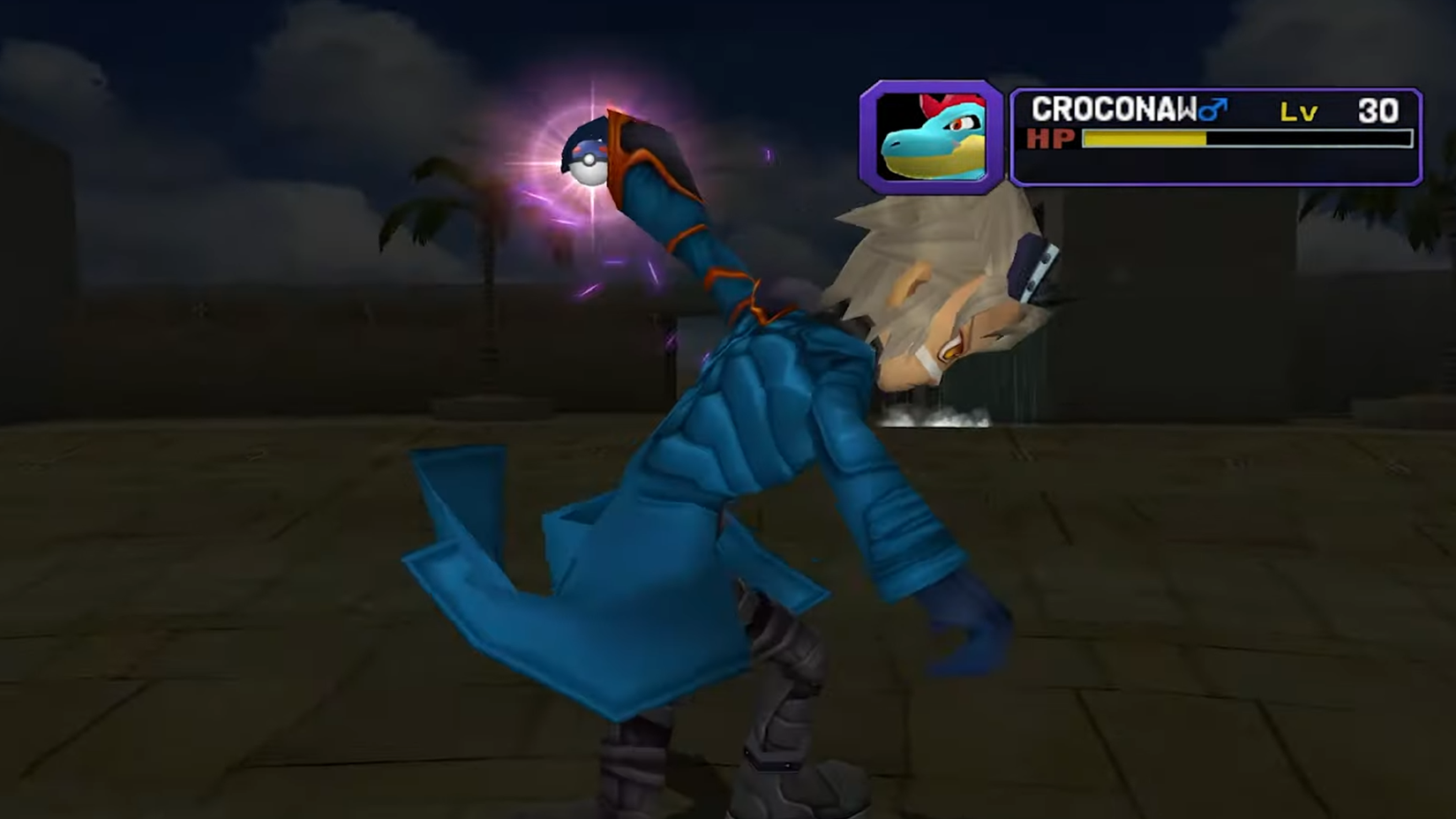
One of the first lessons you learn in any mainline Pokémon game is that Poké Balls are only to be used on wild Pokémon. Attempting to chuck one at another Trainer’s Pokémon would always fail and get you a stern admonishment for being a thief. For the first three generations, this rule was iron-clad, but in 2004, Pokémon Colosseum finally broke that bedrock tenet, albeit in a mildly roundabout way.
The initial advertising for Pokémon Colosseum naturally hyped up the game’s major gameplay element and differentiating factor from the main games: the ability to steal Pokémon from other Trainers. It was unheard of! My friends and I couldn’t believe what we were seeing! That most sacred law of Pokémon, violated! Granted, we were literal children, so we were being a little more dramatic about it than it really warranted, but still.
In actuality, you couldn’t just steal any Pokémon you wanted; attempts to use your Snag Machine wantonly would earn you the usual admonishment. You were specifically supposed to steal away corrupted Shadow Pokémon from unscrupulous Trainers to return them to normal, so you weren’t as much of an anti-hero as the ads gave off. Even so, it was a departure from the norm for the series, and people noticed it.
That Pokémon Wants You Dead

In the world of Pokémon, Pokémon and people live in a symbiotic, mostly-harmonious relationship, helping each other live and becoming lifelong companions. Given this world’s fervor for Pokémon, it’s easy to assume things had just always been that way. That assumption is why Pokémon Legends: Arceus caught us off guard: not only was it set in the distant past, but specifically in a past where humanity and Pokémon were at odds.
In a time when the typical mainline Pokémon game formula was getting a little played out, Pokémon Legends: Arceus went ahead and asked, “what if you didn’t have all of this companionship and infrastructure to rely on in your Pokémon journey?” The feudal region of Hisui is largely unsettled and populated with Pokémon that attack humans on sight, forcing you to run and dodge out of harm’s way.
The initial hook, seeing wild Pokémon so overtly hostile, definitely got everyone interested, with the dodge roll drawing joking comparisons to Dark Souls of all things. It does eventually build up to a semblance of normal Pokémon battling, but actually getting to catch Pokémon outside of battles and drawing their ire was entirely unexplored territory.

Next



![ELDEN RING NIGHTREIGN: Deluxe Edition [FitGirl Repack]](https://i5.imageban.ru/out/2025/05/30/c2e3dcd3fc13fa43f3e4306eeea33a6f.jpg)
 English (US) ·