.png)
.png) 4 months ago
45
4 months ago
45


Published Feb 10, 2026, 2:48 PM EST
Daniel has been playing games for entirely too many years, with his Steam library currently numbering nearly 750 games and counting. When he's not working or watching anime, he's either playing or thinking about games, constantly on the lookout for fascinating new gameplay styles and stories to experience. Daniel has previously written lists for TheGamer, as well as guides for GamerJournalist, and he currently covers tech topics on SlashGear.
Sign in to your DualShockers account
It’s no secret that the PlayStation 2 was the jackpot winner of the sixth console generation. It had a borderline flawless intersection of powerful hardware and both first- and third-party support; all the games you wanted, presented in the best capacity available at the time. While it wouldn’t be fair to undersell the hardware in that equation, though, I don’t think it would be hyperbolic to say that the games were pulling the majority of the weight.
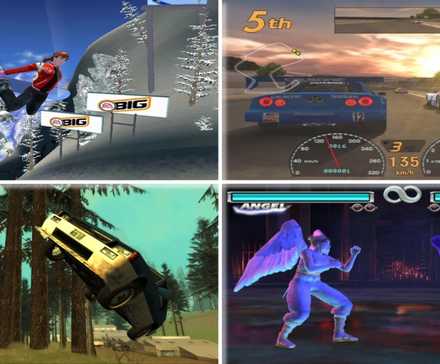
The PS2’s library was a hallmark of the new millennium, new kinds of games for new kinds of audiences, with novel engines and graphical capabilities allowing developers to really start flexing their creative muscles. It was during this landmark era that many particular games were released, each not only being very successful in their own right, but serving as tentpoles for the titles and genres that would follow them. Indeed, without the PS2 library and these games, the face of the gaming industry today would look very, very different.
10 Gran Turismo 3: A-Spec
A Higher Standard in Real Racing

Racing, as a genre of game, has existed since nearly the beginning, albeit to varying degrees of quality. Obviously, something like the Atari 2600 couldn’t replicate the feeling of driving an actual race car, and even up until the fifth generation, things were still a little shaky in that regard. With the sixth generation and PS2, though, real racing games finally started to break the proverbial speed barrier, starting with Gran Turismo 3: A-Spec.
The third installment in Sony’s seminal real-racing series that started on the PS1, Gran Turismo 3 pulled out all the stops to really, truly realize the concept of simulated race car driving. The basic gameplay was more or less the same as its predecessors, but every aspect was fine-tuned to more accurately reflect realistic racing, from the ways every car handled to the contours of each track, including both quick circuits and long endurance races.
In a time when the racing genre was starting to become more synonymous with party kart racers like Mario Kart, Gran Turismo 3 helped real racing stand its ground and properly show the appeal of professional-grade simulated driving. The game absolutely killed it in sales, and the Gran Turismo series is still giving the likes of Mario Kart a run for its money today.
9 Spider-Man 2 (2004)
Swinging into a New Age

It may seem strange to have a licensed movie video game on a list like this. Indeed, the vast majority of licensed games, especially around the early 2000s, were less-than-stellar to put it charitably. However, there were some shining diamonds in the rough, and one of them came to us courtesy of the video game adaptation of Sam Raimi’s second Spider-Man film.
In broad strokes, Spider-Man 2 wasn’t the greatest game ever made. Its mission structure was repetitive, the combat wasn’t particularly interesting, and the bits that weren’t pulled directly from the film felt a bit shoehorned. However, the game did have a very particular secret sauce: its open world, and the means by which you traverse it. Spider-Man 2 had a remarkably faithful and expansive recreation of Manhattan, which you traveled through using the most responsive and intuitive web-swinging any Spider-Man game had ever utilized at the time.
Even if the major beats and side missions of the game were kind of whatever, the sheer exhilarating joy that accompanied swinging about through New York kept players firmly planted in their seats. I would go as far as to say that, had this game not set the standard, we wouldn’t have had the excellent web-swinging we got in Insomniac’s Spider-Man games, not to mention other movement-focused open-world games.
8 Devil May Cry
The Birth of Character-Action

Here’s a classic tale from the annals of gaming history: when Hideki Kamiya and Shinji Mikami were prototyping builds for Resident Evil 4, one of their concepts had a superhuman protagonist battling monstrous entities with nothing but his bare hands, deftly dodging attacks and countering stylishly. Unfortunately, this concept didn’t really jibe with Resident Evil’s horror aspects, but rather than scrapping it, Mikami told Kamiya to turn it into its own thing. Thus, Devil May Cry was born.
The original Devil May Cry was the progenitor of the character-action sub-genre, or “spectacle fighter” as it is sometimes known. Obviously, action-focused hack-and-slash games were nothing particularly new at this point, but Devil May Cry was a little different. Devil May Cry wasn’t just about mindlessly pummeling monsters, it was about doing it with style, building up massive combos without letting your foes lay a single claw on you.
With the creation of the character-action template, similar games would gradually crop up over the following years and generations, many also from Kamiya, some from those who worked with him, and some from those inspired by Devil May Cry. It was a niche genre, and still kind of is, but it’s a powerful, distinctive niche.
7 Shadow of the Colossus
The Intersection of Scope and Impact

Every new generation of console needs its large-scope games to really show off the new hardware. The PS2 certainly wasn’t spoiling for large-scope games, but there was one title amongst the crowd that was a little different, one that carefully considered the application of said scope alongside the weight of its gameplay and narrative impacts. That title was Shadow of the Colossus.
Shadow of the Colossus has been praised for decades as a true work of art in playable form, and it’s easy to see why. Its map is massive, but also largely barren. A large portion of the game consists of quietly riding your horse through these barren landscapes, gradually zeroing in on the Colossi you’re hunting. When you actually found one, that’s when things kicked into high gear, as these massive, monolithic creatures pushed the PS2 to the limits of what it was capable of to render their sheer, terrible majesty.
Shadow of the Colossus captured the hearts and minds of a generation, showing us all that a giant game doesn’t necessarily need to be jam-packed with stuff to do. The map informs the setting and journey, and its remarkable scope has set the stage for similar quietly striking titles like Journey or The Legend of Zelda: Breath of the Wild.
6 Persona 3
Style and Substance

The Megami Tensei franchise has been around since the late 80s, but most of its fanbase was over in Japan. The games did come westward, but they were pretty niche, even the franchise’s many spin-offs that changed up the setting and tone. One of those spin-offs was the original Persona, which came and went on PS1 with little western fanfare, to the point its second game didn’t even come west. Arguably, the game that really started turning heads the world over was Persona 3.
Persona 3 was a major departure from both the previous Persona games and MegaTen at large, primarily by incorporating your character’s social life into the turn-based RPG elements. The game ran on a fixed calendar, with only so much time in a day for either socializing or dungeon-crawling, which encouraged you to carefully manage your time. It was also a very visually-appealing game, with Atlus really starting to beef up its UI efforts.
Persona 3 was a smash hit, and laid the groundwork for the even better Persona 4, as well as one of the most influential JRPGs of the modern age, Persona 5. Developers across the board are still trying to capture the distinctive dual-world vibes that Persona 3 first brought to us.
5 Final Fantasy X
A New Standard of JRPG Presentation

Part of what really put the original PlayStation on the map was the release of Final Fantasy VII, the first 3D game in the series. It was quite the spectacle for its time, and subsequent games on the PS1 each managed to up the ante in presentation. With the PS2, though, Final Fantasy could break all kinds of new visual boundaries, starting with the tenth mainline entry.
Final Fantasy X followed a similar presentational trajectory to its predecessors, interspersing full, pre-rendered cutscenes with in-engine character dialogue. The obvious difference is that better hardware allowed for far more elaborate instances of both; the pre-rendered cutscenes were cinematic in quality, and the in-engine stuff had both dynamic camera angles and fully-voiced characters, as opposed to silent characters milling about on pre-rendered backgrounds.

Related
While there would be plenty of lower-tech Final Fantasy games released around this time and in subsequent years, Final Fantasy X showed that Square wasn’t playing around when it came to the mainline series. This commitment to presentational excellence would continue into the following games and well into the modern day, with each entry continuing to push the envelope.
4 Silent Hill 2
A Hallmark of Japanese Horror

Resident Evil’s success as a horror game was undeniable, but it was a very western-tinged concept of horror, with its greater emphasis on guns and action. The subtler flavor of Japanese horror was quietly cooking overseas during this period, providing a brief sample to the States with the original Silent Hill. It was Silent Hill 2, though, that made us start craving more.
Silent Hill 2’s take on horror was quiet, oppressive, and psychological. You could fight the monsters if you needed to, but you were always overmatched, and always at risk of attack when wandering the foggy streets. To paraphrase a better writer than myself, Silent Hill 2’s experience is akin to being trapped in an enclosed space with an all-powerful, malevolent entity that hates you in a very visceral, personal way, and the natural terror that arises from such a situation.
While Konami’s own treatment of Silent Hill as a franchise in the following years was a bit… checkered, the success of Silent Hill 2 did help pave the way for a multitude of subtler horror games, those that really drove home the helpless feeling of their oppressive locales. Thankfully, Konami itself has also started learning its lesson, returning to its roots with games like the Silent Hill 2 remake and Silent Hill f.
3 God of War
Brutal, Unfettered Action

When the sixth generation rolled around, gamers were entering their teen and adult years. There had been plenty of hack-and-slash action games in the preceding generation, including 3D ones, but without sounding like too much of an edgelord, those games didn’t really have the violence of the genre down to a science. That’s when the original God of War showed up to teach us a lesson.
The original 2005 God of War was an action platformer rather unlike those that had come before it. It was brutal, it was bloody, and it didn’t care what you thought about all that. It was the most severed heads gaming had seen since Mortal Kombat, and the parents did not care for it. Putting aside any cultural outrage, though, it was an action game wholly committed to its motif, with both its gameplay and presentation laser-designed to really highlight all of its highest-impact moments.
God of War’s success inspired an entire generation of similarly-gory action hack-and-slash games, at least until the novelty of ultraviolence started to wear off a bit. Ironically, it was then that the series’ revival in 2018, with a calmer, less violence-prone Kratos, was perfectly poised to recapture an audience that had grown up alongside it.
2 Resident Evil 4
The Harbinger of Action-Horror

The original Resident Evil really popularized the survival horror genre, giving proper form to a concept that somewhat lacked a definite state of being prior. Its subsequent games all followed the same formula, more or less, but when it came time for Resident Evil 4, Capcom decided it was time to get a little more innovative, ditching the fixed camera and speeding up the pace.
As I mentioned before, Devil May Cry was one of the first prototypes of Resident Evil 4, and you can still kind of see the DNA in it. Compared to its predecessors, Resident Evil 4’s over-the-shoulder camera, quick-time events, and large, outdoor maps made the game feel both larger in scope and a lot more in-your-face. Whether or not it was as scary is a matter of opinion, but it was definitely unique, not to mention fun enough that you could play it through several times before getting tired of it.
Resident Evil 4 was an absolute game-changer, bringing about the action-horror boom of the mid-to-late 2000s, leading to other excellent games like Dead Space. Also, before anyone “um, actuallys” me, yes, I know Resident Evil 4 was originally a GameCube-exclusive before being ported to the PS2. That doesn’t change its impact, and really, being good enough to escape an exclusivity deal is quite an achievement in itself.
1 Grand Theft Auto 3
What a Sandbox Could Really Do

Prior to the 2000s, the Grand Theft Auto series looked absolutely nothing like it does today. They were level-based, top-down action games with a greater emphasis on arcade-style driving. The first two games were fun enough, but nothing particularly noteworthy. It was the release of Grand Theft Auto 3 in 2001 that really, truly cemented the series not just as an all-timer, but as the one to beat when it came to open-world sandboxes.
Grand Theft Auto 3 all but completely ditched the framework of its predecessors; no more levels, no more top-down view. Now, it was a fully-realized 3D world that you could run or drive through at your leisure, either following the main missions for the story or getting wrapped up in all manner of side shenanigans. If you wanted to be an absolute degenerate, running your car over pedestrians on the sidewalk with an SMG blasting out the window, you could do that for as long as you darn-well pleased, in-game cops notwithstanding.
Grand Theft Auto 3 opened the proverbial floodgates of open-world games, with subsequent generations seeing other developers not only trying to one-up the series in terms of crime-focused city sandboxes, but all kinds of open-worlds full of side missions and activities. Grand Theft Auto 3 showed us just how big a game’s world could get, and it’s only gotten bigger.

Next
10 PS2 Games That Never Got Remastered, but Desperately Deserve One
There are so many excellent PS2 games that deserve to return with the remaster treatment.



![ELDEN RING NIGHTREIGN: Deluxe Edition [FitGirl Repack]](https://i5.imageban.ru/out/2025/05/30/c2e3dcd3fc13fa43f3e4306eeea33a6f.jpg)
 English (US) ·