.png)
 3 months ago
21
3 months ago
21

Published Apr 16, 2026, 6:30 PM EDT
'It's about tech and storytelling, and finding what also feels authentically Star Wars'
 Image: Polygon
George Lucas hasn't been directly involved in Star Wars for more than a decade, but many of the people who helped build the franchise with him are still working at Lucasfilm. So when Jon Favreau set out to direct his new Star Wars movie, The Mandalorian and Grogu, he assembled a Jedi High Council of sorts to ensure he gets the tone and style right.
That group includes:
- Dave Filoni — the closest thing Lucas had to a padawan, now running Lucasfilm
- Doug Chiang — design director on Episodes I and II, now serving as executive creative director
- John Knoll — visual effects supervisor on the Star Wars prequels, now chief creative officer of Industrial Light & Magic
Speaking to the press at a preview event for The Mandalorian and Grogu attended by Polygon, Favreau explained how the group works together to maintain Lucas's original vision: "We're almost voting on it, like, 'Does this look right?'"
The Mandalorian and Grogu may feel like a fresh start for Star Wars cinema, bringing characters previously only seen on Disney Plus to the big screen to reboot the franchise after a seven-year theatrical hiatus. But the new film also digs deep into the original trilogy’s filmmaking toolbox. Favreau revealed three different ways his movie repeats techniques from the very beginning of Star Wars.
3. Razor Crest miniatures
 Image: Polygon
The Mandalorian's iconic spaceship, the Razor Crest, returns in Favreau's movie after getting smashed to bits back in season 2 of the show (it's a totally different ship, but with the same build and name). As part of the process of bringing the ship to the big screen, Lucasfilm created a miniature model similar to the ones used in previous Star Wars movies.
Polygon had access to a prop room on the Los Angeles set of The Mandalorian and Grogu where several versions of the Razor Crest are kept. That includes a full-sized set piece, a Dykstraflex version (used with a special camera rig created by Lucasfilm to film dynamic space battles) version used in several shots for the show, and a larger, more detailed ship built by longtime Lucasfilm model-maker John Goodson specifically for the new movie.
"For the film, we had more time, and we had the knowhow, and we had John Goodson actually build us a larger Razor Crest that was used in the footage you saw," Favreau says. "So we're using the models like they would have in the old days."
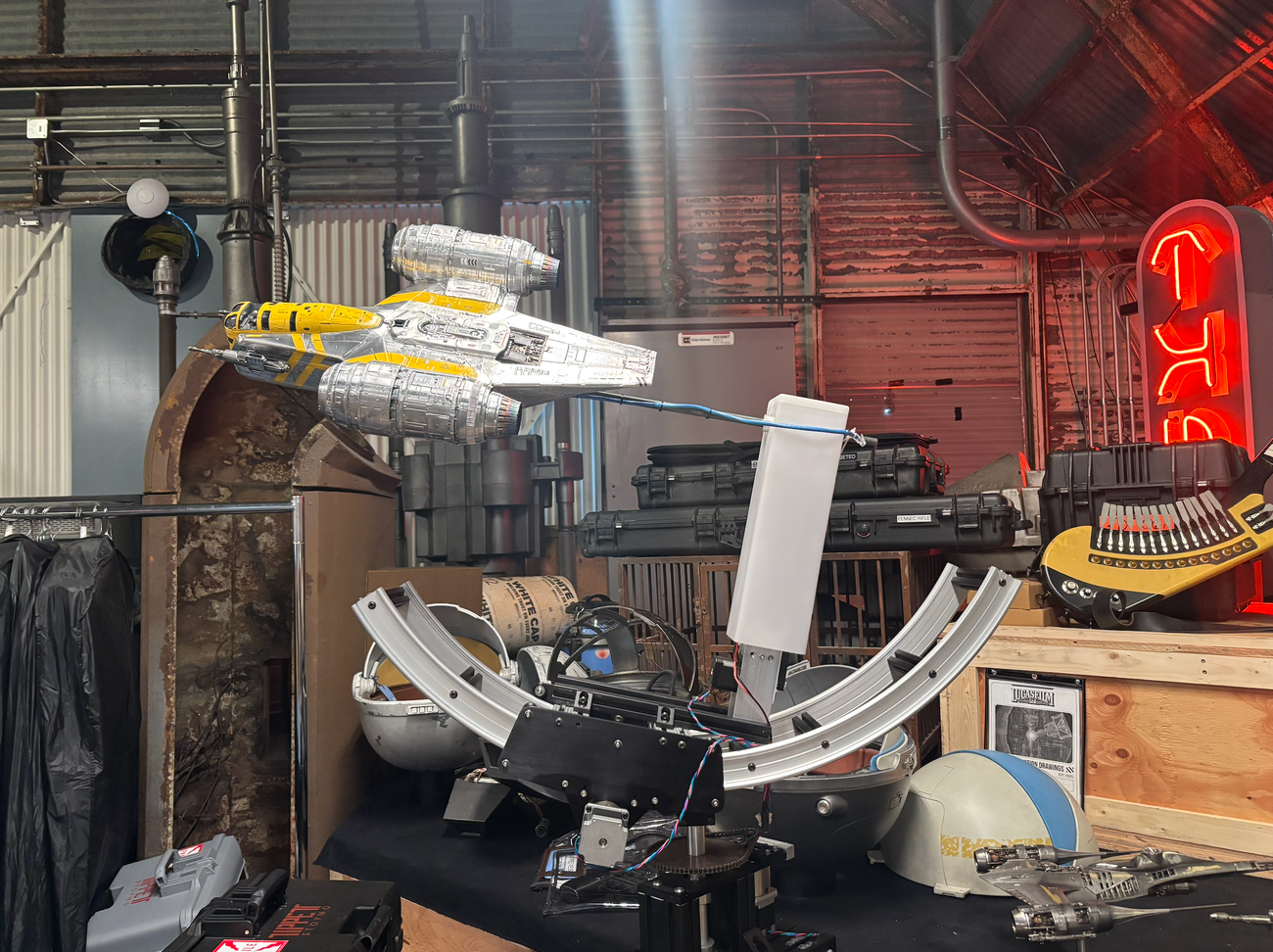 The Dykstraflex version from The Mandalorian seriesImage: Polygon
The director hopes that casual audiences won't even notice these behind-the-scenes details, while other fans will appreciate them.
"If you're like me and a film geek, that's cool," he says.
2. Kitbashing the movie
When Lucas first presented Star Wars to a group of trusted friends, his screening didn't go well. Not only was the plot opaque and nonsensical at the time, but the special effects were nonexistent, and scenes from movies like Battle of Britain were used as placeholders for unfinished space combat sequences.
"George would cut with footage from old war movies because it was before pre-vis," Favreau says. "We still did that technique, too."
He compares it to the kitbashing, a term used by hobbyists who combine pieces from several different model kits and come up with their own unique creations, rather than following the printed directions. Kitbashing has always been at the heart of Star Wars, with Lucas pulling from various other influences to create his science fiction universe. Favreau continues the tradition in The Mandalorian and Grogu, in more ways than one.
"You're also inheriting a certain cinematic tradition when you're kitbashing not just the costumes, the cockpits, the weapons, but you're kitbashing cinema a little bit," he says. "That's part of what Star Wars is: drawing upon cinematic inspiration."
1. Stop-motion robots
 Image: Polygon
Stop-motion was a part of Star Wars from the very beginning, with legendary animator Phil Tippett contributing many pieces to the original trilogy, including both the Imperial Walkers and the tauntaun in Empire Strikes Back.
For The Mandalorian and Grogu, Tippett created two more creatures, a pair of hulking robot guards who protect the Hutts, a classic Star Wars crime family who play a crucial role in Din Djarin's mission.
"When you walked in, there were stop-motion models from Tippett," Favreau says. "Those were really used in this."
 Image: Polygon
For Favreau, using analog animation techniques isn't just about recreating the look of the original Star Wars movies and placating a specific fandom, it's about keeping the spirit of the franchise alive.
"We think of it like it's quaint that we're doing miniatures, but at the time [when Lucas was working on these movies], it was cutting-edge tech," Favreau says. "Pushing the limit on technology and storytelling and human artistry too, and how we match up those things — that's been a conversation in cinema since the beginning. It's about tech and storytelling, and finding what also feels authentically Star Wars."
The Mandalorian and Grogu releases in theaters on May 22.
Disclosure: This article is based on a press event held in Los Angeles. Disney provided Polygon’s travel for the event. You can find additional information about Polygon’s ethics policy here.



![ELDEN RING NIGHTREIGN: Deluxe Edition [FitGirl Repack]](https://i5.imageban.ru/out/2025/05/30/c2e3dcd3fc13fa43f3e4306eeea33a6f.jpg)
 English (US) ·