.png)
.png) 2 weeks ago
11
2 weeks ago
11

Published Jul 9, 2026, 10:30 AM EDT
Adam Braunstein is a Contributor at DualShockers who has been covering games professionally since 2019. He primarily writes lists and features, with a focus on RPGs, JRPGs, action-adventure games, VR, long-running franchises, nostalgia, and the broader state of the gaming industry.
Before joining DualShockers, Adam contributed to gaming outlets including Venture 4th, GameSkinny, The Nerd Stash, Attack of the Fanboy, and Daily Gamer. He has also interviewed developers, written occasional guides and news articles, and reviewed games for previous publications. Adam holds a Master’s Degree in Creative Writing.
The GameCube is one of the more underrated consoles for JRPGs, and while the titles were not numerous in this genre, the ones that did release were tough and fun, and some started iconic franchises or revived dormant ones.
There was a unique aesthetic here though, with that distinctive Nintendo flair that gives games a personality that they don't get elsewhere, but don't let that fool you; these games were tough as hell.
We're going to check out a bunch of GameCube JRPGs that we're incredibly tough to get through.
8 Baten Kaitos
Sometimes, It's Not in the Cards
Baten Kaitos: Eternal Wings And The Lost Ocean
Baten Kaitos may look like your typical JRPG from afar, but this one is much different than your average bear. See, everything in this game, combat-wise, revolves around a card-based deck-building system. It's a system that is so annoyingly complex that while you're wrestling with how to actually set up your deck, your best-laid plans can still be completely useless when you need them most.
The reason is that your deck comes out at random, much like any deck-building game would. But the problem is, sometimes you'll be ready for your turn to attack and all you have is defensive abilities, and you waste them, and then the enemy attacks, and you might not have any good cards to defend yourself with. It's maddening, and it makes this otherwise fantastic game a war of attrition sometimes, and it's really difficult sometimes, if only because of how the combat was built.
7 Skies of Arcadia
Final Fantasy of the Sky

Skies of Arcadia was the game for the GameCube that said, "See? We have Final Fantasy here too," and while that wasn't exactly the case, it's still a great game in its own right. But it's also more challenging than its JRPG contemporaries. For some reason, the bosses in this game just never die. Their health pools are outrageous, and you have to know how to fight them not only on foot but also on ship, which changes things considerably.
Your planning has to be on point, as does your resource management, because if you enter into one of these battles ill-prepared, well, you better have a previous save to go back to because it's unforgiving if you're not ready. That goes for the dungeons too. Want to get cute and try to make it through with only a couple of healing items? You're toast. The fights are relentless, and even the smaller ones will leave you in shambles if you're not careful. I think they went a little too heavy on the unforgivable nature of the battles here, and easing up a bit might've led to more success and maybe the birth of a franchise.
6 Tales of Symphonia
Colorful and Dangerous

Tales of Symphonia may not seem like a really tough game from the outset, but that's before you experience what lies in some of the dungeons in this game and learn the harsh reality of inventory management. I'll give you a hit, if you're in a town, find a shop and buy all the curatives you can. No, don't spend it on a weapon or equipment, that doesn't matter. If you have to choose, it's healing items every single time.
Because when you get stuck in a dungeon here, you're going to have a rough time getting out without getting wrecked in the process. There are no random battles here, but the enemies on the map will hound you relentlessly, so you can't avoid battles most of the time. The bosses are also brutal, requiring careful timing and use of your Artes, because they operate in response to you, and if you leave even a single opening, you could see the game over screen in no time at all. But it's worth the grind because it's one of the all-time great JRPGs.
5 Lost Kingdoms
FromSoftware Enters the Fray

|
FromSoftware |
|
2002 |
|
Gamecube |
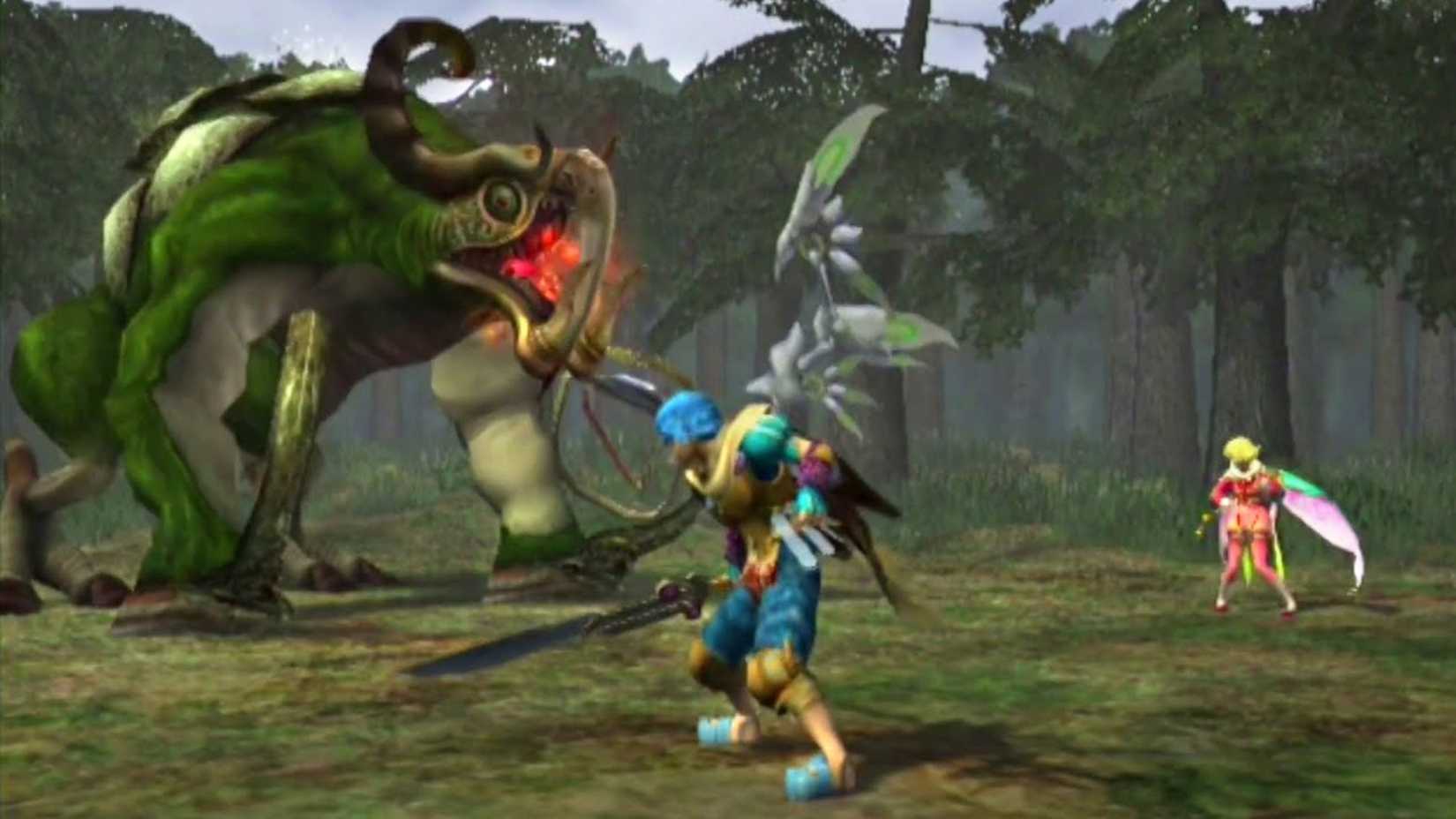
Leave it to FromSoftware to come up with a JRPG that is real-time while also using a card-based, deck-building system to do pretty much everything in the game. The resulting gameplay is the video game equivalent of rubbing your stomach while tapping your head. While it is fun, it's absurdly difficult at times because of how weird the setup of the gameplay is.
For example, your cards are a limited resource, so for each level, you have to make sure you bring enough attack, defense, and healing-type cards to get you through, otherwise you can find yourself screwed mid-level. If that happens, you don't really have much of an option but to adapt. The fact that attack cards can disappear after a number of uses means you really need to be frugal with when and how you attack. If you forgot to add enough ranged attacks, and you find yourself fighting an enemy that needs to be engaged at a distance, well, that's just what happens to you, I guess. It's an unforgiving game, but one that is really rewarding and a preview for the Souls-level difficulty that would become the company's calling card just a few years later.
4 Paper Mario: The Thousand Year Door
Timing is Everything

Paper Mario: The Thousand-Year Door
Paper Mario: The Thousand Year Door may look like a cute and cozy game from the graphics, but once the combat starts here, you're going to be gripping that controller and forgetting that it's rated E for Everyone, because the enemies in this game didn't get the memo. The reason it's so tough is that every attack requires timing of some sort, which you can get the hang easily enough, but then defending also requires that same type of input.
There is also the mechanic of Superguard, which, for me, I couldn't resist being a big fan of souls-likes and games that have rewarding parrying systems. Here, that parrying system is Superguard and the timing is incredibly precise to the point that it feels like it's not even worth the risk vs reward. But it's the best option to reflect damage back when it's not your turn, so that pull to use it is really addicting, especially against boss enemies. Speaking of those boss enemies, some are easy as can be and others are out of a nightmare. It's hard to know what you're going to get, as there is no rhyme or reason to who is going to give you a hard time or not. It's part of the fun, but it's a challenge a lot of the time.
3 Pokémon Colosseum
Can't Catch Em All

Pokémon Colosseum is far from your average Pokémon game. Where in the typical Pokémon game, you'd get to wander around and catch different Pokémon, that's not the case here. You're often required to just make the best of what you have in terms of Pokémon and sometimes, that can feel like it won't be enough.
You have to have a strong grasp on the systems of the game, such as Shadow Pokémon, which you need to capture mid-battle and can be really hard to utilize properly until they're purified. The fact that you can't catch wild Pokémon here hurts big time, because if you've got a weak link in your arsenal, you have to find a way around it rather than just a replacement. You're also tight on resources here, so you need to make more meaningful decisions here compared to other games in the series.
Then there's Hyper Mode, which your Shadow Pokémon can jump into at any time, causing them to essentially go berserk and cause a ton of damage, but also occasionally hurting themselves in the process, and they just straight up ignore you some of the time as well. It's a lot to manage and more complex than your average JRPG, making some fights very difficult here.
2 Baten Kaitos: Origins
Let the Cards Fly

While the first game in the series is challenging for sure, it at least has the grace to wait for you to take your turn before the battles get going. You don't get that same opportunity in Baten Kaitos: Origins. That's because the combat is real-time here, but still card-based and a deck builder. That means you have to focus on what your enemy is doing while also keeping an eye on what your cards are.
You have to be able to identify quickly what your attack options and defense options are while the enemy is caring very little about your dilemmas and attacking you relentlessly. It's an intense dance that has a few too many moving parts to create something that is incredibly chaotic but ultimately rewarding. It's the boss fights that get really rough here, as some just give you very little time to figure out what your attack strategy is going to be before wailing away on you and if you want to avoid damage, you'll have to do that in real time too. It's super stressful and closer to an action game than a JRPG, but it's a system that feels at home in this hidden gem of a game.
1 Fire Emblem: The Path of Radiance
The Cost of War

Fire Emblem: Path of Radiance
Fire Emblem: The Path of Radiance doesn't even give you an easy mission or two before it starts obliterating you. The enemies in this game are absolutely malicious, taking advantage of every wrong move you make, and before you get a grasp on your squad's strengths and weaknesses, that's going to be happening a lot. There's also Permadeath here, so your mistakes are punished all the more.
It's a series built on its difficulty, and Fire Emblem: The Path of Radiance does not let up in the slightest. Some of the later fights in the game require you to guess your enemy's movements before they make them, and you really need to think like a general to come out on stop because the smallest mistake could result in your entire party getting routed. It's a great game, but one that demands an intense level of focus from you.



![ELDEN RING NIGHTREIGN: Deluxe Edition [FitGirl Repack]](https://i5.imageban.ru/out/2025/05/30/c2e3dcd3fc13fa43f3e4306eeea33a6f.jpg)
 English (US) ·