.png)
.png) 3 months ago
75
3 months ago
75

Published Apr 12, 2026, 11:30 AM EDT
Murillo Zerbinatto is a contributor from Brazil. He's a JRPG enthusiast who has been around the world of games and content creation for more than six years now. He has a particular love for Final Fantasy and has absorbed all the content this long-running series offers, including its obscure spinoffs such as Dimension I & II, Explorers, and My Life as a King. While playing JRPGs is already a time-sinking endeavor, Murillo doubles down by being a platinum hunter as well.
Playing JRPGs is quite the time-consuming endeavor. Even when we talk about short JRPGs, we are thinking about 15 to 20 hours of playthrough. To get to know more games in the catalog, I started a weekly activity of playing two new JRPGs for two hours each, just to expand my knowledge of the genre a bit more.

Related
It was during this undertaking that I came across several iconic NES JRPGs, which, although quite hard to play today given their old-fashioned mechanics, still have a thing or two to show. So, if you're not a maniac like me and don't want to revisit the past, I invite you to explore some NES JRPGs that are, relatively speaking, fun throughout their entire playthrough.
8 Willow
Based on the Movie

Willow is a licensed RPG based on the movie of the same name, developed by Capcom. I don't know how inspired by the film it is, since I haven't seen the movie, but narrative isn't the game's strong suit. Before we start the adventure, we learn about the wicked ways of Queen Bavmorda, and then we are free to explore the world. The action is in real time, and all items are found by talking to NPCs or in dungeons.
Willow is quite intriguing and one of the few RPGs where magic made a difference in battle (though not all of them). The biggest issue with Willow is the lack of a map, which I'm not sure is missing from the game or might be in the manual. Since each area is extremely similar, it was easy to get lost and frustrated. In contrast, it was satisfying to see that I reached the correct location because I followed an NPC's instructions.
7 Ghost Lion
Another Licensed JRPG

|
Kemco |
|
Kemco |
|
October 1992 |
Still on the subject of licensing, we have Ghost Lion, known in Japan as White Lion Densetsu: Pyramid no Kanata ni, which is also the title of the movie. Ghost Lion follows the JRPG standard of the time, where we explore villages, an overworld, and encounter enemies in random turn-based battles.
The biggest difference is that the protagonist, Maria, can summon allies in battle using items she finds. Each invocation has a distinct power, whether as a warrior with a strong physical attack or as a mage. The JRPG does not offer a level system. Instead, it offers a progression in which we find items to increase our Hope, Courage, and Dream, which represent Level, HP, and MP, respectively.
Increasing Hope also unlocks new skills for the respective summons, which can make the whole adventure much easier, although, as usual, there is a difficulty spike as the game progresses. It is a really competent JRPG that even offers side quests that develop NPCs and make them react to events and navigate through different villages.
6 Crystalis
Graphics Ahead of Its Time

|
SNK |
|
SNK |
|
July 1990 |
One of the things that surprises most in Crystalis right off the bat is its graphical prowess. The JRPG seemed much more modern than any other game released around the same time in 1990, which also made the gameplay much more engaging and lasting.
After a narrative summary showing that the world was destroyed in 1997 by a thermonuclear war and returned to a medieval period, we take control of a hero who was cryogenically frozen and now needs to stop the villain Draygon.
All the action takes place in real time from a top-down perspective, allowing the player to attack, cast spells, and use items. You can find or buy numerous pieces of equipment that change the gameplay of Crystalis, even allowing for different sword attacks (which was uncommon for the NES). Killing enemies grants experience, which in turn increases the hero's level and attributes.
5 EarthBound Beginnings
Mother of Mothers

If you played EarthBound, you probably saw that its Japanese name is Mother 2. Being the second, it is to be expected that there is a first Mother, a JRPG for the NES that was only internationally released in 2015 for the Wii U. The game arrived under the name EarthBound Beginnings, which suggests a retroactive nomenclature considering how long it took for its international release.
I played EarthBound Beginnings as soon as I bought my Switch, since it is available on Nintendo Switch Online. It is possible to see all the systems that inspired EarthBound, especially the setting parodying American culture. Gameplay-wise, the JRPG was inspired by Dragon Quest, offering turn-based battles, experience-based progression, and the ability to learn new skills at certain levels.
The script was already satirical and presented an atypical story compared to those normally seen in fantasy JRPGs. The most important milestone was that EarthBound Beginnings had good sales numbers, which guaranteed its sequel, considered one of the best JRPGs on the SNES.
4 Final Fantasy
The Franchise's Origin

|
Square |
|
Square |
|
July 1990 |
There's a case to be made that Final Fantasy III is the most enjoyable of the first three, but since it didn't officially reach the West until the remake, I'll stick with the game that originated the series. And while Final Fantasy II introduced fixed characters, that progression system was way too half-baked for my tastes.
If you played Final Fantasy Pixel Remaster without a guide, you know how some directions in the game are quite obtuse. The original was the same, plus we had no quality-of-life features, and the only way out of a dungeon after facing a boss was to walk back, which was undoubtedly the real challenge. Still, that was what made the first Final Fantasy engaging.
The magic system, the evolution of the classes, the four Orbs (not crystals yet), and the battle system that displays characters on the side all came together to create what would become one of the biggest JRPG franchises in the world. This franchise continues to thrive today, making history and consistently seeking to win over new audiences.
3 Sweet Home
Inspiration for Resident Evil

Sweet Home, amusingly known as Resident Evil -1, was a Capcom JRPG that served as inspiration for the developer's renowned survival horror, and this is evident from the start. Upon starting the game, our five protagonists are trapped in a mansion full of bizarre figures like ghosts, zombies, and apparitions.
Each protagonist has a tool, such as a lighter, a key, or a camera, and they find more items along the way that help solve puzzles and advance the game. There are also random turn-based battles, but I felt they aren't the focus of the game, as many battles are resolved just with normal attacks or by using the items we find.
The main focus is on puzzle solving and item management in Sweet Home. The game can get a bit frustrating down the road, given the limited inventory and all the party members swapping. However, it's still incredible how ambitious the JRPG was on the NES, bringing many unprecedented innovations to the console at the time.
2 Fire Emblem: Shadow Dragon & the Blade of Light
Birth of Tactical Games

Fire Emblem: Shadow Dragon and the Blade of Light
For the life of me, I will never understand why Nintendo made Fire Emblem: Shadow Dragon & the Blade of Light officially available for the Switch only for a limited time. From December 2020 to March 2021, everyone could buy a localized version with very welcome quality-of-life features, but that's it. If you haven't bought it then, you can't buy it anymore.
Which is a shame, because this was the first Fire Emblem release and already showcased the series' high points: tactical gameplay in a fantasy setting, with a focus on narrative. The Weapon Triangle mechanic, where one weapon was strong against another, didn't exist yet, but there were classes, each with its own skills and weapons, and some even had promotions.
Fire Emblem: Shadow Dragon & the Blade of Light, however, was already merciless and had the permadeath system, meaning that if one of your characters died in battle, they would not return in the next. Of course, letting the protagonist Marth die meant game over, since he would still eventually need to appear in Smash Bros.
1 Dragon Quest III
Erdrick's Legacy
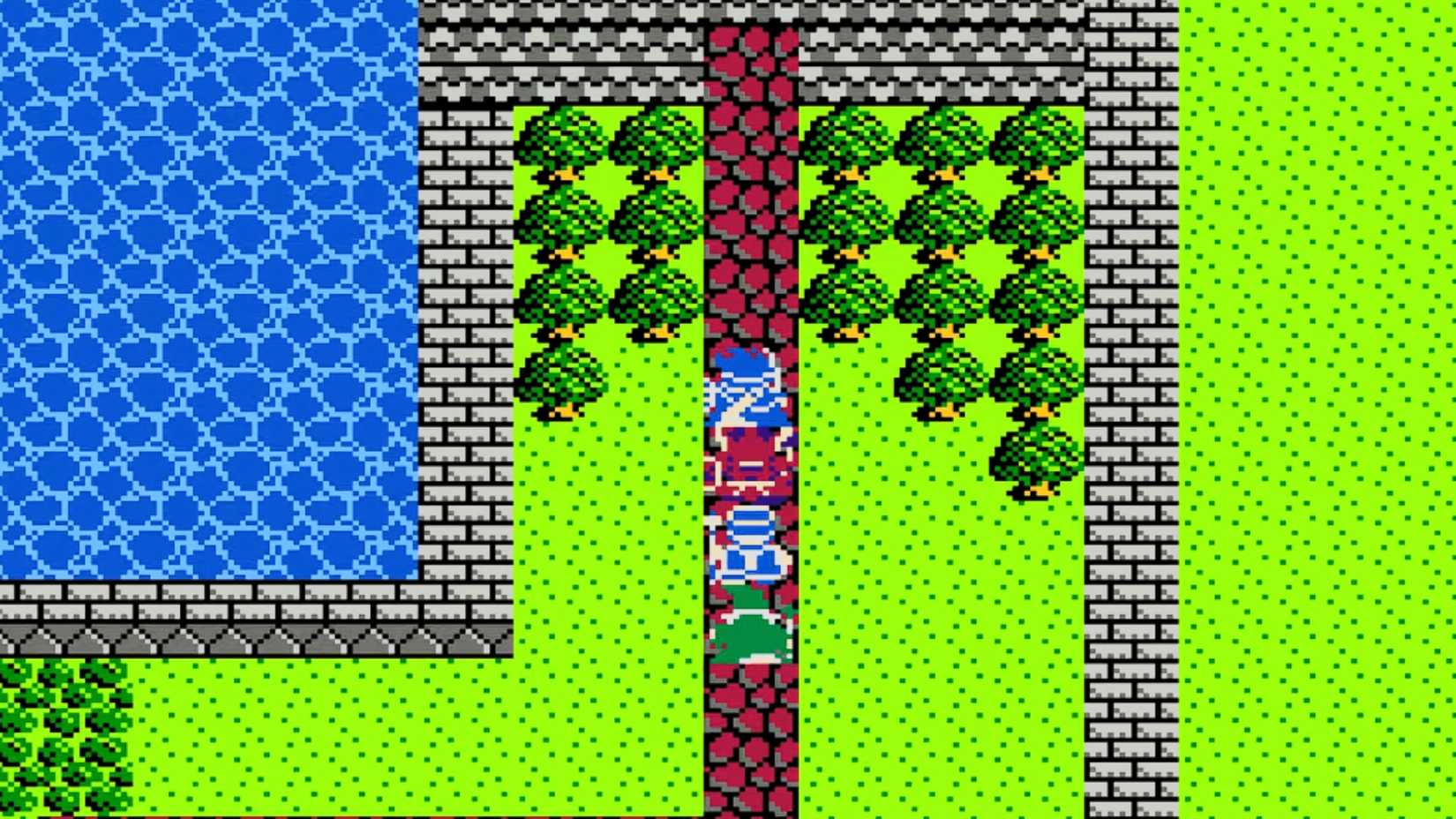
By now, you are already familiar with the story that Dragon Quest created the blueprint for what would be considered the JRPG genre. While we had other RPGs produced in Japan before it, it was Dragon Quest that shaped this more streamlined format of gameplay and progression, as well as a linear narrative focused on the fixed characters we love so much.
While the first Dragon Quest deserves all the respect, I believe it was Dragon Quest III that really showed the full potential of the NES version (though Dragon Quest IV is even more refined). What made me put the third game here was the possibility of recruiting numerous Vocations - still called Class at the time - right off the bat and making the system more dynamic.
Furthermore, for those who played the first two Dragon Quest games, seeing the narrative and the story's evolution was crazy. The launch of Dragon Quest III was a resounding success and created the urban legend that Dragon Quest titles can no longer be released on weekdays in Japan, which isn't true, but it emphasizes how impactful this entry was.

Next
10 Game Boy Advance JRPGs That Are Fun from the Start
A compact fantasy world in the comfort of your pocket.



![ELDEN RING NIGHTREIGN: Deluxe Edition [FitGirl Repack]](https://i5.imageban.ru/out/2025/05/30/c2e3dcd3fc13fa43f3e4306eeea33a6f.jpg)
 English (US) ·