.png)
.png) 5 months ago
119
5 months ago
119
When I was a kid, both my friends and I all owned GameCubes. Some of us also had PS2s, and I think one of them had an Xbox, but when any of us were at someone’s house, the GameCube always came out first and foremost. The PS2 may have had the best broad-scope appeal of the sixth generation, but when it came to party games, including those you could play co-op? The cube was the place to be. It certainly didn’t hurt that the GameCube was cheaper than the Xbox and had four controller ports natively, which helped to make it more accessible.

Related
The GameCube was something of a predecessor to the Wii’s more casual, party-focused design, though it still maintained the N64’s greater emphasis on higher-impact gameplay. The result was a hearty library of games most players could get into during a weekend get-together, including those that you could enjoy alongside your friends rather than just against them.
We’re focusing on games with a built-in co-op element, rather than anything you unofficially declared with friends, like forming alliances in Mario Party.
9 Serious Sam: Next Encounter
Let’s Get Serious

Serious Sam: Next Encounter
While the Xbox was arguably the poster child of console first-person shooters in the sixth generation, the GameCube was no slouch in that department either. There were a handful of quality shooters to be found, made comfortable to play by the controller’s analog triggers. One of my favorites to play with a friend was Serious Sam: Next Encounter.
A spin-off from the mainline Serious Sam games, Next Encounter features integrated two-player co-op for its main campaign in addition to the four-player split-screen multiplayer modes. Whether solo or co-op, Next Encounter had a very simple, cathartic gameplay loop: grab the biggest gun you could find, and keep shooting everything until it all stopped moving. There’s a distinctive feeling to being back-to-back with a friend, gunning down an endless wave of headless, shirtless, screaming dudes.
I have one particularly fond memory of blazing through this game with a friend some forgotten Saturday, the two of us glued to the screen well into the wee hours. We had to turn the volume down around 1:00 AM due to the aforementioned screaming dudes, but it was totally worth the sleep deprivation.
8 Tales of Symphonia
A Tag-Team Fantasy Adventure

Lengthy JRPGs are typically a solitary affair, as lengthy cutscenes, overworld puzzles, and reading dialogue doesn’t always lend itself best to more than one player at a time. However, the Tales series is an exception to this, as many of its entries allow additional players to plug in and chip in during combat. This is part of what made Tales of Symphonia one of the GameCube’s standout JRPGs.
During most of Tales of Symphonia’s gameplay, player one is in exclusive control, moving around the overworld and solving puzzles in dungeons. When combat starts, you have control over one of your four party members, while the rest are CPU controlled. At any time during combat, though, three other players can plug in and assume direct control of the rest of the party. It was surprisingly seamless, so if anyone didn’t want to play anymore, they could drop back out at their leisure.
Having a full player-controlled team made boss fights a lot more exciting, not to mention less frustrating, since you didn’t need to worry about CPUs wasting all of your items. You do need three friends of a very particular disposition to sit through cutscenes and puzzles, but if you’ve got that perfect squad, it’s an unforgettable experience.
Holding Out for Several Heroes

Games that center around large teams of protagonists tend to lend themselves naturally well to co-op frameworks. After all, if you’re only playing X-Men Legends by yourself, you’ll probably just stick exclusively to your favorite heroic mutant, but with a full squad, everyone gets time to shine.
X-Men Legends is an action RPG dungeon-crawler in which you can assemble a team of four X-Men regulars like Cyclops, Wolverine, Storm, and more, and pit them against a series of linear levels battling various super-baddies. In solo play, you just switch between the characters as necessary, but the game’s a lot more fun if you delegate a friend to each character on the team.
Every character on your team gains experience independently, so having four players in action at once ensures you can get four of your favorite X-Men up to snuff in rapid order. In addition to the campaign, there’s a Skirmish mode where you and your team can take on endless waves of enemies to set a high score, just for the fun of it.
6 Mario Power Tennis
Can One Court Fit This Much Tennis?

The original Mario Tennis on the N64 was a more or less straightforward tennis game, just with Mario characters. For the game’s sequel on the GameCube, though, Nintendo and Camelot got a little wackier with it, while still preserving the game’s inherent multiplayer and co-op design. The result was Mario Power Tennis.
Like its predecessor, Mario Power Tennis offers both singles and doubles tennis, both of which can be played by yourself or with CPUs and other players. Doubles is where the co-op element comes in; you and a buddy can command one side of the court, while the other two players can be your two least favorite friends. You can also play through the tournament mode in doubles, knocking out teams of CPU opponents.
While the overall tennis mechanics remain the same, the introduction of offensive and defensive power shots both increase the overall game tempo and make it a little more exciting. It’s a wonderful moment of friendship when your partner is about to miss a return, only for you to fly in with a defensive shot and keep things going.
5 Super Mario Strikers
There’s No “I” in Soccer

I don’t pay much mind to soccer normally, but then again, I don’t pay much mind to most sports. If there were a concrete way to get anyone interested in nearly any sport, it’s to add Mario to it, and Super Mario Strikers is no exception.
Super Mario Strikers is a combat soccer game with the expected rules of soccer; get the ball, kick it into the other team’s goal, and don’t eat dirt, though with the added fun of wacky field hazards and explosive super shots. One player can control a single captain and several sidekick characters by tagging between them, but up to four players can assume direct control of every character on a team. Ergo, you can have a traditional one-on-one match between two players, but you can also have a co-op match with two players per team, three players versus one player, or even all four players together against CPUs.

Related
10 Best Mario Sports Games, Ranked
Mario's taken on a number of sports over the years, but which Mario Sports game reigns as the best among those outings?
Besides the exhibition matches, you can also apply this same co-op format to playing through the Cups. If you’ve got a full four footie fans, the lot of you can take on the tournament together, working your way up to the toughest Super Team CPUs. All the fun of soccer with far less likelihood of a soccer riot.
4 Final Fantasy Crystal Chronicles
Worth Investing in Link Cables For

One of the accessories for the GameCube was the Game Boy Advance Link Cable, which allowed you to plug a Game Boy Advance or Game Boy Advance SP into one of the four controller ports. This was used to transfer data from some GBA games, as well as little incidental things like the Tiny Chao Garden in Sonic Adventure 2. One game, however, straight-up required these cables for multiplayer: Final Fantasy Crystal Chronicles.
Final Fantasy Crystal Chronicles is a dungeon-crawling RPG with a wholly unique setting and story from any other Final Fantasy game before or after. Up to four players can play at once, each with their own inventories and abilities, though for some reason, everyone besides player one needed to connect with a Game Boy Advance and a Link Cable. I guess the reason for this is so everyone and their abilities don’t need to be displayed on-screen at once, which… I feel as though could’ve been facilitated more easily, but whatever.
Odd design choices, it is a fantastic game, and a lot of fun to play with friends, assuming you had three friends with Link Cables. Hey, nothing makes co-op feel like an event like a required accessory. You can’t deny that.
3 The Legend of Zelda: Four Swords Adventures
One Link, Divided by Four

The Legend of Zelda: Four Swords Adventures
Speaking of Link Cables, if you wanted another good reason to invest in a set of the things, The Legend of Zelda: Four Swords Adventures was a good impetus. In fact, this game actually came bundled with one Link Cable, so it was a good place to get started if you didn’t already have a cable of your own, and a fun co-op game besides.
Four Swords Adventures, specifically its main adventure mode, is sort of a sequel to The Legend of Zelda: Four Swords on the GBA, in which four differently-colored Links go on a little adventure to defeat the evil Shadow Link. While all four Links can be controlled in formation by one player, up to three players can join in with GBAs and Link cables to control a Link of their choice. This actually makes the game a lot easier, as all four Links can move simultaneously and independently instead of having to individually move them one at a time for puzzles.
As for why a Link Cable is required, when one player leaves the group, particularly when entering a cave or building, that player’s view moves down to their GBA screen, so the rest of the party can keep doing what they’re doing while the solo player operates on their own.
2 Mario Kart: Double Dash!
I’m Gonna Take You for a Ride

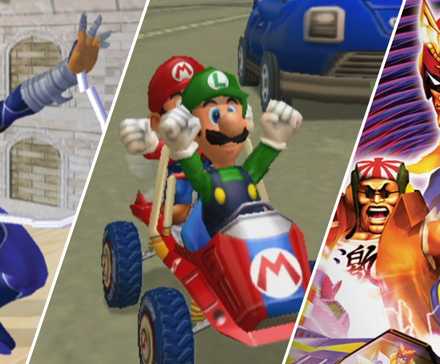
Mario Kart has always been one of the de-facto party games, Nintendo-made or otherwise. Of course, outside of battle mode, Mario Kart is not usually meant to be played co-op; it is meant to be played with fiery vengeance in one’s heart for everyone around you. One of the first major exceptions to this came about with Mario Kart: Double Dash.
Unlike previous and subsequent Mario Kart games, Double Dash has you riding a tandem kart, with one character at the wheel and one on the little platform in the back using items. When playing multiplayer, every player can have their own kart, but you can also go two to a kart, swapping between driver and passenger with a quick button tap. The passenger can hinder and harass other racers while the driver focuses on the road, swapping as necessary to best utilize each character’s specialties.
Fun fact, Double Dash was one of the few GameCube games that supported LAN play, in which several GameCubes could be networked together for simultaneous play. At max, up to 16 players could play simultaneously, broken up into eight pairs. Now that’s a team-building exercise.
1 Super Smash Bros. Melee
Flexible Melee

The first Super Smash Bros. on the N64 established the two main multiplayer modes, Free-for-All and Team Battle, the latter of which was a go-to choice for those who wanted some co-op action. The GameCube's beloved launch title, Super Smash Bros. Melee, continued this tradition, naturally, though with more than a few extra wrinkles thrown in to make things more interesting.
Up to four players can segment off into teams in Team Battle, designated by up to three different colors. Team Battle can be played with the usual stock or time battle rules, though you can also apply it to both the new Coin Battle mode, as well as the Special Melee modes that have unique and wild modifiers like Super Sudden Death or Giant Melee.
Super Smash Bros. Melee also introduced an extra mechanic for Team Battle that would go on to become a standard: if one player on your team ran out of stocks, and you had more than one left, they could swipe one of yours to get back in the game. It’s a small detail, but it helped ensure everyone gets to play together for as long as possible, which you want for your team-based party game.
Next
10 Best GameCube Games with High Replay Value
The best GameCube games we keep playing over and over again.



![ELDEN RING NIGHTREIGN: Deluxe Edition [FitGirl Repack]](https://i5.imageban.ru/out/2025/05/30/c2e3dcd3fc13fa43f3e4306eeea33a6f.jpg)
 English (US) ·