.png)
.png) 7 months ago
74
7 months ago
74

Sign in to your DualShockers account
Since the very first Dragon Quest hero pummeled a slime in a little box, novel combat systems have gone hand-in-hand with JRPGs. That’s a big part of what gives the genre its enduring appeal, how it can take either turn-based or real-time combat and add all sorts of wild twists and wrinkles. Granted, sometimes things get a little too complicated for their own good, but in the best cases, you have systems that are wholly unique without being overbearing.

Related
10 Best JRPGs With ATB Combat Systems
Some people argue that ATB isn't a true turn-based system. Still, it remains one of my favorite approaches to JRPG combat.
For decades, games across the JRPG genre have tinkered with combat systems, sometimes iterating upon the bedrock mechanics that already work and sometimes cooking up something entirely new. Some JRPGs are so proud of their combat systems, they even give them their own unique names! If we could, we’d highlight every single individual JRPG combat system out there, but since that would take too long, here are a few standouts from over the years.
9 Judgement Ring And Sanity
Shadow Hearts
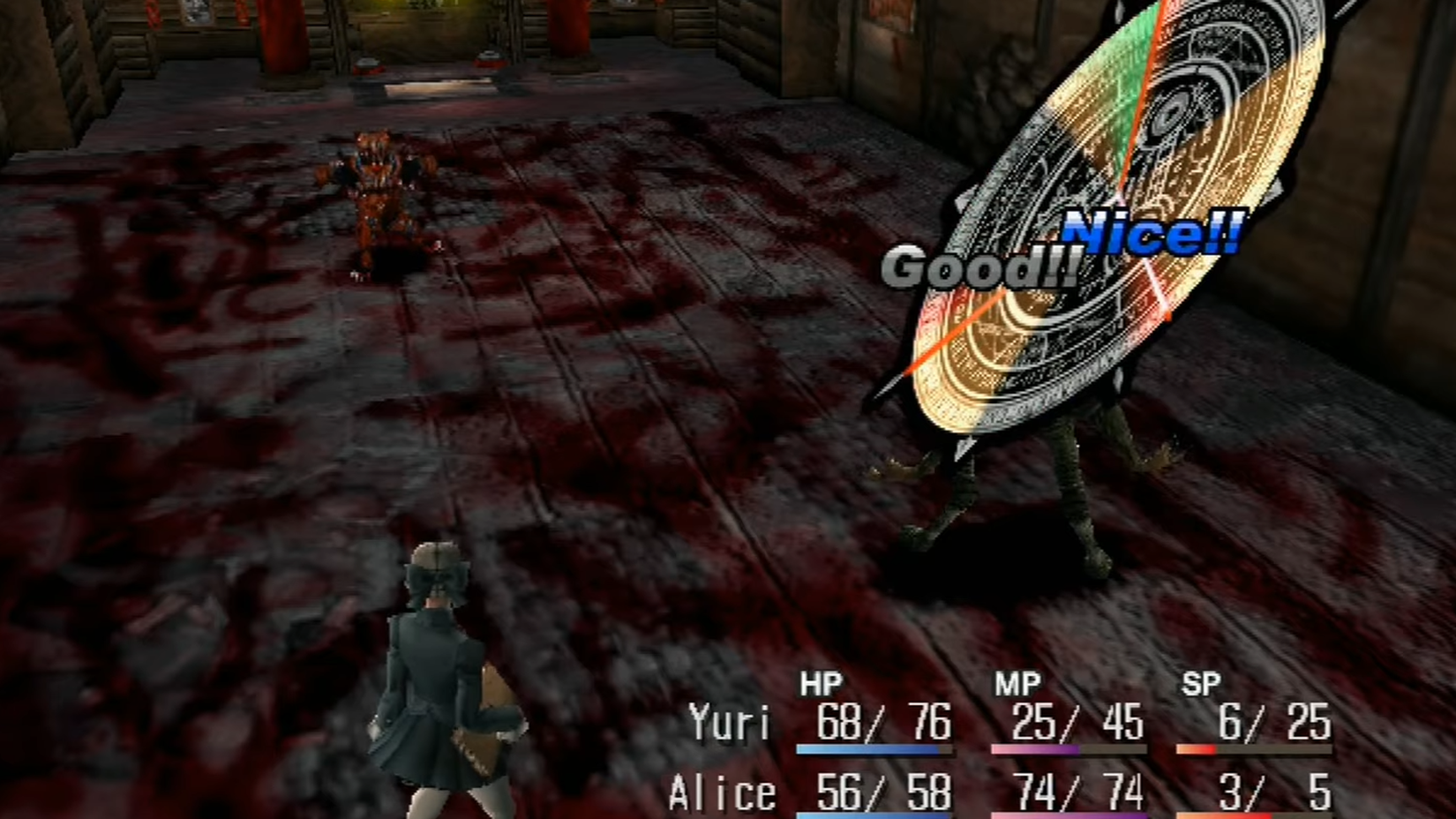
Shadow Hearts dabbles extensively in the realms of Lovecraftian horror, a setting where it’s vital that you keep your head on straight at all times. This manifests in combat in two major ways: the Judgement Ring for attacking and using abilities, and Sanity Points for facing down the unknowable hordes.
When you perform an attack or use an ability with any character, a circular glyph called the Judgement Ring will appear on-screen. The Judgement Ring has several highlighted areas, some larger than others, and a marker that goes around its surface. You need to press the button right as the marker passes over the highlighted areas in order to successfully perform the attack and maximize its damage. Certain items and abilities can actually modify the Judgement Ring, increasing the size of the highlighted areas or slowing the speed of the marker.
The other major mechanic is Sanity Points, or SP. Every character has an SP rating alongside their HP and MP, and it gradually decreases as they take turns or endure damage. If and when it drops to zero, that character will enter a berserk, uncontrollable state. You’ll always get your sanity back at the end of a fight, but if you want to heal it mid-battle, you have to make strategic use of special sanity-restoring items.
8 Brave, Default, And Bravely Second
Bravely Default

In many ways, Bravely Default was something of a modern reimagining of the original Final Fantasy games, particularly games like Final Fantasy 3, which have a big emphasis on character classes. While the bedrock of its combat system is similar to Final Fantasy as well, however, Bravely Default differentiates itself with its signature mechanics named after the title itself.
The linchpins to Bravely Default’s combat system are the Brave and Default actions. On a party member’s turn, you can consume Brave Points from the party’s shared pool to power them up, allowing them to take up to four additional actions. You can push your Brave Points down into the negatives if you want to really make a splash, but you’ll have to wait until they recover before you can do that again. On the flip side, you can have your characters Default, assuming a defensive stance and restoring Brave Points more quickly. It’s a simple risk-reward gameplay style that forces you to balance your own offensive pursuits.
In addition to those mechanics, there’s a secondary ability aptly named Bravely Second. When you activate a Bravely Second, your character can instantly interrupt an enemy action and make up to four moves at no cost. However, Bravely Seconds can only be performed with Sleep Points, accumulated by leaving the console in sleep mode for extended periods of time.
7 The Press Turn System
Shin Megami Tensei 3: Nocturne

While the Megami Tensei franchise dates back all the way to 1987, the early games were more straightforward turn-based JRPGs. It wouldn’t be until the franchise branched out into Shin Megami Tensei and specifically reached Shin Megami Tensei 3 that it would pick up its most iconic combat system, one that would go on to inspire the combat systems in just about all of its sequels and spin-offs.
Shin Megami Tensei 3’s combat utilizes what’s known as the Press Turn System. Rather than you and your party members just taking your turns, followed by your enemy doing the same, your ability to act is determined by the turn icons at the top of the screen. Taking an action consumes an icon, and when your icons run out, it’s the enemy’s turn. However, if you land a weakness or critical hit, your turn icon starts flashing, and you get to go again. With a full team and optimized tactics, your normal four turns get doubled into a mighty eight turns.
This same system applies to your enemies, which means you have to guard your weakpoints to ensure they don’t get doubled turns. Additionally, if an attack from either side gets nullified, it consumes all the icons and the other team gets to go.
6 Tactical Time System, Light And Dark
Eternal Sonata

Despite having a lot of musical iconography in its world, story, and characters, Eternal Sonata’s combat system doesn’t have any particularly rhythmic elements. What it has instead is a greater emphasis on positioning and timing via a two-pronged setup.
The first part of this setup is the Tactical Time System. On any character’s turn, a timer on the left side of the screen begins ticking down. During this time, you can do pretty much anything, including run around, perform simple combos, queue up specials, or use items. Neither side is defenseless while this is going down, though; players and enemies can end their turn with a guard to turtle up against incoming attacks, and you can also press a button in time with enemy attacks to mitigate some of the damage.
The other half of the equation is the light and dark positioning system. Attack properties change depending on if someone is standing in the light or in a shadow cast by characters or the environment. You can use different specials, monsters may change form, and so on. Certain items and abilities can shift the placement of light and shadow, which could be a benefit or a hindrance depending on where your specialties lie.
5 The Live Command RPG System
Like A Dragon: Infinite Wealth

The vast majority of games in the Yakuza/Like a Dragon franchise have straightforward action brawlers for their core gameplay. That changed with the release of the seventh mainline game, Yakuza: Like a Dragon, which switched things to a hybrid brawler and JRPG. While it was the first game in the series to do it, though, I think the following game, Infinite Wealth, was when things got really interesting.
Infinite Wealth uses the Live Command RPG system, an evolution over the previous game’s system. In addition to taking turns and selecting attacks and abilities, every attack comes with a line and radius showing who and what will be in the line of fire when the attack is performed. Enemies are constantly circling around the battle zone, and you can manually control your party members’ positioning on their turns, so the trick is to try and snag as many bad guys in damage radius as possible when you make a move.

Related
10 Best JRPGs For Non-JRPG Fans
JRPGs are an acquired taste for some, but these games are tasty no matter what.
Positioning is also used to determine things like support skill ranges, picking up random items off the ground to use as weapons, and whether your other party members can perform follow-up attacks. What’s especially cool about this game is that, when you’re playing as Kiryu specifically, you can use his special ability to temporarily break out of turn-based combat and go buck-wild on enemies like in the old days.
4 Timed Hits And Defensive Moves
Mario & Luigi: Superstar Saga

Mario & Luigi: Superstar Saga
The very first Mario RPG, Super Mario RPG, focused extensively on the concept of timed hits, wherein pressing buttons while attacking or defending increases/decreases damage. Just about every subsequent Mario RPG has used this system to some degree, though arguably, the one that took the biggest creative leap with it was Mario & Luigi: Superstar Saga.
In this game, both Mario and Luigi have several basic attacks, gradually unlocked over the course of the game: Jump, Hammer, and Hand attacks. Each of these attacks, when performed, requires some manner of special timing in order to maximize damage. Jump has you press A right when you bounce on an enemy, Hammer needs to be reared back, and Hand needs to be charged up for a moment. The same applies to their signature Bros. Attacks, which are made up of a sequence of precise timed button inputs to pull off perfectly.
In Super Mario RPG and Paper Mario, you can press A to mitigate incoming damage, but not avoid it entirely. In Superstar Saga, however, your defensive options shift depending on the incoming attack. If you watch your enemy’s moves carefully, you can jump over them or repel them with your hammer, either eliminating damage entirely or even dealing counter damage.
3 Battle Chips
Mega Man Battle Network

The premise of the Mega Man Battle Network games is that a NetNavi like MegaMan.exe can’t actually do that much damage against viruses and other Navis on their own. To help him, Lan needs to send him specialized combat data in the form of Battle Chips downloaded to his PET. It’s these Chips that form the backbone of the game’s highly-customizable battle system.
Outside of battle, you can set a certain number of Battle Chips in a folder, which is randomly drawn upon when a fight starts. There are all kinds of Battle Chips, from basic cannon blasts to arena-altering effects. There are even special Chips that can summon other Navis to attack or aid you, though you can only have a few of these in your folder at once.
The trick to maximizing the effectiveness of your folder is using Chips with matching types and symbols. Individual chips can only be downloaded one at a time, but if they’re the same type or have the same symbol, you can queue up multiple chips at once for more sustained damage, as well as special Program Advance attacks that require a precise sequence of Chips.
2 Numbered Cards
Kingdom Hearts: Chain Of Memories

Kingdom Hearts: Chain of Memories
The original Kingdom Hearts, gameplay-wise, was a pretty straightforward action JRPG. Moving the command menu around mid-action was a little weird, but didn’t take long to get used to. However, the interquel between Kingdom Hearts and Kingdom Hearts 2, Chain of Memories, opted for something way weirder, something that I don’t mind admitting my ten-year-old brain could barely wrap around.
Chain of Memories’ shtick is that nearly all of your actions in combat besides moving, jumping, and dodging, are governed by numbered cards. Swinging your Keyblade, using magic and summons, or throwing out items all take cards, which you have to arrange into a deck ahead of time. The numbers on the cards don’t actually determine their strength, but you want high numbers to break the cards your enemies use, stopping their attacks in the process.
You can also pack three cards together to make a combo attack, and if the number and component cards are right, unleash a Sleight ability with a more potent effect. However, doing this causes the first card in the group to disappear for the rest of the battle, so you can’t just do it over and over, at least without items to restore them.
1 The Stride Cross Battle System
The World Ends With You

Some JRPGs have combat systems that are kind of difficult to conceptualize in words alone. I sometimes wonder if that’s the reason that The World Ends With You didn’t set the world on fire despite being a very cool and stylish game. Well, that and originally being a DS exclusive, maybe. Still, conceptually dense as it was, you can’t deny it was unique.
TWEWY utilizes the Stride Cross Battle System, an action-JRPG setup meant to utilize the dual screens of the DS. Neku’s on the bottom screen, while his partner’s on the top screen, and as they fight, they pass a puck back and forth between them. When Neku has the puck, you need to draw symbols on the touchscreen corresponding to your equipped Psyches in order to perform attacks. The puck is then passed to your current partner, who can fight using combo inputs on the D-Pad and face buttons, as well as a card mechanic unique to each partner.
While both characters are on different screens, the enemies they’re fighting exist simultaneously across both, so even if only one character is taking damage, you need to keep both of them out of trouble, or you’re toast. This system was streamlined for the mobile and Switch ports, focusing more on Neku’s inputs and less on partner attacks, as well as placing both characters on one screen.

Next
10 Terrible Combat Systems In Great JRPGs
There are great JRPGs throughout the years, but they have not always been supported by the best battle systems.



![ELDEN RING NIGHTREIGN: Deluxe Edition [FitGirl Repack]](https://i5.imageban.ru/out/2025/05/30/c2e3dcd3fc13fa43f3e4306eeea33a6f.jpg)
 English (US) ·