.png)
 2 hours ago
1
2 hours ago
1

Published Jul 4, 2026, 9:30 AM EDT
The hit anime series lost its primal appeal when it started focusing on lore and politics
 Image: WIT Studio
I vividly remember the episode that Attack on Titan lost me.
It wasn't the controversial ending where Eren Yeager became one of anime's most divisive protagonists. It wasn't even the basement reveal that changed everything. It was the moment Rod Reiss dropped to the ground and licked cerebrospinal fluid off an icy crystal cave floor littered with broken glass. Then he transformed into this big nasty malformed kaiju thing that could only crawl as it dragged its guts and exposed skull on the ground.
For fans of the series, that scene was just another stop in Attack on Titan's relentless march toward bigger and more complex ideas. For me, it was the moment I realized I wasn't watching the same show anymore. It had transformed from one of anime’s most intriguing survival horror stories into just another magical spectacle bogged down by its own lore.
When I first discovered Attack on Titan on Netflix over a decade ago, I was so hooked that I distinctly remember faking a headache so I could go to bed early, curl up with my phone, and squeeze in another episode before falling asleep. Its starting premise remains one of the greatest hooks in anime history.
Humanity huddles behind enormous walls while grotesque, naked giants roam the countryside devouring anyone unlucky enough to cross their path. Every expedition beyond the walls feels like a suicide mission. Named characters die horrific, unceremonious deaths. You feel it in your gut: They aren’t just eaten, they are devoured. Nobody is safe. Watching early Attack on Titan felt like seeing Game of Thrones in its prime.
Part of what makes the Titans so compelling and terrifying in the earlier seasons is that they're unknowable. Where did they come from? Why do they eat people? Why are they all naked with Barbie doll privates? When Eren suddenly develops the ability to generate a special Titan body he can control from inside, it feels like a total anomaly in this dark world — and like the key to saving humanity. Attack on Titan immediately becomes this bizarre body horror mecha anime that raises even more questions. What makes Eren so special? Why is his Titan form so much stronger than other Titans? Why does he have to mutilate himself to trigger the transformation?
 Image: WIT Studio
Every question that arises only deepens the mystery without making it feel like a series of disconnected weird ideas. Even as more “special” Titans get introduced, like during the Female Titan arc, that just means Eren gets to face off against an enemy on his level. When he suffers from performance anxiety and struggles with his powers, it feels like Spider-Man going through his identity crisis.
Then, as soon as Attack on Titan reached season 3, it quietly shifted genres. That change had already begun somewhat in season 2. Instead of focusing on humanity’s survival in a hostile world, the show became increasingly interested in royal bloodlines, political conspiracies, inherited Titan abilities, spinal fluid, succession rules, secret histories, and eventually a bizarre metaphysical realm known as the Paths that connected it all together. Titans stopped feeling like monsters and started feeling like a magic system — over time, Eren just kept stacking different Titan powers until he became a sort of god. Cool? Sure. Kind of dumb? Yeah.
The Rod Reiss sequence crystallized everything that no longer worked for me. When Attack on Titan began, it was a personal story of three children connected by great trauma. There was this unbearable tension generated by the possibility that a Titan might suddenly appear over the horizon. The feeling of risk and terror evaporated as the show began expecting you to care about who should inject whom with which serum and who should eat which Titan shifter to inherit which ability. An emphasis on mechanics and lore — and just complexity in general — doesn't always make for better storytelling.
Even the Titans themselves became less frightening. The Female Titan and Armored Titan were shocking because they shattered the rules we'd come to understand. They were a lot like Eren in terms of build, size, and intelligence, but they could harden their skin to give themselves an advantage. Then there’s a Titan that’s just a really big orangutan. Another, literally called the Cart Titan, is a quadruped used as a large beast of burden. There is absolutely no parity between the nine special Titans, which vary wildly in terms of size, ability, and overall power. The more varieties the series introduced, the less terrifying the monsters became.
I know many fans adore the mythology. They love tracing every connection between Ymir, the Founding Titan, Marley, Eldia, and the Paths. They relish a story that rewards encyclopedic knowledge. I’m not here to yuck anybody’s yums. I just miss the version of Attack on Titan that made me fake a headache so I could watch one more episode, the version where every trip beyond the walls felt like a nightmare.
Looking back, the last moment I remember Attack on Titan being really good is the season 2 finale. Eren and Mikasa have lost. Hannes has just been killed trying to avenge Eren's mother. Mikasa is injured. Eren is exhausted and can't transform again. The Smiling Titan — the same Titan that devoured Eren’s mother in the very first episode — slowly approaches.
There isn't some elaborate strategy they employ to get away. They're just going to die. Mikasa thanks Eren for wrapping that iconic red scarf around her all those years ago, basically saying goodbye. It's one of the most intimate scenes in the series because it feels like the end. Then, in one last act of helpless defiance, Eren screams through tears and punches the Smiling Titan’s hand.
Suddenly, all the surrounding Titans turn on the Smiling Titan instead. It's one of anime's greatest "what the hell just happened?" moments as Eren unlocks a portion of the Founding Titan’s power. Neither Eren nor the audience understands why it worked. That's the version of Attack on Titan I fell in love with, a show that wasn't afraid to suddenly introduce huge new mysteries. I just felt simultaneously underwhelmed and overwhelmed when Attack on Titan began answering those questions.
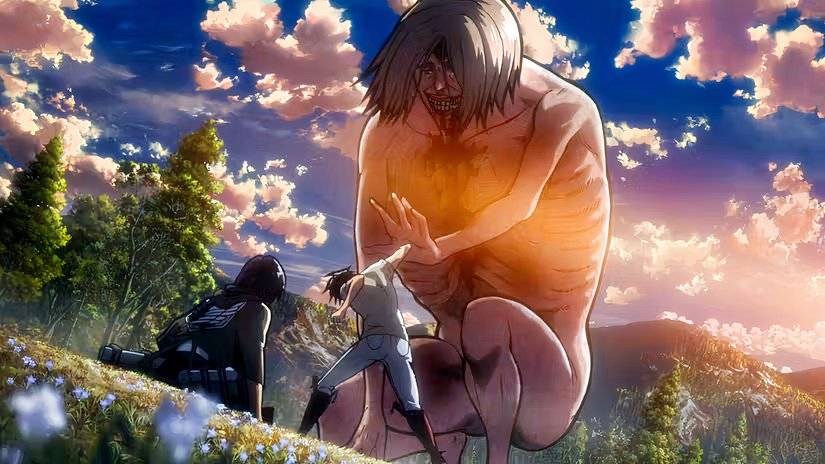 In the season 2 finale, Eren punches at the Smiling Titan and inadvertently activates the Founding Titan power.Image: WIT Studio
By the time Eren gets chained up in that cave, too much exposition earlier in season 3 has explained how his father stole the Founding Titan power, injected him with the Titan serum, and then let his son eat him to claim the power — something Eren conveniently forgot about entirely. Because Eren is so burdened by trauma, he hates himself for the role he played in upending the world order. He screams, pleads, and cries for Historia to inject herself and eat him to set things right. Her refusal, and the decision to smash the serum on the ground, is a triumphant moment for a future queen. It’s just not one I care about when everything happening in this scene is so over-the-top.
Part of why this pivot doesn’t really work for me is that for so long, Historia (who had previously gone by Christa) was just another member of the Survey Corps. Suddenly, Attack on Titan makes her the main character. But things were so much more interesting when it focused on the hopeless despair felt by a trio of orphans in a world full of carnage. The shift from personal to political stakes and an emphasis on lore rather than trauma is much less compelling — and it loses sight of what made the show special in the first place.
Attack on Titan didn't lose me just because it had become more complicated. It lost me because it stopped being a survival horror story and became a mythological fantasy epic that didn’t make a lot of sense — or offer characters I could invest in.
 Related
Chainsaw Man and Attack on Titan reveal a dark truth about modern masculinity
Both shows mirror the experience of modern youth, navigating the harsh realities of growing up today



![ELDEN RING NIGHTREIGN: Deluxe Edition [FitGirl Repack]](https://i5.imageban.ru/out/2025/05/30/c2e3dcd3fc13fa43f3e4306eeea33a6f.jpg)
 English (US) ·