.png)
.png) 5 months ago
82
5 months ago
82


Published Jan 28, 2026, 2:00 PM EST
Maddie Fisher is a writer, journalist and game developer. She was born and raised on the east coast, having started working in games journalism over fifteen years ago. She tends to enjoy musical theater, hockey and tennis.
Squall is dead.
No, that's not just a random, albeit grim statement. Squall is dead is the germ of a much larger, more complex fan theory that has permeated the Final Fantasy 8 fandom for over two decades. That theory being that the time-traveling sorceress Ultimecia, whose diabolical plan reaches all the way back to the present day of FF8, is actually a future version of Rinoa Heartlilly, the game's second lead character.
It's a broad, highly complicated theory that relies on time compression, fateful paradoxes and outright ignoring what the game's creators say. Writer Yoshinori Kitase has said that they are two distinct people, but would later backtrack, saying that he had no idea what the intentions of Kazuhige Nojuma and Tetsuya Nomura were. He left the theory open to fan interpretation, which is great news for all of us tinfoil hat-wearing Final Fantasy fans.
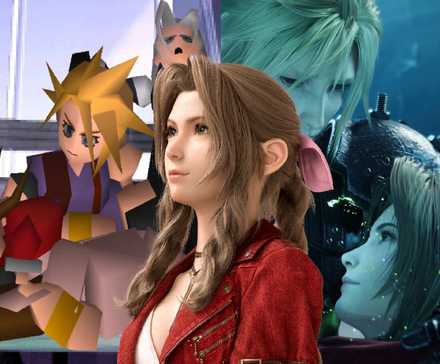
RELATED
Why Cloud Can't Use Phoenix Down on Aerith in Final Fantasy 7
Cloud's decision to not use Phoenix Down on Aerith has a good reason behind it.
The concept of Ultimecia being a future version of Riona is dependent on several factors, many of which come directly from the game itself. There's no need to track multiple games, reach through developer interviews or explore the Ultimania books, although they do help in some cases. The theory lives or dies almost solely within the text of Final Fantasy 8 itself.
In simple terms, the theory posits that Squall is killed at the end of disc one's climactic finale, leaving Rinoa descending into despair and becoming the game's nefarious villain Ultimecia. It's a lot less simple than it sounds, however, and I will do my best to walk you through this tale of time travel, grief and destiny.
For obvious reasons, it needs to be noted that this article contains crucial endgame spoilers for Final Fantasy 8. If you still haven't cleared FF8, be warned that this article spoils nearly everything about the game.
The Origins of Ultimecia
From Rejected Concept to Full-Fledged Villain
It's well documented that Edea Kramer was born from a rejected concept for Final Fantasy 7. She began as that game's secondary villain, a sorceress that would be tracked by Hot-Blooded Detective Joe. When that concept went by the wayside, Square would end up re-using the New York and detective themes for Parasite Eve.
She wasn't known as Edea until her introduction in Final Fantasy 8, where she was introduced as a woman possessed by a time-traveling sorceress from the future known as Ultimecia. The true villain of FF8, Ultimecia exists in the far-flung future of the game's world, where she uses the magic of that time to send her consciousness back in time to possess Edea and unleash her Time Compression spell that will allow her to rule all creation.
In fact, the game plays up Edea's villainy to such a degree, that Ultimecia isn't even mentioned until the third disc of a four-disc game. For the first fifteen-twenty hours of Final Fantasy 8, you're led to believe that Sorceress Edea is the major threat of the game. That is especially true during the first disc, where the party crashes a parade in Deling City.
Squall Is Dead
RIP Squall
At the end of disc one, Squall's chest cavity is caved in by an icicle thrown by a possessed Sorceress Edea. While a lot of Final Fantasy heroes have lived through some nasty encounters, this isn't just a KO on the battlefield. This is a mortal, seemingly fatal wound, yet somehow Squall is back into action as soon as disc two begins.
The theory surrounding Squall being dead is a long-standing fan theory, which implies that the events of discs two, three and four are an afterlife fever dream. But what if "Squall is dead" wasn't just a funny meme? What if that could form the basis of one of the franchise's most ambitious plot twists of all time?
As the theory goes, Squall is killed by Edea at the end of disc one. The parade scene ends with a climactic battle and Edea conjuring up a jagged ice shard, which she then impales Squall with. After his death, Rinoa becomes consumed with grief and begins trying to find a way to make the timeline correct.

Related
5 Connections Between Final Fantasy Games
The Final Fantasy games don't take place in the same worlds, until they actually do sometimes.
What makes Squall dying at the end of disc one rather intriguing is just how much of the game becomes absolutely mental afterward. It feels like some sort of purgatory dreamscape, where Squall's life goes from rather mundane to one of the most out-of-control adventures you've ever seen, culminating in a trip to space and getting the girl of his dreams.
In the ending FMV of Final Fantasy 8, there are a lot of implications for death and the passing on of souls to an afterlife. Squall is even shown without a face at one point. Squall's life after disc one feels like one final, desperate attempt to hold on to a life that is fading away.
The Succession of Witches
How Rinoa Became Ultimecia
As the party enters Ultimecia's Castle, the final dungeon of Final Fantasy 8, the theory starts to evolve from fans having fun to some hard to ignore, fairly concrete evidence. This isn't just a bunch of fans having fun on the internet. There are some genuine connections between Rinoa and Ultimecia that are difficult to look past.
For one thing, Rinoa and Ultimecia share remarkably similar facial structures. No other female characters in Final Fantasy 8 have this much resemblance, and when you look at the two of them side-by-side, it's hard not to notice that they have the exact same face. Their nose and face shape are identical, which leads directly into the next bit of evidence.
The ending FMV shows Riona entering various time-loops in order to find Squall, who is lost in the time stream. During this section, the game flashes various images of Ultimecia, seemingly linking the two and showing just how similar the two look. These two characters are linked in so many ways.
During the final battle against Ultimecia, a few things stand out. The first of which is that she summons the Guardian Force known as Griever, a mythical lion that has more than a few connections to Squall. Griever appears on Squall's necklace and his gunblade, as well as a ring that he gives to Rinoa.

When Squall gives Rinoa his Griever ring, he says, "Maybe I can become a lion, too." After Ultimecia summons Griever, the song that plays during this final conflict is called "Maybe I'm a Lion." Not to mention that both characters have an innate desire to stop time at a moment where their life was perfect.
If that's not enough for you, then there are two key pieces of evidence found in Mobius Final Fantasy and Dissidia Final Fantasy: Opera Omnia. In Mobius, Ultimecia copies Rinoa's dance in the ballroom almost to a tee, even down to the finger in a "shh" motion. It's rather striking when you look at them side by side. While this is a mobile game, it's rather important to note that the game was written by FF8 writer Kazuhige Nojima.
In Opera Omnia, there's a fairly convincing bit of evidence that comes when you attempt to put Rinoa and Ultimecia in the same team. Instead of allowing this combination, the game will deny you, insisting that they are the same character. It just goes to show that outside of the game's text, where the meat of the theory exists, there's a ton of outside evidence that one can point to.
Kitase may have left the final conclusion about the theory and its validity up to the fans, but the very text of Final Fantasy 8 seems to lean into the concept more than he realized. As always, fan theories remain just that until proven otherwise, but Rinoa losing her love and becoming the very villain that started the events of the game is still one of the most fascinating lenses to view this timeless classic through.

Next

Released February 11, 1999
ESRB T for Teen: Mild Language, Suggestive Themes, Violence
Developer(s) Square Enix
Publisher(s) Square Enix
Engine luminous engine



![ELDEN RING NIGHTREIGN: Deluxe Edition [FitGirl Repack]](https://i5.imageban.ru/out/2025/05/30/c2e3dcd3fc13fa43f3e4306eeea33a6f.jpg)
 English (US) ·