.png)
.png) 6 months ago
138
6 months ago
138


Murillo Zerbinatto is a contributor from Brazil. He's an RPG enthusiast (with a focus on JRPGs) who has been around the world of games and content creation for more than five years now. He has a particular love for Final Fantasy and has absorbed all the content this long-running series offers, including its obscure spinoffs such as Dimension I & II, Explorers, and My Life as a King. While playing RPGs is already a time-sinking endeavor, Murillo doubles down by being a platinum hunter as well.
Sign in to your DualShockers account
JRPGs have been enjoying a long-deserved resurgence in recent years after a turbulent period since the seventh console generation. Hallmark titles like Final Fantasy, Dragon Quest, and Persona have always remained in the public consciousness, but other titles didn't get the same opportunity.
During what is considered the golden age, the period between the SNES and the PS1, we saw the birth of many new IPs. Some were more successful than others, but overall they were highly creative and fun, always offering something new to players. However, many of them did not endure the transition between generations and slowly faded away.
Related
10 Most Obscure PS1 JRPGs
If you know five or more titles from this list, I've failed my mission.
This list aims to pay homage to several JRPGs that were forgotten by time, whether because they failed to make a buzz at launch or because publishers pulled funding and projects were cut short. Regardless of the reason, these are all incredible JRPGs that deserve a second chance today.
10 Final Fantasy Dimensions
A Great Mobile Spinoff

Final Fantasy remains a hallmark series among JRPGs. From time to time, newcomers dive into spinoffs like Final Fantasy Type-0 or even World of Final Fantasy, keeping the flame of these experimental titles alive at Square.
However, there are other titles that, while relatively obscure, were well-loved at the time of their release, such as Final Fantasy Dimensions, a mobile title launched worldwide in 2012 that brought many references to the franchise and gameplay elements inspired by Final Fantasy III and V. The game offers a Job System very familiar to the series, but with a twist.
In total, there are eight characters, four Warriors of Light and four Warriors of Darkness, who journey across two halves of the same world. What's interesting is that the Warriors of Light have access to unique jobs like Paladin or Dragoon. In contrast, the Warriors of Darkness are the only ones who can become Dark Knights or Ninjas, creating an interesting dynamic as the story alternates between parties.
9 Infinite Undiscovery
Tri-Ace Forgotten RPG

During the Xbox 360 era, Microsoft spared no effort in trying to conquer the Japanese market, investing in several developers to fill its catalog with JRPGs. We got games like Lost Odyssey, Tales of Vesperia, Star Ocean: The Last Hope, and also Infinite Undiscovery.
Like Star Ocean, Infinite Undiscovery was developed by tri-Ace and published by Square Enix. It was a new action RPG IP with strong strategic elements. Before engaging in battle, players could preselect specific commands to gain a preemptive advantage against enemies.
We play as Capell shortly after the Order of the Chains army captures him. After Aya rescues him, he joins a group trying to dismantle this evil force. There are also environmental actions that can help with tactics, though not as many as originally designed, since several were cut from the final game. Still, it's a great title that ended up forgotten, mainly because it's still locked to the Xbox 360.
8 Brave Fencer Musashi
Action and Puzzle at Its Finest

If there was one thing Square excelled at in the past, it was maintaining a functional pipeline of creative releases. Every year brought bold, inventive, and most importantly, fun new IPs. Brave Fencer Musashi was one of those, an action RPG released on the PS1 in 1998.
In the game, we play as the titular Musashi after Princess Fillet summons him to stop the Thirstquencher Empire, puns included. Against his will, Musashi accepts the quest simply so he can return home. To fulfill his mission, he wields the swords Fusion and Lumina, which also define two distinct gameplay mechanics.
With Fusion, Musashi can attack quickly and absorb enemy skills. Lumina, on the other hand, delivers slower and more powerful attacks, and as we obtain more scrolls, its potential is further unlocked. The swords' specialties are also used to traverse dungeons filled with head-scratching puzzles that left me stuck for days, especially since the first time I played the game, everything was in Japanese. The game received a PS2 sequel, which, although I enjoyed it, failed to capture the same audience and quickly fell into obscurity.
Related
10 Best GBA JRPGs, Ranked
Those who wanted to explore Nintendo's JRPG catalog in the 2000s would have to rely on its handhelds rather than home consoles.
7 Threads of Fate
Even Square Forgot About This Game

Still on the action RPG front, we have another Square title that wasn't afraid to innovate. Threads of Fate allowed players to start the adventure with one of two protagonists, Rue or Mint. Depending on your choice, gameplay changed drastically, along with certain puzzle-solving elements and narrative beats.
Rue was a more melee-oriented fighter who could transform into monsters. While transformed, he could use enemy abilities at the cost of MP. Mint, on the other hand, could fight both in melee and at range, relying on magic and a color-based system. By combining different colors, it was possible to unleash different spells.
These distinct gameplay elements also affected the solutions to puzzles. Rue relied on transformations, while Mint used her magic. Although both storylines eventually converge at the same endpoint, each protagonist experiences unique story beats tailored to them. These variations gave Threads of Fate a notable degree of replayability, something uncommon for JRPGs of that era.
6 White Knight Chronicles
Amazing Knight Transformations

Level-5 has always been a reliable developer. Every game it released, whether an original IP or a third-party project, carried a mark of excellence. If you doubt that, just look at more recent releases like Fantasy Life i: The Girl Who Steals Time and Inazuma Eleven: Victory Road.
That said, not every Level-5 title resonated with both critics and audiences, and some ended up forgotten, as was the case with White Knight Chronicles. Its premise is extremely intriguing, as early on, we see the protagonist, Leonard, merge with a suit of armor and transform into the magnificent White Knight. What's not to love?
Combat takes cues from MMOs, being real-time with every skill tied to a cooldown. Alongside Leonard was our custom-created character, who could also be taken into online multiplayer to tackle quests and visit other players' towns, thoroughly enjoying everything the game had to offer. It's a shame that White Knight Chronicles was so thoroughly forgotten by time, because it certainly deserved more love.
5 Eternal Sonata
Chopin Deserved Better

If I could choose just one JRPG from this list to return to the spotlight, or even enter it for the first time, it would be Eternal Sonata. To this day, I don't understand why it's considered an underrated gem, because it deserved all the love and attention from the JRPG fanbase. Yes, it originally launched on Xbox 360, but it soon came to PS3, where I played it.
Right from the start, we experience a fever (tuberculosis) dream of Frédéric Chopin as he wanders through a fantastical world. Music is a dominant theme in Eternal Sonata, both in the story and in gameplay. You can find Score Pieces across the globe and use them to perform music with NPCs, earning items in return if the melody is pleasing.
Battles are turn-based but include real-time elements. When you move a character, a timer begins to count down, and during that window, you can attack and use skills freely. The biggest twist is that a character's abilities change depending on whether they're standing in light or shadow, a key feature in every battlefield. There's also a small timed input when you're attacked, allowing you to either defend or counter if you hit the timing correctly. Truly a masterpiece of a JRPG.

Related
10 Best 16-Bit JRPGs
It was during the 16-bit generation that the JRPG word began to spread across the world.
4 Lufia II: Rise of the Sinistrals
One of the SNES' Most Underrated Gems

Lufia II: Rise of the Sinistrals
We won't talk about the DS remake because, while good, it's a far cry from the original. The original Lufia II is often considered the best forgotten SNES JRPG. It may not reach the heights of Chrono Trigger or Final Fantasy VI, but it still deserves to be remembered and to stand proudly alongside them.
The game offered so many features, and all of them worked so well, that it was uncommon for its time. Great dungeons with clever puzzles? Check. Monsters as party members? Check. A creative equipment-based progression system? Check. Strategic and fair turn-based combat? Check, check.
Everything Lufia II sets out to do, it delivers with excellence. It's a well-rounded title that appeals to any nostalgic JRPG fan. There are many theories as to why it never reached the same level of success as its peers, such as a late worldwide SNES release or a lack of marketing. Still, none of that diminishes the brilliance of Lufia II and the incredible experience it provides.
We Fight Aboard Tanks

Did you know the Metal Max series has seen more than 16 titles across mainline entries, remakes, and mobile releases? It's one of those highly niche franchises, but deeply beloved by its audience. I've only played two entries, Metal Saga on PS2 and, more recently, Metal Max Xeno: Reborn on my PS4.
Granted, the games are a bit rough around the edges and lack the polish of more renowned JRPGs, but they still have their charm. Beyond being set in a post-apocalyptic world, you're usually riding vehicles that are used both for traversal and combat.
In Metal Max Xeno: Reborn, the remake of Metal Max Xeno, you control your party members in the field and, upon encountering enemies, select commands through a menu. Gameplay works similarly when aboard a tank, but you can also manually aim at long range, making combat more active. The game was supposed to receive a sequel in 2022, but it was canceled, once again pushing the series into obscurity.
2 Brigandine: The Legend of Forsena
Legend of Runersia Is Also Good
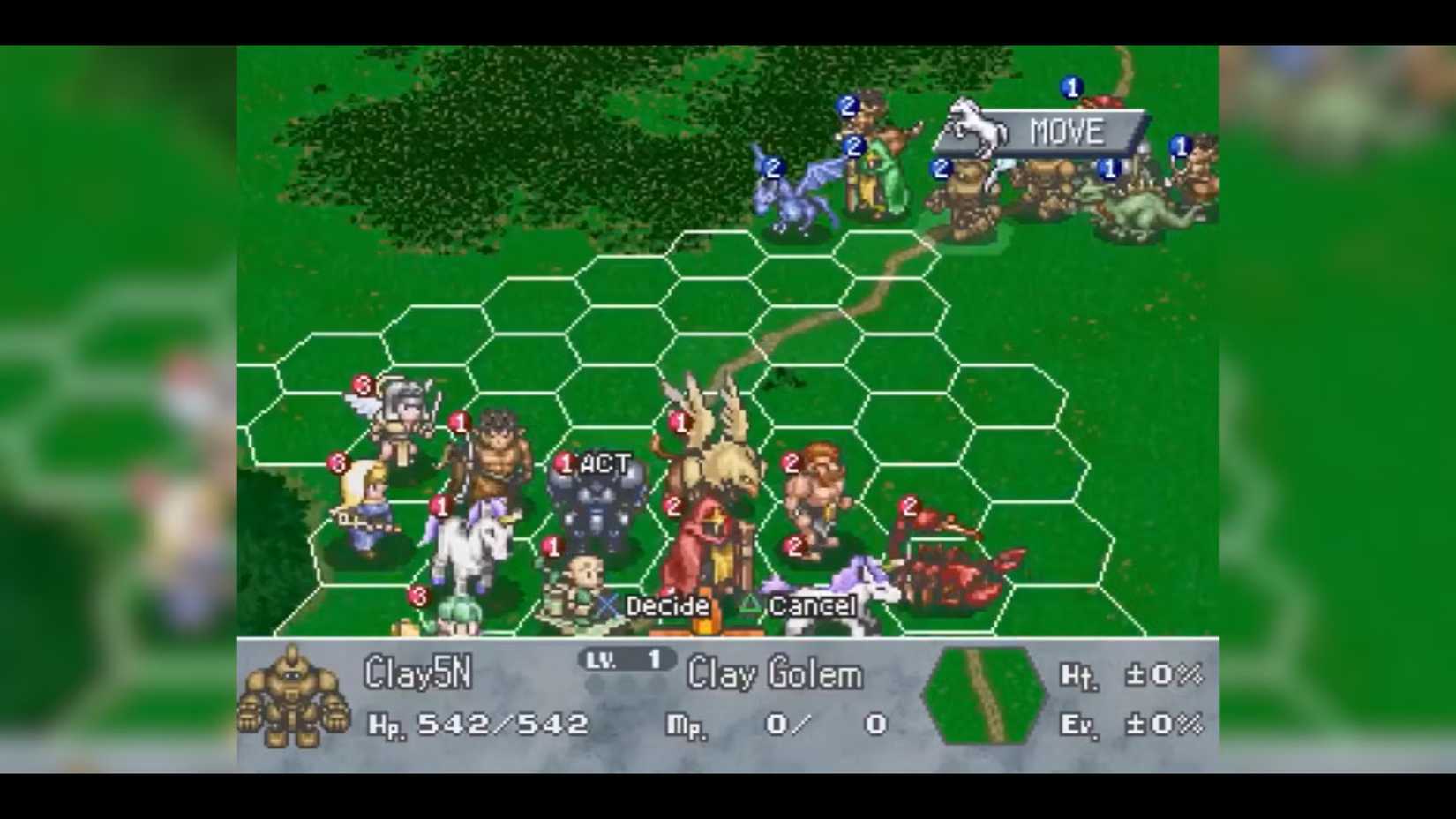
Brigandine: The Legend of Forsena
One of my favorite activities during the PS1 era was hunting for new games just by browsing their covers, since information wasn't readily available back then. In a particularly shady rental store, I stumbled upon Brigandine: The Legend of Forsena and bought it on the spot. At first, it struck me as clunky, unpolished, and unimpressive.
The more I engaged with it, however, the more I began to understand and appreciate its systems, its highly strategic gameplay, and the world and conflict of Forsena. Consequently, my enjoyment steadily grew until it hooked me completely, and I became obsessed with leveling up my troops and monsters to their fullest.
For a long time, Brigandine remained forgotten until, out of the blue, a new entry called Brigandine: The Legend of Runersia appeared. Still, it felt like only a handful of players knew the franchise, and it faded again quickly. If you're looking for a tactical RPG unlike anything you've played before, you should give Brigandine a chance.
1 Radiata Stories
A Massive Cast

In almost every discussion about underrated or hidden gem JRPGs, one or more people bring up Radiata Stories, and for good reason. The game was released on the PS2 by tri-Ace, which was on a roll at the time. Radiata Stories had everything that made a JRPG great: strong characters, engaging combat, a gorgeous anime-inspired aesthetic, and a fairly solid story.
What truly set Radiata Stories apart from its peers was its roster of 176 recruitable characters. If a character spoke, and you could interact (or kick) with them, they could potentially join your team. It was a shame that you could only directly control the protagonist, Jack Russell, in battle, especially since the AI was highly incompetent, but the sheer variety more than made up for it.
The thing is, Radiata Stories doesn't necessarily outshine other JRPGs in specific areas. It simply does what it sets out to do very well. Granted, some feel the plot loses coherence over time and fizzles out near the end, but it's still a title worth remembering and could easily warrant a return on modern platforms.


![ELDEN RING NIGHTREIGN: Deluxe Edition [FitGirl Repack]](https://i5.imageban.ru/out/2025/05/30/c2e3dcd3fc13fa43f3e4306eeea33a6f.jpg)
 English (US) ·