.png)
.png) 2 months ago
41
2 months ago
41

Published May 30, 2026, 3:51 PM EDT
Maddie is a Contributor at DualShockers covering JRPGs, survival horror, arcade games, retro gaming, shooters, and features. She has been writing about games professionally since 2011, with more than a decade of experience across lists, reviews, guides, and games journalism.
Before joining DualShockers, Maddie contributed to WhatCulture, GameRant, and NowLoading, and has written extensively about games across multiple websites over the years. She is also a writer, journalist, and game developer, bringing both editorial experience and development perspective to her coverage.
During the height of their arcade dominance, Capcom was also an absolute rock star in the home console market. Thanks to hits like Mega Man and Breath of Fire, Capcom proved that while they had a strong handle on the arcade market, they knew a thing or two about home console development. Their arcade business never suffered, either.
They were absolutely crushing the competition in fighting games with Street Fighter, while Strider had them firmly entrenched in the action-platformer market. There was simply no stopping Capcom, as they had nearly all corners of the market covered.
If that wasn't enough, Capcom would go to work on a game that would not only coin the name of an entirely new genre, but influence indie developers for decades. 1996 wasn't just an important year for Capcom. It was the day the entire PlayStation generation got the leg-up it needed, and Capcom would go on to define nearly every aspect of that era.
Wow, What a Mansion!

Resident Evil was put into production by Capcom in the early 1990s, where the initial goal was to create a remake of Sweet Home, a 1989 NES RPG that was released alongside a movie of the same name. The movie? Decent. The game? Pretty weird, but okay enough that Capcom wanted to revisit it with the new, emerging technology of the PS1.
Shinji Mikami was assigned to the project in 1993, where he would steer the project into what it became. Through numerous drafts and concepts, including several that involved aliens and ghosts, Resident Evil's final form was more in line with the George A. Romero Night of the Living Dead movies. Any traces of the paranormal were removed, replaced with the shambling corpses of the undead.

To bring their spooky nightmare to life, the team at Capcom took inspiration from fellow horror game Alone in the Dark to create high-quality 3D renders of environments, then display them as images that 3D polygonal characters could be superimposed over. It wasn't an entirely unique concept, as pre-rendered backgrounds had existed in the years before Resident Evil, but to do it in this way that amounted to a sort of interactive horror movie, was an absolute slam dunk.
When Capcom combined the pre-rendered backgrounds with intense survival gameplay and a story that felt like the greatest B-movie you'd ever seen, you didn't just have a great game. You had something that would become a global cult phenomenon. Luckily for Capcom, and for us, this was only the beginning of a long, frightening roller-coaster ride that we would still be on decades later.
The Pre-Rendered Revolution

Although Resident Evil didn't originate the concept of pre-rendered backgrounds with 3D characters, it was the game that showed everybody just how powerful a technique it was. The industry was so enamored with the high-fidelity illusion it created, in fact, that the concept spread like the zombie plague that started this whole thing. Everybody wanted to get in on the action, and I do mean everybody.
It wasn't an entirely unique concept, as pre-rendered backgrounds had existed in the years before Resident Evil, but to do it in this way that amounted to a sort of interactive horror movie, was an absolute slam dunk.
Square created an entire generation of new Final Fantasy fans with FF7, 8, and 9 using pre-rendered backgrounds. They would also find a way to merge Final Fantasy with Resident Evil in the form of Parasite Eve, a breathtakingly brilliant survival horror action RPG that simply had no equal. Developers from all over the world were hooked.
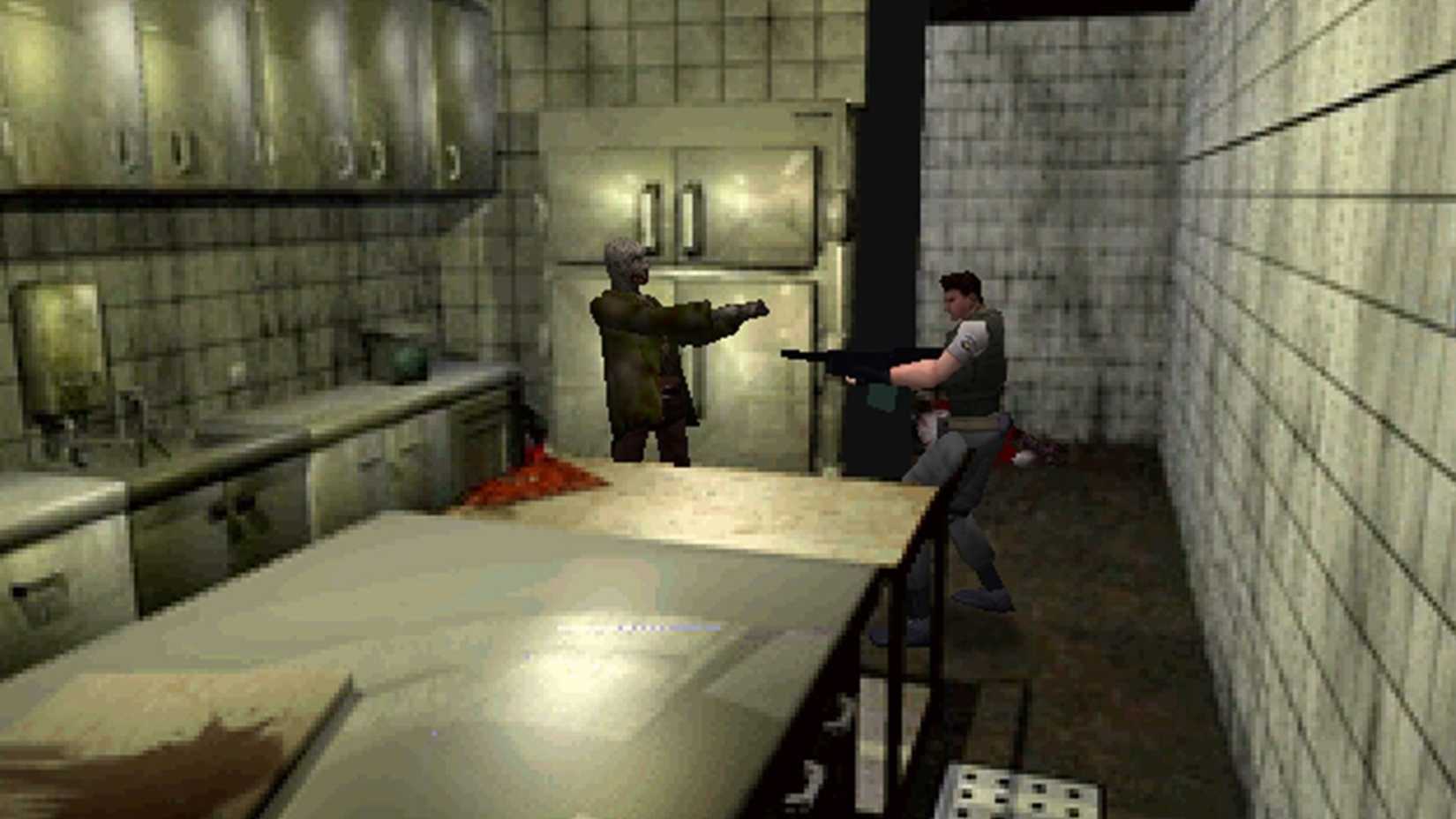
Games like Koudelka, The Legend of Dragoon and an untold number of others just couldn't resist. It was almost like an entirely new way of making video games, where the artists came first. Any studio attempting to replicate it that didn't have a decent 3D artist on their team was facing a bit of trouble, as their backgrounds were destined to not come out as well.
 Related
10 Amazing Games With Pre-Rendered Backgrounds
Pre-rendered backgrounds are one of the most iconic and distinctive design tricks in gaming history.
The entire PS1 generation was affected by Resident Evil 1. It created a seismic shift, one that affected the rest of the PS1's run. Pre-rendered backgrounds persisted in home console games well into the sixth-generation, as Capcom would continue to use them for classics like Onimusha, while Square would use them for parts of FF10. They weren't going away anytime soon.
The Survival Horror Legacy

In the decades since Resident Evil first released, pre-rendered backgrounds began to fade away. At least, in the AAA space, that is. Pre-rendered backgrounds may have lost their luster in a world of gigantic, 3D open-world games with a five-year development cycle and multi-million dollar budgets, but they lived on in the hearts of the players.
Some of those players went on to become developers, crafting an indie horror scene that isn't just surviving the horror, but thriving in it. Resident Evil-likes, as it were, are still an enormous part of the indie horror game scene. You can't go anywhere on Steam or itch.io without running into a PS1-era survival horror game with pre-rendered backgrounds and 3D characters. If you ask me, that's nothing but a good thing.
Games like Koudelka, The Legend of Dragoon and an untold number of others just couldn't resist. It was almost like an entirely new way of making video games, where the artists came first.
This style of game is something special. I don't think it will ever die, which is really a testament to how fantastic of a game the original Resident Evil was. I think it gets unfairly maligned these days, with most people preferring the stupendous 2002 GameCube remake. It's an outstanding game, but there's something about that creaky old PS1 game that I just absolutely love.
Resident Evil didn't just codify the survival horror genre. It birthed an entire cottage industry, and one that has inspired indie developers for decades now. The rebellious spirit of Resident Evil 1 never died. It just became something else, forever burned into the hearts of those who carry that flame today. It may be over three decades since this PS1 classic came out, but its unique soul will outlive every single one of us like the shuffling zombies that inhabit its dark, sinister hallways.
 NEXT
NEXT

Resident Evil: Director's Cut
Systems

Released September 25, 1997
ESRB M For Mature 17+ // Blood and Gore, Violence
![Spider-Man: Brand New Day post-credits scene explained: How [spoilers] sets up Avengers: Secret Wars](https://static0.polygonimages.com/wordpress/wp-content/uploads/2026/07/mcdspma_sp140_h.JPG?w=1600&h=900&fit=crop)


![ELDEN RING NIGHTREIGN: Deluxe Edition [FitGirl Repack]](https://i5.imageban.ru/out/2025/05/30/c2e3dcd3fc13fa43f3e4306eeea33a6f.jpg)
 English (US) ·