.png)
.png) 1 month ago
18
1 month ago
18

Published Jun 1, 2026, 1:00 PM EDT
Maddie is a Contributor at DualShockers covering JRPGs, survival horror, arcade games, retro gaming, shooters, and features. She has been writing about games professionally since 2011, with more than a decade of experience across lists, reviews, guides, and games journalism.
Before joining DualShockers, Maddie contributed to WhatCulture, GameRant, and NowLoading, and has written extensively about games across multiple websites over the years. She is also a writer, journalist, and game developer, bringing both editorial experience and development perspective to her coverage.
Last month, I was invited to a preview event to take a look at a game being published by The Arcade Crew and developed by Regal Pigeon, a solo creator based out of Hong Kong. The absolutely delightful Chivalware is a grid-based action Roguelite, where you take control of a Disk Knight on a quest to save the digital world and look pretty cool doing it.
The developer himself mentions Mega Man Battle Network as a key inspiration, and as a huge fan of that series, I can only offer my utmost respect. I'm still waiting for some maverick who loves Mega Man Legends to do their thing, but until then a spiritual successor to Battle Network sounds like a great time.
 RELATED
10 Story-Driven Indie Games with Better Story Than The Last of Us
Naughty Dog's tale is great, but these journeys go a step further.
Having spent a few hours playing Chivalware, I came away realizing that this is a game you're going to want to watch out for. Aside from its clever title, Chivalware is tapping into a genre that has been ignored for far too long. Thankfully, a brave Disk Knight is coming to our rescue and bringing it back to the spotlight.
Knights of the Grid Table
Chivalware is the kind of game that you pretty much get immediately. The core concept and systems are laid out simply and explained plainly, but that doesn't mean Chivalware is a simple game. Far from it.
What Chivalware does so well is its pace. You are able to get acclimated to its speed and velocity rather quickly, as the game lets you take it at your own pace. It doesn't rush you along. Instead, it lets you understand its systems at your discretion. Once you do get a clear understanding of it, Chivalware lets the leash off and really gets its legs underneath it.
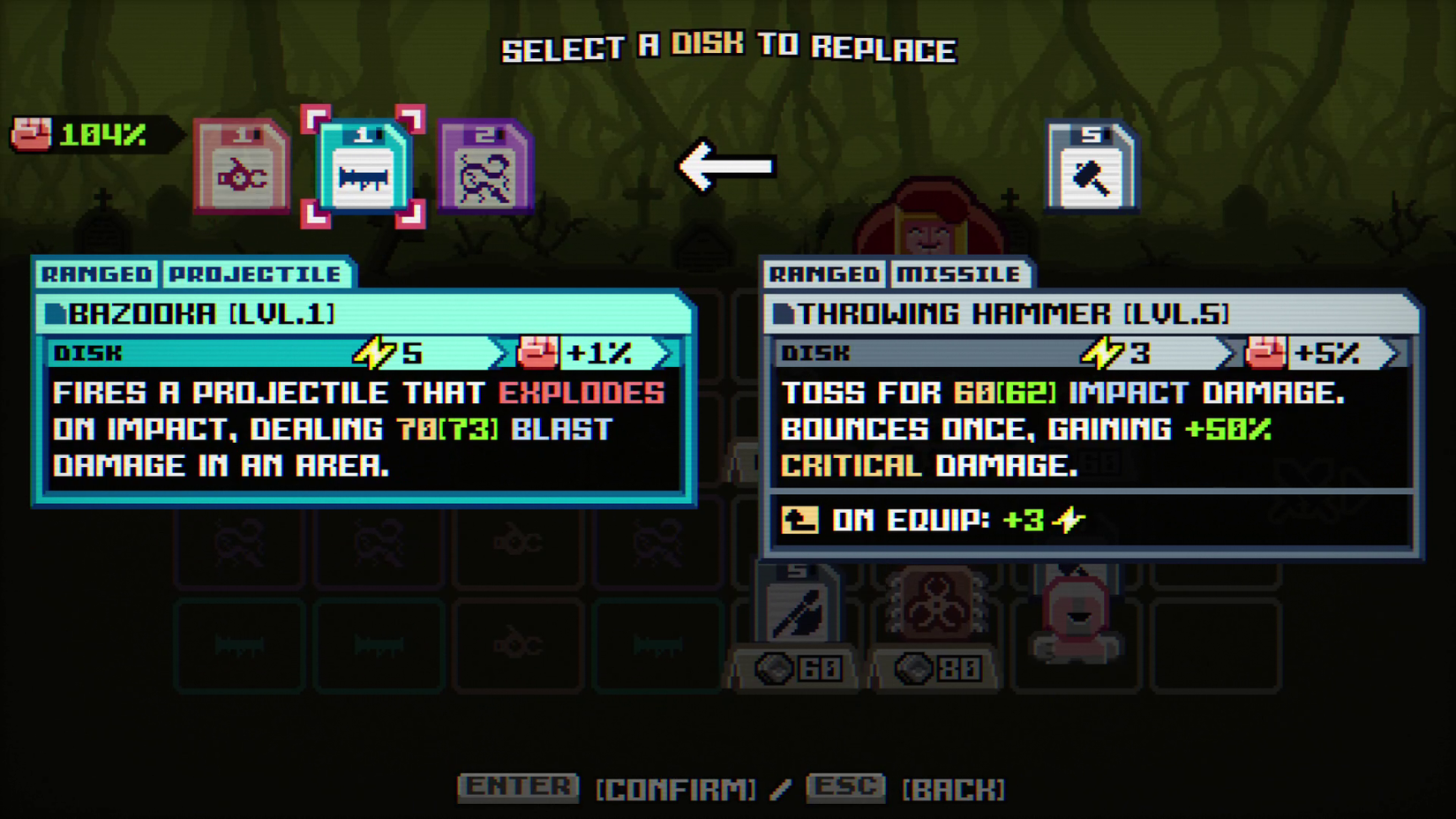
The core concept of Chivalware revolves around controlling your Disk Knight in a grid-based environment, where you use a tile-matching system to equip and power up a series of weapons. As enemies come at you in waves, you are free to move along the entire grid, even into enemy turf, to unleash your chaos on them.
Once you do get a clear understanding of it, Chivalware lets the leash off and really gets its legs underneath it.
It's precisely that level of chaotic freedom that makes Chivalware so enjoyable. I've played a lot of these grid-based games, and sometimes the biggest problem is how restrictive they might feel. This is usually compounded by an unusually small grid, which does speed up the pace as you and the enemies have fewer spaces to lay claim to, but it can leave a grid-based game feeling a touch constrained.
Chivalware's main concern is letting you explore the grid and experiment with the weapons. That's really when the game finds its voice, too. The rhythmic, almost dance-like nature of these digitized encounters feels hypnotic sometimes. It's remarkably easy to get into a precise flow state, and when you do, Chivalware becomes the kind of game that you just have to keep playing.
Press On, Brave Disk Knight
Controlling your Disk Knight in Chivalware feels absolutely fabulous. Movement is sharp and natural, which is pretty important when you consider how aggressive the enemies in the game can get. This only increases as you reach each new grid. Chivalware sets you on a path that's showcased at the top of the screen, as clearing each grid will shuffle you to the next one.
Each grid presents a new opportunity and challenge to show your stuff. Enemies will often be color-coded, meaning that weapons of the same hue will just bounce right off them. Strategizing is incredibly important, as you will have to stay on your toes and use the tile system to grab the weapon you need. It's a really fun sense of chaos and speed, as you'll often find yourself scrambling to find the weapon that's going to help you.

Surviving in Chivalware means using everything that the game gives to you, as well as using its unique tools to your advantage. Enemies stack up in higher numbers with each grid, and you're never really quite sure what's coming your way next. It's really the game's biggest strength, and if the full game can keep up this torrid pace of enemies and rest grids, it's going to work out extremely well in its favor.
It's remarkably easy to get into a precise flow state, and when you do, Chivalware becomes the kind of game that you just have to keep playing.
As this is a Roguelite, however, what you see on the next grid is going to be unique each time. It could be a wave of enemies, or it could be a weird shop. It might be some sort of off-beat NPC offering you a new upgrade or chip to use. The game really throws a lot at you in a short span of time, but that sense of madcap randomness is really what keeps Chivalware so entertaining.
Chivalware is in active development for PC and will be playable on Steam Deck.
 NEXT
NEXT
10 Best Metroidvanias With Short Runtimes
If you're in the market for a 'microvania' then we have a few great suggestions to throw your way.






![ELDEN RING NIGHTREIGN: Deluxe Edition [FitGirl Repack]](https://i5.imageban.ru/out/2025/05/30/c2e3dcd3fc13fa43f3e4306eeea33a6f.jpg)
 English (US) ·