.png)
 3 hours ago
3
3 hours ago
3

Published Jun 19, 2026, 12:00 PM EDT
One sees first contact as disruption. The other sees it as the beginning of something bigger.
 Image: Paramount/Everett Collection
Near the end of Star Trek: First Contact, after Captain Jean-Luc Picard (Patrick Stewart) and the crew of the Enterprise stop the Borg from altering history, the movie arrives at the scene its title promises. Scientist Zefram Cochrane (James Cromwell) successfully launches Earth’s first warp-capable flight, a passing Vulcan ship detects the signal, and visitors from another world land in rural Montana. The sequence is remarkably restrained for one of the most important events in Star Trek history. There’s no massive celebration, no military mobilization, and no panic. A group of humans walks forward, a group of aliens walks forward, and contact begins.
That encounter becomes one of the foundational events in Star Trek lore, but what makes it memorable is how little the movie tries to turn it into spectacle. For arguably the biggest turning point in human history, the scene stays quiet and intimate. It’s the encounter itself that matters. Humanity’s first contact with alien life eventually leads to the creation of Starfleet, the Federation, and the more optimistic future that defines the franchise. Star Trek has never suggested humanity becomes perfect overnight (or ever), but it treats first contact as an inflection point. It's the moment where people stop seeing themselves as separate nations sharing a planet and start imagining themselves as one civilization among many.
That scene kept coming back to me while watching Steven Spielberg's new sci-fi movie, Disclosure Day, even though the two stories don’t initially seem to have much in common. Most of First Contact is occupied with the Borg and time-travel action, while Disclosure Day focuses more directly on what alien revelation means in the present. But underneath those differences, both stories are built around the same central question: What happens when we learn we aren’t alone?
Viewed together, the two films almost feel like they’re imagining different phases of the same event.
What makes Disclosure Day interesting is that it treats that revelation less as a scientific breakthrough than a cultural and philosophical one. Rather than dwelling on the logistics of contact, the movie becomes interested in what happens once the information becomes public. Spielberg's concern isn’t simply that aliens exist, it’s how we reinterpret ourselves once we know.
The movie repeatedly suggests that disclosure would disrupt the institutions people rely on to make sense of the world. Governments could lose power. Economies could destabilize. And perhaps most notably, religious belief systems would suddenly face questions they were never designed to answer. Disclosure Day imagines disclosure not as a scientific event but as a societal shock. One that forces us to reconsider long-held assumptions about authority, identity, and our place in the universe.
 Image: Universal/Everett Collection
There’s a moment when someone kneels in front of Emily Blunt’s character and she immediately recoils, “I won’t be anyone’s god!” It’s a small scene, but it captures one of the movie’s more interesting ideas: faced with something incomprehensible, we don’t only search for answers, we also search for meaning.
Spielberg seems skeptical that our first response to aliens would be enlightenment and slightly more convinced it would be discourse. If a long-hidden truth about alien life suddenly became undeniable, we’d have to reconcile an entirely new reality with systems built around old assumptions.
That perspective feels distinctly modern because Disclosure Day never assumes everyone reacts the same way. We may learn the truth together, but we don’t experience it together. Some debate. Some question motives. Others interpret events through entirely different frameworks. Even moments that should inspire wonder become filtered through distrust, identity, and competing ideologies. The movie argues that once alien life becomes undeniable, life changes whether we want it to or not.
That’s where Star Trek: First Contact becomes such a fun comparison.
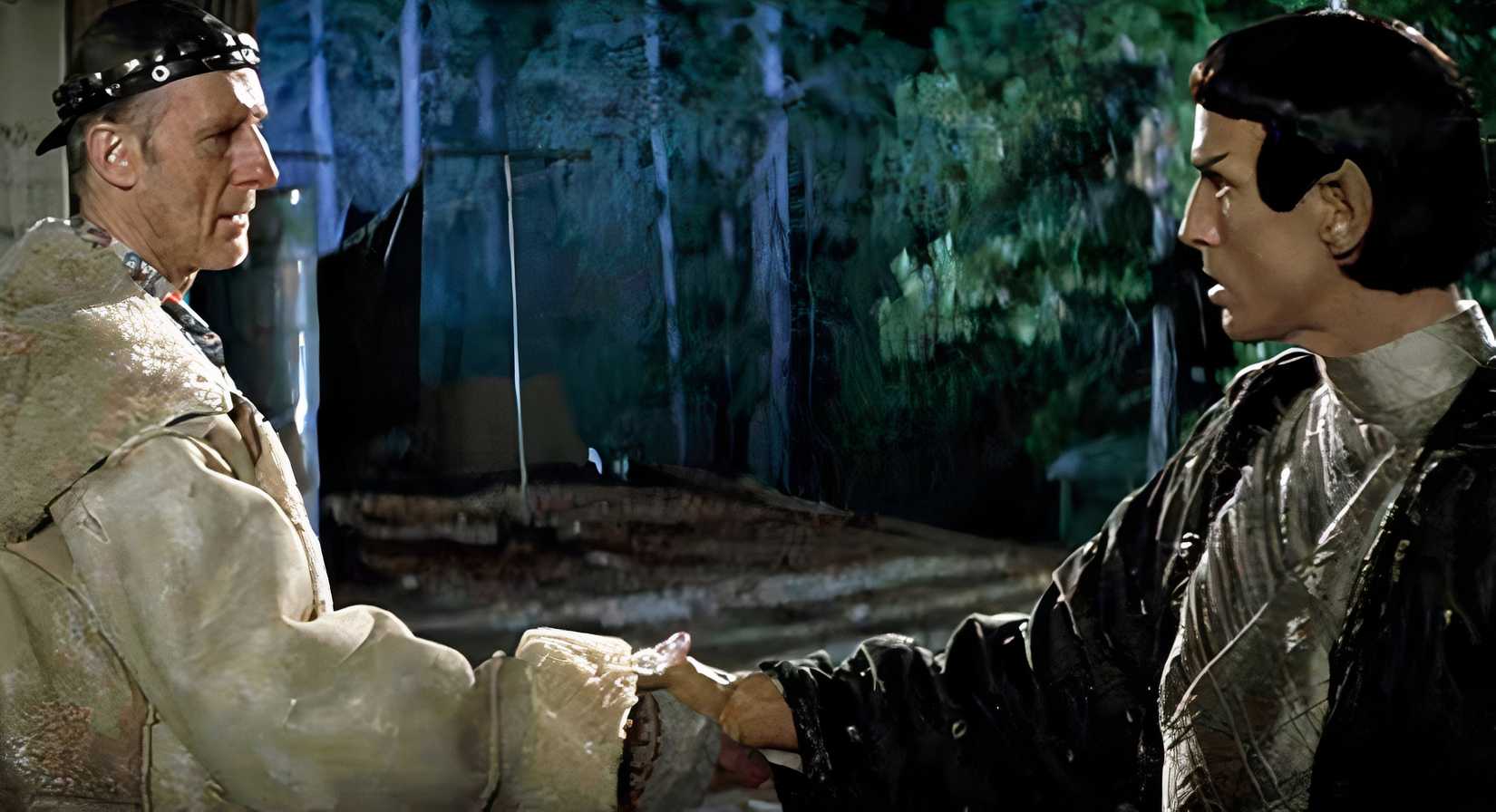 Image: Paramount Pictures
The famous Vulcan scene arrives at a different conclusion. In Trek’s version of history, learning we’re not alone ultimately expands us, it doesn’t destabilize. Contact becomes the beginning of a long process of growth. Humanity doesn’t abandon conflict or suddenly transcend its problems, but it does move toward a broader understanding of itself and its place in the universe. Star Trek’s answer is basically that eventually we get our act together. Although admittedly it takes a few centuries and several other movies and TV shows.
That contrast may be what stayed with me most after watching Disclosure Day. Both movies are wrestling with one of science fiction’s oldest ideas, but they arrive at slightly different conclusions. Neither treats alien life as an existential threat or frames first contact as an invasion. Instead, both ask what revelation does to the people receiving it.
Disclosure Day imagines disclosure as a reckoning, an event that questions assumptions and forces us to redefine our place in the universe. Star Trek: First Contact takes the longer view, where that same revelation eventually opens the door to something bigger. Together, they feel less like opposing visions than different stages of the same journey: first the shock of learning we’re not alone, then the difficult process of deciding who we become afterward.
Disclosure Day is in theaters now.





![ELDEN RING NIGHTREIGN: Deluxe Edition [FitGirl Repack]](https://i5.imageban.ru/out/2025/05/30/c2e3dcd3fc13fa43f3e4306eeea33a6f.jpg)

 English (US) ·