.png)
 5 months ago
124
5 months ago
124

Published Jan 28, 2026, 5:30 PM EST
Good direction will get you (almost) everything
 Image: AdHoc Studio via Polygon
Video games are not movies or television, and yet most studios with big budgets spend those budgets trying to blur the distinction between the mediums. They often fail. Dispatch, a small game from a small studio, succeeds where they don't. It's almost more of a TV series than a video game, and it sets a new standard for how games can effectively draw upon techniques from other types of storytelling. AdHoc Studio’s episodic workplace adventure comes to Nintendo Switch on Jan. 28, but it’s worth a look on any platform for folks who love a good story and are fascinated by the intersections between games and other narrative mediums.
Dispatch follows Robert Robertson III, a normal man in a world of heroes who pilots a giant mech suit his grandfather built. A villain murdered his father, then ruins his life even further. But the Superhero Dispatch Network (SDN) swoops in to save the day by offering him a temporary job, coordinating squads of heroes tasked with fighting crime and other noble deeds. The catch is that his team is the worst one, comprised entirely of former villains on their last second chance. The villain who ruins Robert's life, a genuine Bad Guy who isn't interested in redemption, is still causing trouble in the city, but he's only around for a little bit at the end.
 Image: AdHoc Studio via Polygon
This is not a profound tale of grief, or recovering from trauma, or finding hope. Those things are present in the story, which does have occasional moments of emotional insight. But AdHoc is more concerned about making you feel at home with Dispatch's cast than using them to deliver a particular message. It's almost impossible not to commiserate with Robert Robertson III on some level, a person who's lost everything and pursues a single goal in an almost suicidal manner, only for everything to go sideways almost immediately. Dispatch captures his personality to perfection, through his facial expressions and even the difference in how he carries himself while standing versus when he puts on his headset and starts work. It's tempting to write off Aaron Paul's performance here as one-note, since he initially delivers most of his lines in a near monotone, but he gradually adds layers of emotional complexity (thin layers, admittedly, but still). Warmth when speaking to a friend in need. Passion and conviction when he discovers something to believe in again.
There's a measure of tonal inconsistency with his personality and the rest of the cast once Robert gets settled in at the dispatch unit. On paper, they’re terrible villains getting a second chance. In practice, they’re just like everyone else’s shitty colleagues. Favoring workplace comedy over character-driven drama smooths out their rough edges and keeps Dispatch from doing much with its central theme of redemption (how can you redeem what's not really lost?). Yet the relationships between Robert and his team still feel vibrant and important, even if the game is mostly about them getting to know each other and little else.
It helps that every scene is expertly staged. Blocking, animation, length, line delivery, and, most importantly, pacing are consistently excellent. That gives each episode an air of prestige that makes up for Dispatch's weaker scenes — of which there are several, but more on that later. No moment lingers longer than it should, and every word spoken has a purpose, the latter of which is essential given how much Dispatch leans on comedy. It's often crass, but only in brief bursts, before stepping back over the line of propriety again. Corny jokes are supposed to make you feel embarrassed for the person who made them. Quips are biting and witty, but also reveal something about a character or point out a relationship problem, rather than just filling silence. While the supporting cast, which mostly includes influencers, is of a quality noticeably different from the professional actors, it turns out that's a good thing. There's a rough charm to them, and they behave and sound like normal(ish) people, not characters. That adds warmth and believability to what would otherwise be a standard "found family" story.
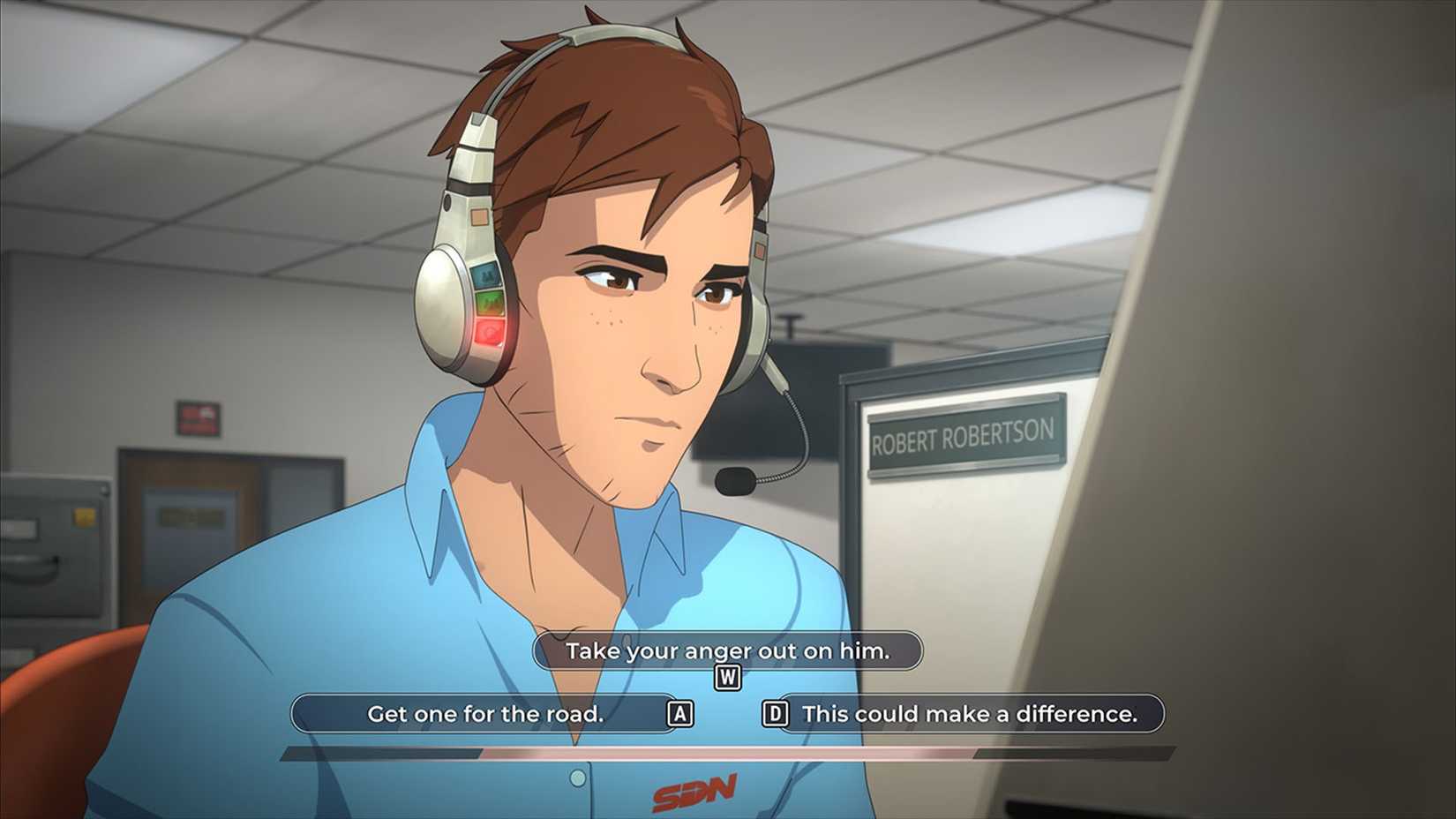 Image: AdHoc Studio via Polygon
Tight dialogue and sharp direction are Dispatch's biggest strengths and what earned it a spot on Polygon's best games of 2025 list. The story itself is fairly generic, but how that story is written and presented makes it one of the finest examples of craft in games. Scene building. Writing. Relationships between people and their environments. These, Dispatch proves, are where video games can, and should, borrow from film techniques. Not photorealism or dramatic action sequences or the empty fluff that doesn't matter.
Perhaps in a bid to avoid having it labeled and ignored as a visual novel, AdHoc added an interactive element to each chapter. You help Robert manage his dispatch shifts, deciding which calls to take on, when to do it, and who to send. Each member of the Z-Team has specific strengths and weaknesses that make them suited for particular mission types, and some more complicated calls require you to make multiple decisions on the fly. There's just enough complexity to make you feel smart for making it through a shift with no failures, and while they seem like busywork initially, AdHoc manages to deftly tie Robert’s daily grind into Dispatch's broader story in a way that makes them feel essential by the last two episodes, when the villain finally reappears and Dispatch remembers it's a superhero story.
There are a few odd difficulty spikes, like when AdHoc randomly adds instant failure parameters to certain missions without any warning. It's maddening for someone like me, who wants to clear each mission as close to perfectly as possible. Still, perhaps in keeping with the theme of second chances, perfection doesn't matter in Dispatch. Your performance in each mission has no effect (that I've discovered, anyway) on how the story plays out. Whether he's a shit manager or the most efficient dispatcher in history, things still end up okay.
 Image: AdHoc Studio via Polygon
It's the same with most of Dispatch's other choices as well. Most of the big decisions are wrapped up in Dispatch's two romance interests, Invisigal and Blonde Blazer, though not necessarily the romance itself. Choices and consequences get more complicated here, and decisions made over the course of several episodes shape those relationships. (It’s worth noting those outcomes can still be positive if you don't get emotionally involved with either of them — romance isn’t mandatory.) However, these relationships are also Dispatch's weakest points, and polished production values only go so far in making up for them. Blazer gets very little development in or out of a romantic relationship, which pushes you toward Invisigal, who takes up much more oxygen in every episode. (I can only assume Robert's status as a temporary staff member at the SDN explains Dispatch's flagrant disregard for workplace ethics and standard decency, making a subordinate and a supervisor his romance options.)
And just as Dispatch clearly nudges you toward one woman over another, there’s really only one canonical storyline here. Robert can lose faith in Invisigal and lead her toward a bad ending, but, thanks to an early incident where it's impossible to have a negative outcome with her, you're quietly encouraged to follow the game's theme of second chances and have faith in her, whether that leads to romance or not. If you force the issue by always choosing bad responses, Dispatch's logic starts to fall apart.
This behavior only makes sense for Robert if you exclusively pick asshole choices, and even that route is at odds with his personality in Dispatch's scripted sections. He becomes a terrible person who's actually still kind of okay and wants to help everyone — except when you make him cruel and unhelpful only because you want him to be. This kind of friction is inevitable for a choice-driven game where the protagonist has a personality distinct from your own, though with how carefully crafted the rest of Dispatch is, it's surprising to see this element handled so clumsily.
AdHoc's writers are well aware of these shortcomings, though that doesn't make them any less jarring to encounter. Other important choices, including how you handle the villain at the end, have weaker influence (often none at all) over how the story plays out. It's hard to get further away from what makes the Telltale games that inspired Dispatch work than that. Important choices are the main draw there.
But overall, it works for Dispatch's unique hybrid of video game and cinema. If I'm watching The Lord of the Rings again, I'm doing it to appreciate the storytelling, the acting, the set design and quality of direction, the little details I never noticed before — not with the expectation that the story might change. And if I'm replaying Dispatch, which I will, I'm doing that for the same reasons.


![ELDEN RING NIGHTREIGN: Deluxe Edition [FitGirl Repack]](https://i5.imageban.ru/out/2025/05/30/c2e3dcd3fc13fa43f3e4306eeea33a6f.jpg)
 English (US) ·