.png)
.png) 5 months ago
44
5 months ago
44


Published Feb 2, 2026, 10:00 AM EST
Murillo Zerbinatto is a contributor from Brazil. He's an RPG enthusiast (with a focus on JRPGs) who has been around the world of games and content creation for more than five years now. He has a particular love for Final Fantasy and has absorbed all the content this long-running series offers, including its obscure spinoffs such as Dimension I & II, Explorers, and My Life as a King. While playing RPGs is already a time-sinking endeavor, Murillo doubles down by being a platinum hunter as well.
Sign in to your DualShockers account
For a while now, Square Enix has been under scrutiny from a portion of its veteran fanbase. It's often said that the developer has lost its essence, that it only tries to please the West with its titles, and that it has never again captured lightning in a bottle quite like it did during the golden age of JRPGs.
I've noticed, however, that these boasts and complaints don't usually come from strictly Square fans, but rather from Final Fantasy enthusiasts. That franchise is a chameleonic one that innovates with every entry, often at the cost of potentially alienating its players.

Related
10 Best-Selling Square Enix Games Of All Time
Spoiler alert: there’s a lot of Final Fantasy here.
On the other side of the brand, we have Dragon Quest, the hallmark series of Enix. This property has followed the same design blueprint almost religiously, which continues to captivate its fans in Japan while slowly winning over players worldwide, as evidenced by the staggering sales success of Dragon Quest XI.
Another way Square has been attempting to introduce Dragon Quest to a fresh player base is through its remakes. The Erdrick trilogy, comprising the first three games, received the HD-2D treatment. Meanwhile, Dragon Quest VII, originally released for the PS1 and later remade for the Nintendo 3DS, was once again rebuilt from the ground up for modern consoles.
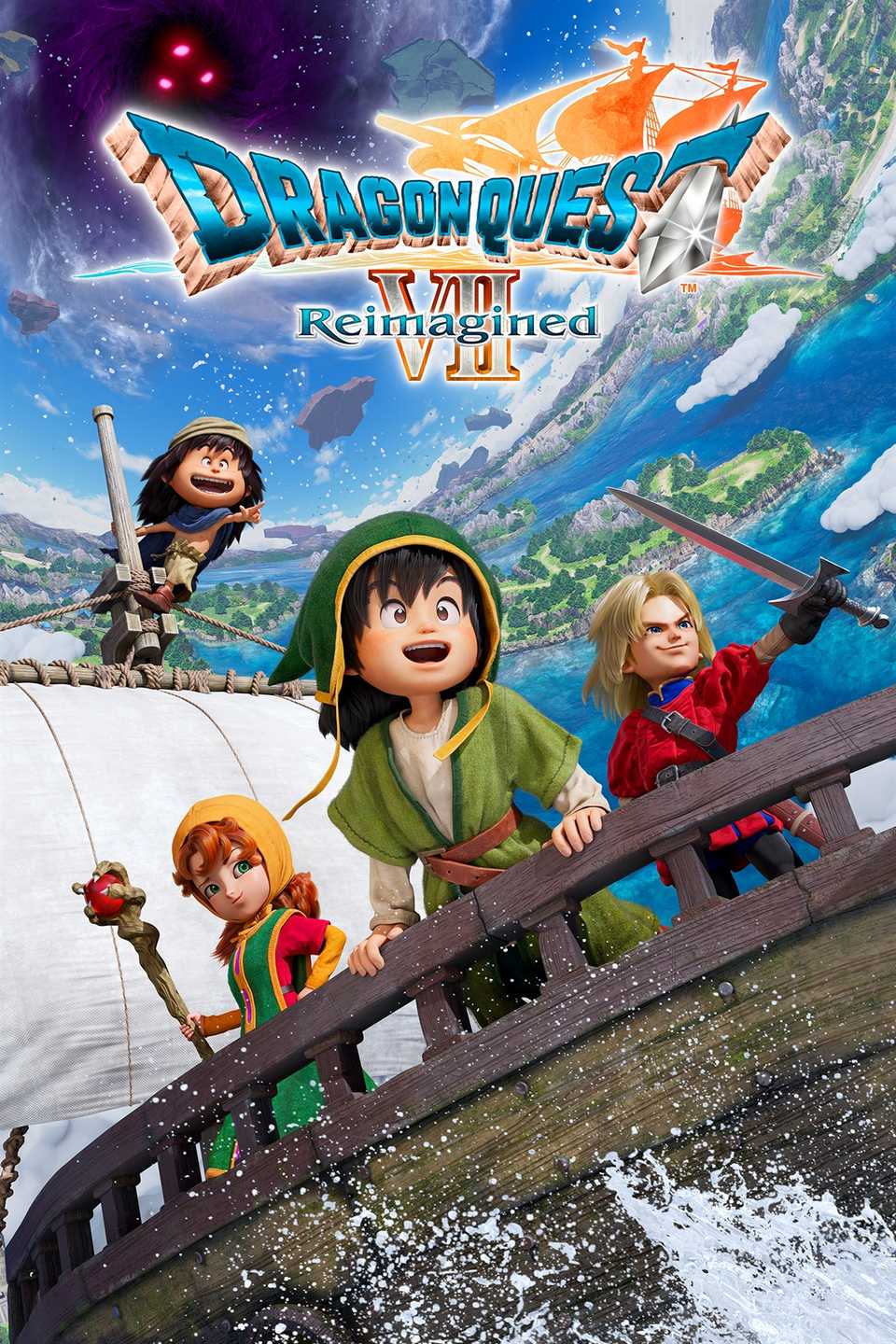
Titled Dragon Quest VII Reimagined, this new entry was conceived as a fresh gateway into the franchise. It showcases the iconic, decades-old design of the JRPG's pioneer while introducing new features and quality-of-life improvements for a contemporary audience. The goal was to satisfy both those who played the original and those who had never even encountered a Slime in battle.
I had played the classic version before, but never finished it. I put in about 25 hours, unlocked the Vocations system, adventured a bit more, and then burnt out. The pacing of the remake is undoubtedly much better than the original, yet it still drags on too long for those unaccustomed to the slow-burn nature of JRPGs.
After almost ninety hours with the game and a pristine platinum trophy, I feel ready to share my review of Dragon Quest VII Reimagined.
The Story of the Past
If you lived on an island with only one castle and one village, where everyone knew each other and your only future prospect was limited to a handful of activities, what would you do? You'd probably try to sail away in search of other lands. The problem is, people have tried that, and apparently, yours is the only island in existence.
That is the premise of Dragon Quest VII Reimagined: a world populated by just a single isle. Fortunately, the young silent protagonist (son of the village's greatest fisherman in Pilchard Bay) and Kiefer (crown prince of the Estard Kingdom) are dissatisfied with this reality. They want to venture out in search of new regions. And I can't fault them, because I'd be in the same boat.
It's during this escapade between the two — unwillingly accompanied by Maribel — that they stumble upon a Shrine. After collecting some fragments and placing them on an altar, the trio is transported to another island. From then on, the journey truly gets underway. The twist is that, after resolving the conflict in that region and returning to the present, they hear reports of a new island emerging near their home. It doesn't take much to put two and two together and realize that saving the past is the secret to safeguarding the present.
Following this, we need to collect more fragments, place them on another altar, and travel to another region of the past. The narrative structure reveals itself as a collection of short stories rather than a single overarching tale. Each region has its own problems, culture, and local flavor, reflected even in the dialogue. By solving a crisis, the island appears in the present, often mirroring what was experienced in the past.

This episodic structure is both a strength and a weakness of Dragon Quest VII Reimagined's storytelling. On the one hand, this format allows the NPCs' reactivity to flourish. Every story beat that advances changes all their interactions and dialogues, as even simple villagers react actively to events. The fact that we are generally confined to one village, dungeon, and subplot allows this evolution to feel more organic and intimate, enriching the world-building.
On the other hand, it's difficult to see how these short stories connect to a central plot or what the point of our hero's adventure is. I won't mention if a connection eventually appears because I want to preserve your experience, but know that for twenty, maybe thirty hours, you'll be traveling from region to region helping residents without having a clue of what awaits you or what your role is beyond being a video game adventurer.
Which, to be fair, wasn't a problem for me. Honestly, except for a few setpieces, I've never considered Dragon Quest stories to be their strongest suit. The focus is always on the journey, not the destination, and here in Dragon Quest VII Reimagined, that becomes even more evident. The plot of more than a few regions takes an unexpectedly dark turn, but the majority are highly predictable in both execution and outcome.
The narrative structure reveals itself as a collection of short stories rather than a single overarching tale.
Still, I was interested and engaged on every new island. Collecting new fragments, placing them on the altar, and teleporting to a forgotten past was always a pleasant and intriguing adventure. Never knowing what awaited me or how it would be solved was an unorthodox storytelling method that, inadvertently, showed me a new side of the genre even after playing so many JRPGs.
Meanwhile, players who prefer that every character arc, subplot, and a bit of foreshadowing connect to a central plot might not have the patience to endure the many hours of vignettes that Reimagined offers. They might end up throwing in the towel before seeing how their temporal adventures pay off in the long run.

Related
Party Chat is Back, Somewhat
The only consistency across the scattered islands and all the time-traveling is our group, which experiences all these moments together. And sorry to start this one on a negative note, but my biggest personal bone to pick with JRPGs nowadays is silent protagonists. Even Yuji Horii has accepted that this archetype isn't ideal for modern games, and I have to agree.
In pixel visuals, it's more acceptable, but in 3D, with facial expressions, top-tier voice acting, and impactful set pieces, having a main character with the same blank stare at all times, who at most only nods during the most emotional scenes, is a detriment to the narrative.
One way the game gets around the hero's lack of a voice is through Party Chat. This feature was added with the original release of Dragon Quest VII. While I couldn't find the official source, it's said that Maribel was added to the game specifically to utilize this chat the most. In the original, you could access the menu and talk to your party members, who would discuss anything that had just happened. And I really mean anything, from entering a random house to facing a specific enemy with a buff or debuff, and even petting a dog.
Party Chat was conceived as a means to enrich the characters and deepen their personalities without bloating the main story or hindering the pacing. The original game assumed you would interact with this system, though. When I first played Dragon Quest VIII, I rarely used the chat because I was unfamiliar with it. For a long time, I felt like my characters had no personality, when in reality their depth lay hidden behind the feature.

Dragon Quest VII Reimagined has toned down Party Chat significantly, but it's still there. After my first battle, Kiefer had a distinct dialogue. Two seconds later, I picked up a fragment, and his chat changed again, showing the system remains somewhat intricate. These banters occurred, however, because I sought them.
Sometimes, the interface will prompt a Party Chat. If you press the corresponding button, a party member will give you a hint about the next objective. If you exhaust the dialogue, they will repeat that hint. Occasionally, I would come across an interesting event, and the group had nothing to say, but other times, I would do something unremarkable, hit the hotkey, and there it was: a distinct conversation. This essentially forced my hand, making me spam the Party Chat button almost constantly, which ironically hindered my pacing rather than helping it.
If Dragon Quest VII Reimagined showed a cue whenever a new chat was available, like the skits in the Tales of series, it would be much more pleasing. As it stands, it feels counterintuitive. After forty hours, I stopped pressing the button because I was simply worn out. And don't get me wrong, I'm the sort of literary player who reads every bestiary and item description seeking tiny, teensy world-building elements that tie into the grand scheme. But I draw the line when all I get is repeated texts.
Related
The Best JRPGs On Every Nintendo Console, Ranked
The rise, the fall, and the resurgence of JRPGs in Nintendo history.
Fortunately, the remake added many new dialogues directly into the main story, fleshing out characters without leaning so heavily on Party Chat. Still, it's only a small portion compared to what you get when you explore the feature to the end. Many of Maribel's acerbic and sometimes petulant remarks are reserved for Party Chat. If you forget it or don't want to spam her at every turn, you'll miss out on her eccentric personality.
Every other party member is colorful and unique, and they give body to the whole we-must-save-the-world narrative. I wonder how many players will miss their quirks and personalities because they will overlook the Party Chat. It's an odd script device, for sure. Maybe I would feel detached from the characters if I hadn't engaged with the mechanic. But since I was constantly chatting away, my adventure with them was more enjoyable. If I may give you a tip, do try to engage with the Party Chat now and then to enhance your storytelling experience, even at the cost of pacing hiccups now and then.
The Most Classic of Turn-Based
Dragon Quest VII Reimagined maintains the turn-based system, but instead of being a round-style battle, it's now individual character turns. This means each member acts the moment you choose their command.
The rhythm of battle is satisfyingly snappy. I couldn't play the HD-2D remakes at normal speed. Here, even the default speed felt fluid enough. In addition to fast-forward, the title brings several modern conveniences, such as enemies appearing on the field, Zoom (fast travel) from the word go, and, for the first time ever in the franchise, a shared inventory.
Other improvements include markers on the minimap showing chests and the location of the next main goal. There are also no more party members being dragged in coffins. If you win a battle with a member knocked out, they return with 1 HP. Finally, we have modular difficulty levels, allowing you to change experience and gold gains, as well as the strength of both your party and the enemies. These modifiers were essential while I was grinding to take down the game's superboss.
Dragon Quest VII Reimagined features a Vocation system, the series' version of classes. Now, even the initial ones have ranks, and with each new one, we learn a skill. The remake also added a feature called vocational perks. Sometimes, our characters get worked up, and when they let loose, a special move related to their Vocation becomes available. The protagonist's fisher vocation, for example, makes the entire party invulnerable to a single enemy attack. Each Vocation has its own unique perk that can turn the tide in a single action.

The progression and gameplay are as basic as they come, but still pleasurable because the game delivers exactly what a Dragon Quest fan expects. Since enemies appear on the map, there's no longer a soft bump when a fight breaks out, and you can even start with an advantage if you whack them on the field. Plus, if your level is much higher than the enemies', they die without even entering a battle screen, which keeps the momentum going.
Overall, all the additions were welcome. I played the whole game on the default difficulty, and among all the Dragon Quest titles I've played, Reimagined was the easiest. I only saw a Game Over screen when facing the superboss. I won almost every fodder battle on auto-battle, and I suspect I could have done the same for some bosses. I think I understand why the remake was made so accessible, though.
Dragon Quest VII Reimagined can still be a slog. The producers repeatedly mentioned that the experience was streamlined, but it still takes a while to get into gear. My first battle happened an hour in, and unlocking new Vocations took 15 hours. For context, I had mastered the initial ones in six hours, meaning I spent nearly ten hours using the same skills before I could enjoy new ones.
On the bright side, once I unlocked more Vocations, the gameplay exponentially improved. I would change them all the time, mixing and matching two of them with the Moonlight system to draw the best of every single specialty. Mastering initial Vocations also unlocked intermediary and advanced ones, which motivated me to keep battling and leveling up. Yet, it still took way too long to unlock them.
The remake removed Monster Vocations. Now, Monster Hearts are accessories earned from defeating Vicious Monsters, a powered-up version of regular ones.

Related
8 JRPG Remakes That Improved Everything From The Original Games
The classics are still classics, but if it's your first time with these games, go for the remakes.
Exploring Every New Island
It's possible I took longer because I was exploring every possible corner of each new area. Dragon Quest VII Reimagined gloriously rewards players who wander off the beaten path. If you stick strictly to the progression of fighting enemies, earning gold and trying to buy new equipment in the next village, you'll soon find yourself short on cash or relying on the same old farming process.
But if you explore every dungeon, break every barrel and urn, and collect all Mini Medals, you'll always be rewarded. You won't need to rely on grinding as much, especially since exploration naturally leads to more combat, which grants you more experience and gold in the long run.
Once I unlocked more Vocations, the gameplay improved exponentially.
A quality-of-life feature the remake added -- which I absolutely adored -- is an interface showing whether or not an area has a collectible. There are two of these: Mini Medals and fragments. If you open the database for these two, the game reveals if any of the regions you've visited still have secrets.
Another way they streamlined the game was by making some past regions optional. You can visit them by finding extra fragments, but they aren't mandatory to reach the ending. These optional areas offer extra equipment and items that naturally make you tougher and better prepared to tackle the next challenge. Emphasis, however, is on optional, because if it's already hard to see the connection between the mandatory areas and the central plot, you won't find any in these side stories.
What I enjoyed most was seeing how my influence in past timelines shaped the islands in the present. There's an optional region where I kept going back and forth, and each new story beat changed the island in the present day in a rather convincing way. The NPC dialogue also develops in a rather amusing manner. Many keep their traditions intact as seen in the old days, while others are distorted by the passage of time, completely altering the village's backstory.
New Graphics, Same Soundtrack
One of the most distinct changes between Dragon Quest VII Reimagined and the HD-2D is the visual presentation. The remake features an art style that attempts to simulate Akira Toriyama's timeless designs in a miniaturized 3D version.
To put it simply: I loved it. The characters have a more youthful appearance that fits perfectly with the theme of boundless adventure. The only uncanny valley moment for me is Kiefer's appearance, because his face looks like it's permanently under a Giga Chad filter.
The biggest glow-up for me is the environment. What I like most about a remake is seeing how small, pixelated worlds grow and expand in 3D, highlighting their magnitude. We still have a beautiful, nostalgic overworld, and every village, dungeon, and castle looks incredible and well-polished.
My major gripe is that some NPC models are recycled to the point of exhaustion. It wouldn't be a problem if it were just filler NPCs, but the same model for an old man or a mayor is reused for unique, named characters. Few have a truly distinct design, usually reserved for those with prominent roles.
The remake features an art style that attempts to simulate Akira Toriyama's timeless designs in a miniaturized 3D version. To put it simply: I loved it.
In battle, the visuals also shine, especially the animations. It's the most beautiful Kaffrizzle or Gigalash look I've ever seen. This art style also allows the game to run smoothly. There were no graphics or performance options, which I assume indicates the game runs at a high frame rate and resolution at all times. Overall, it's a visually stellar remake.
Now, I know my next observation might be controversial, but after playing four Dragon Quest games in the last year and a half, I must say I've grown a bit tired of the soundtrack. I understand and admire how iconic most tracks are, and I agree that the main theme should be Japan's national anthem, but the leitmotifs become easy to identify after listening to Koichi Sugiyama on loop.
For the first few hours, the tracks are pleasant, but as the game progresses, you notice that the music for caves, forests, sadness, or excitement is always the same. They become stale after fifty-sixty hours of gameplay, especially the battle theme, which never changes. I recognize this is a personal take and may reflect my fatigue rather than the game's own merits, so don't take it too much to heart, especially if you love the series' music and don't mind listening to it on repeat.
Related
10 JRPGs That Take Forever To Complete
I really want to emphasize the “forever” in the title.
Streamlined, But Still Dragged On
Ultimately, my experience with Dragon Quest VII Reimagined was very enjoyable. As someone already accustomed to JRPGs and Dragon Quest, my expectations aligned with what the remake offered. Yet, it's hard to justify or even suggest this game as a gateway for new fans, as Square intends. Dragon Quest XI, for instance, is also a long adventure, but from the beginning, we know why we're on the journey, and the conflict engages us from the get-go.
Despite being streamlined, Dragon Quest VII Reimagined still takes a while to hit its stride, both in terms of story and gameplay. The Vocations, which are the lifeblood of the battle system, only unlock fifteen hours in. This made my early dungeon runs feel like little more than chores where I'd strike an enemy and let auto-battle handle the rest.
After a while, however, the game began to unfold. My customization options grew richer, my characters developed their own specialties, and the story started to feel personal and pull me in. From then on, I just steamrolled to the end, with a smile on my face for every past saved and present restored. JRPGs already require a bit of tolerance from the player, but even within the genre, Dragon Quest VII Reimagined asks for a tad more. Thankfully, the payoff is amazing.

Dragon Quest VII Reimagined introduces new systems and quality-of-life improvements that streamline the original experience and make it more palatable for modern audiences. The game still takes its sweet time to show its cards, though. JRPGs are a genre that demands patience and Dragon Quest VII Reimagined asks for a tad more. Still, if you can embrace the episodic storytelling format and make the most of the Party Chat and Vocation system, you'll find that your journey through time was well worth it.
Released February 5, 2026
ESRB Everyone 10+ / Comic Mischief, Fantasy Violence, Mild Blood, Mild Language, Mild Suggestive Themes, Use of Alcohol
Publisher(s) Square Enix
Pros & Cons
- Better pacing than the original, but...
- Fulfilling and rewarding sense of adventure
- Vocation system is great and fun
- Unique and gorgeous art style
- Welcoming new quality of life additions
- ...it still takes too long to get into gear
- Party Chat could be better implemented
- Silent protagonist undermines the narrative

Next
10 Best Dragon Quest Monster Designs, Ranked
What would Dragon Quest be without monsters like Slimes and Golems?




![ELDEN RING NIGHTREIGN: Deluxe Edition [FitGirl Repack]](https://i5.imageban.ru/out/2025/05/30/c2e3dcd3fc13fa43f3e4306eeea33a6f.jpg)
 English (US) ·