.png)
 2 months ago
23
2 months ago
23

Published May 25, 2026, 3:30 PM EDT
'I always considered the two books as one story,' said author Peter F. Hamilton
 Image: Archetype Entertainment/Wizards of the Coast
Sign in to your Polygon.com account
Exodus, the forthcoming space RPG that some (hello) have described as the second coming of Mass Effect, is already so much more than a video game. Although Exodus, developed by Archetype Entertainment, won't be out until 2027, its wider canon already encompasses a Prime Video Secret Level episode, a tabletop RPG, and a novel duology from a bona fide sci-fi legend. The second novel, Exodus: The Helium Sea, is out this summer, and Polygon is able to share an exclusive excerpt of it today.
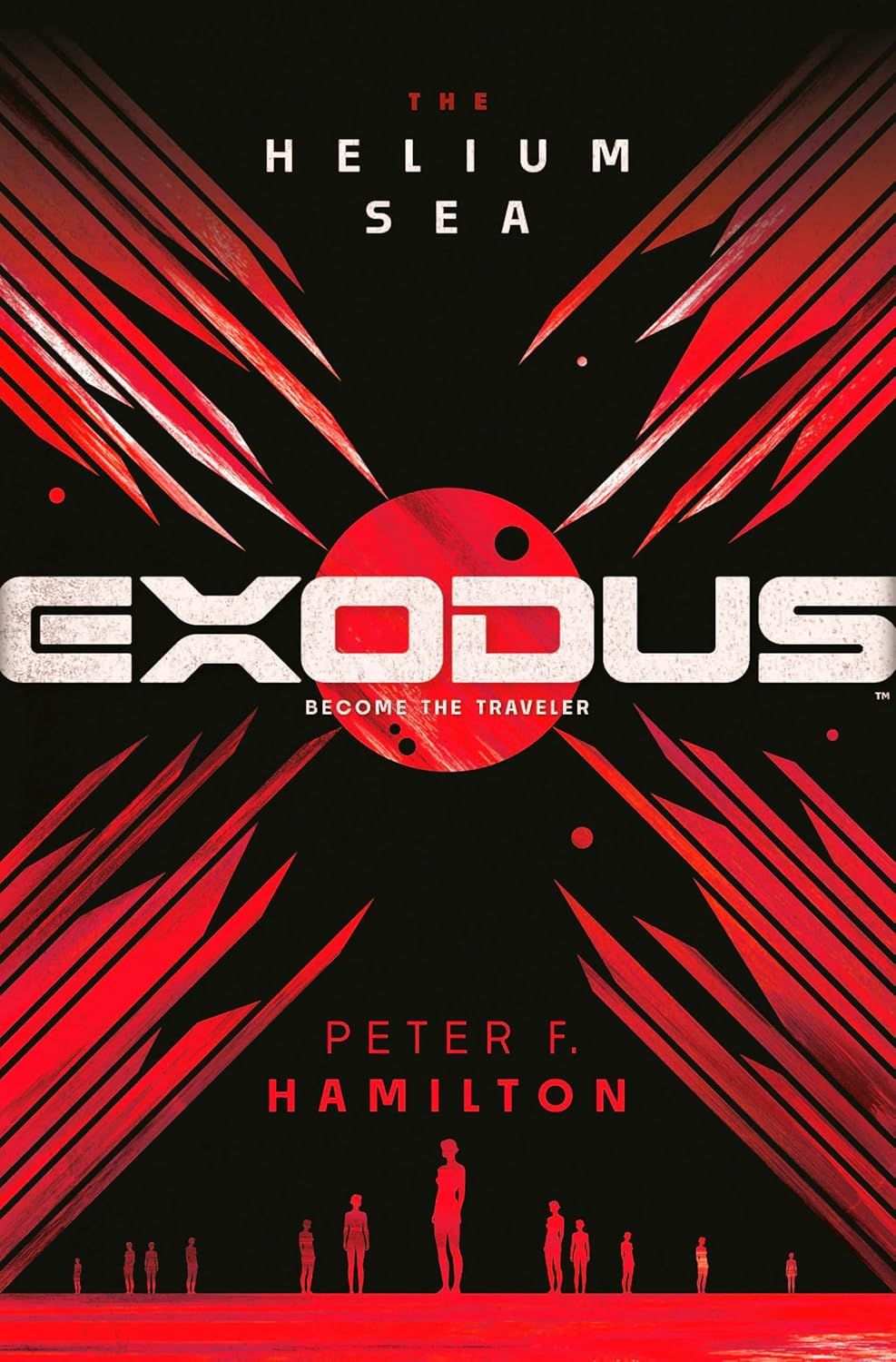
Written by Peter F. Hamilton, Exodus: The Helium sea is set immediately after Exodus: The Archimedes Engine, his nearly 1,000-page 2023 novel that was also set in the Exodus universe. As with most of Hamilton's oeuvre, The Archimedes Engine is a dizzyingly complex yarn told from multiple perspectives across various periods of time. That's fitting for the setting of Exodus, which takes 40,000 years in the future and covers heady sci-fi concepts like time dilation, interstellar travel, and post-human evolution.
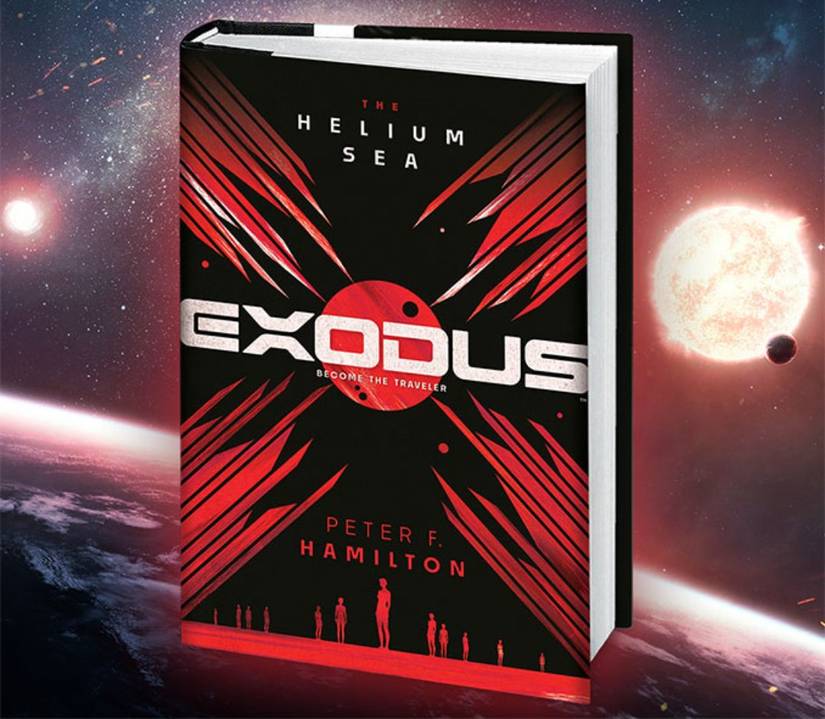 Image: Random House Worlds/Penguin Random House
"The Helium Sea drops the reader back into the story exactly where The Archimedes Engine left off. I always considered the two books as one story, rather than a traditional book one and book two you often get in a series, although I did manage to write a decent cliffhanger ending for book one," Hamilton told Polygon in an emailed statement.
In Exodus, humanity decamps from Earth to the exoplanet-rich Centauri Cluster. Different arkships arrive at different times; the journey from Earth might've last several hundred years for some humans, but 40,000 years have gone by in the Centauri Cluster, during which the humans there fiddled with genetic modification to evolve into a post-human race known as Celestials.
The Archimedes Engine followed a group of regular non-Celestial humans who use ancient technology to steal a gas giant from the Crown Dominion — a powerful group of Celestials who have achieved effective immortality through some seriously messed-up cloning and breeding tactics — upending a pillar of their economy. While dealing with this human rebellion, the Crown Dominion itself is riven by civil war. The book ends with various fronts of this multi-pronged conflict coming to a head.
 Related
Exodus is for the true sci-fi sickos
The new RPG from ex-BioWare folks is way nerdier than trailers have implied
"I was fortunate that Archetype Entertainment brought me on board right at the start of the whole Exodus project, first helping to flesh out the universe where the game is set, then going on to write the two books as an introduction to that universe," Hamilton said. "The whole experience has been an exciting time. I've never really done collaborations before, so expanding the outlines they sent me was great fun. The scope of this universe is so wide I could really go full throttle on the imagination and extrapolation front."
The following excerpt, "The Destruction of Kelowan," showcases the Crown Dominion's technological advancements in the specialized field of cracking planets open like eggs. Read it below ahead of Exodus: The Helium Sea's full release on June 18.
Excerpt from
I. The Destruction of Kelowan
ONE HOUR BEFORE the planets were due to collide, Thyra and a small entourage went to the Dracaenae’s observation chamber—a simple cylinder with a solid floor and curving transparent walls of ultrabonded diamond that now protruded out of the flagship’s fuselage. Admiral Serrilda-Kroja had disapproved on safety grounds, but she’d been swiftly overruled. “I intend to witness, in full, this atrocity committed against the Crown Dominion,” Thyra told her sharply. “It is a memory which must not be allowed to fade.”
Thyra walked down the chamber’s central spiral stair, followed by her princesses and congregants. As soon as the girls reached the deck, they ran to the window and pressed themselves against it. Clavissa hurried after them and stopped the younger girls’ squabbling about who had the best view.
The dreadnought had aligned its axis to point directly at Kelowan, showing them the condemned world traversing a slow circle across space as the huge ship rotated. On one side, far above the terminator line, a loose crescent of furious antimatter exhausts were pushing a collection of habitats clear. They were already more than a million kilometers out, and edging further away at a rate so painfully slow Thyra almost winced. While on the other side of Kelowan, barely twice the radius of the georing away, Boksrock was inbound—a deceptively bland rusty-gray disk, hastening to the end of its existence.
Thyra thought it magnificent. Power of this magnitude ought to be worshiped, not feared and hated. It took all her self-control not to smile in welcome. The others in the observation chamber would never understand. This wasn’t destruction, it was an act of creation, allowing a fresh future to be birthed from the ashes.
“The georing’s moving, look!” an excited princess, Ayoa, called.
Thyra followed the curve of the slender aureate ring, seeing a small but definite distortion bulge rising. She watched the prominence grow as the megastructure was distorted by the gravitational pull of the approaching planet, trying to guess when it would finally snap.
The wretched thing had certainly proved stubborn enough when they’d tried to cut the habitats free. It’d been the first decision Thyra had faced as empress: How many to liberate? There were eight hundred seventy habitats attached to the georing—some of them toruses, while the majority were cylinders, with the largest a hundred twenty kilometers long. Navy engineers advised abandoning all the torus habitats, pointing out that if they started freeflying, their precession would be difficult to maintain, sending them wobbling out of control. The cylinders weren’t much better from a stability point of view, and they definitely didn’t want the larger ones cut free. The three fleets rushing to Kelowan to help evacuate the population were a symbol of overwhelming military potency, but they had nowhere near the drive capacity to push the biggest habitats clear in time. So Thyra announced that only habitats fifty kilometers long or less would be separated from the georing.
Exodus: The Helium SeaGiven their internal volume, sixty-two of them would be sufficient to carry the majority of Kelowan’s billion-strong population (those who couldn’t get a berth on a ship) without their internal ecology collapsing. But that would turn them into lifeboats, not new homes. For eleven days, the industrial stations of the georing had fabricated ultrabonded cradles that were attached in concentric circles to the end of the fortunate sixty-two. Then the warships would secure themselves into the cradles and fire their antimatter engines at full capacity, beginning the agonizingly slow push to the sanctuary of safe distance.
Exodus: The Helium SeaNot that any astrophysicist would provide a firm definition of safe distance.
“We simply don’t know enough to predict the final collision vectors, Majesty,” her court datamaster, Stethos-Thierry, admitted miserably. “At the moment, Boksrock’s trajectory means it will directly impact across a fifth of Kelowan. But what happens after will be chaos at its peak. After the collision, a good percentage of both planets will shatter, and that much mass will inevitably reconjugate into a large planetoid. Whether it will result in a moon, many moons, or a debris cascade that flings a million fragments out across the solar system, nobody knows.”
All four royal dreadnoughts were coasting just more than a million and a half kilometers from Kelowan, maintaining position an unthreatening ten thousand kilometers from one another. The Vengadora, Carolien’s dreadnought, was now under the command of her admiral of the fleet—a position that would soon be taken over by Wynid personnel. The Gegnerin, Inessa-Marwa’s ship, was holding just above the ecliptic. Her fleet had decelerated into Kelowan orbit only forty-one hours ago, just in time to help evacuate the last desperate Imperial Celestials from the seven tower anchor asteroids. While Luus-Marcela’s ship, the Schlachten, was closest to the Dracaenae, which Thyra assumed was a show of solidarity with the new empress.
Exodus: The Helium SeaWith twenty minutes to go, Thyra connected to the Dracaenae’s network through a discreet bulb on her lace brocade glove. It provided an ultra-secure, real-time merger with the other two queens that no one else could access. They materialized within her perception, more real than any hologram, apparently standing next to her—Luus-Marcela in her profligate bloodstone carapace that now had so many antler protrusions it was impossible to wear any real clothes over it. Instead her wardrobe mistress seemed to have draped ribbons across her. By contrast, Inessa had only been in her new host body, Marwa, for a couple of months before leading her fleet to Kelowan. With her beguilingly youthful features, simple sky-blue robe, and not even the smallest bloodstone incursions, it would have been an easy assumption that Marwa was still a princess.
“This still seems like a dream,” Inessa-Marwa exclaimed. “Not even our worst-case scenarios envisaged this.”
“Anyone worked out who it is yet?” Luus-Marcela demanded curtly.
“Only the people on the Diligent know,” Thyra said. “And they’re long gone through the Gate of Heaven on their way to Capo Frois.”
All three queens fell silent as the georing finally snapped. The slender strand burst apart, its splintered ends twisting as aimlessly as dying serpents. Undulations that were thousands of kilometers long began to traverse the slender line. More sections broke free. Three of the orbital towers fractured. The clashing gravity fields of two planets soon began to break up the rest of the structure. But even that massive act of destruction was lost as Kelowan’s atmosphere began to degenerate into roiling storms that quickly expanded and merged, shrouding continents and oceans alike below violent macro-hurricanes. Like the georing before it, the upper atmosphere began to bulge upward, resembling some gigantic living pseudopod reaching to greet Boksrock.
Thyra actually braced herself as the two planets finally hit, the point of impact initially obscured by clouds. Garish crimson light penetrated the anarchic white blanket, but even that provided no clue as to what was happening to Kelowan’s surface. On Boksrock, however, massive fissures ripped open, spreading at incredible speed around the curve of the airless globe. Seas of regolith poured down into the black gulfs as mountains shattered and craters erupted.
Exodus: The Helium SeaSeveral of her congregant daughters started to whimper in spellbound shock, taking a step back from the observation chamber’s wall. They glanced at Thyra, seeking reassurance, only to find zero comfort in her features.
As soon as the worlds touched, the speed of the process seemed to increase. Kelowan’s oceans were vaporizing fast as continent-sized torrents of magma surged up through the broken crust. The atmosphere expanded up from the surface in a blast wave, streaking out to embrace the disintegrating mares of Boksrock. Weird pocks began to erupt from the outer layer—smog mountains born and dying in seconds above the collision zone far below. Their ejecta—huge globs of magma—glowed a dazzling pink as they arched out across thousands of kilometers, some even reaching escape velocity.
“Okay, it’s officially knocked Kelowan out of alignment from the orbital band,” Luus-Marcela said. “My science teams say it’s now elliptical at a three-degree inclination.”
“Mine agree,” Thyra said, examining the data coming through from the Dracaenae’s network.
“We can decide a strategy for Kelowan later,” Thyra told the other two. “The habitats are our immediate priority.” She glanced back out at the catastrophe. Kelowan’s larger mass seemed to have halted Boksrock, although the two bodies were still distorting, obese wrestlers locked in each other’s embrace. Kelowan’s vapor-saturated atmosphere was now writhing up over the lower portion of Boksrock, where the power of the strike shock had transformed to thermal energy, creating a radiant vermillion halo of fragmenting rock.
“Do you think it’s going to stay like that?” Luus-Marcela asked with mild interest. “Sort of not-quite merged?”
“Who cares?” Thyra retorted in annoyance.
“Once the initial shock waves ride through the two cores, they’ll rebound and trigger a mass adjustment,” Inessa-Marwa said brightly. “That’s what my planetologists are telling me, anyway.”
Thyra was tempted to give Admiral Serrilda-Kroja the order to open fire on Inessa’s dreadnought. The only thing stopping her was that even the Dracaenae’s weapons couldn’t blast the other dreadnought out of existence with an opening salvo from the relativistic cannon. The two would have to exchange blows, like a couple of drunk humans, for an hour before one emerged victorious. No guarantee it would be the Dracaenae, either. Stick with the plan, she told herself sternly.
“Ladies!” she snapped. “We need to focus on getting the refugees out of the habitats and down to the remaining planets.”
A red light was now shining into the observation chamber, strengthening like a dawn. Thyra could see Kelowan had clearly been cracked open all the way down to the mantle. Out of the heart of the collision zone, an immense tide of magma was rising through the miasma of vaporized water and atmosphere. Forced outward by the incredible shock waves, it continued to rise, its head crowning thousands of kilometers above the cataclysm producing it. The sight was, she thought, devastatingly beautiful.
1 / 43




![ELDEN RING NIGHTREIGN: Deluxe Edition [FitGirl Repack]](https://i5.imageban.ru/out/2025/05/30/c2e3dcd3fc13fa43f3e4306eeea33a6f.jpg)
 English (US) ·