.png)
 7 months ago
76
7 months ago
76

Critical thinking is a dying art
 Image: Lucasfilm Ltd
“The distance between what is said and what is known to be true has become an abyss. Of all the things at risk, the loss of an objective reality is perhaps the most dangerous.” —Mon Mothma in Andor season 2
From Andor’s award-winning speech against misinformation and genocide to Elphaba fighting back against the Wizard of Oz’s tyrannical regime in Wicked: For Good and Edgar Wright exploring televised slaughter as entertainment in The Running Man, 2025 has been a year for TV shows and movies exploring resistance and revolution. But it wasn’t just a year of characters fighting back against oppressive regimes — it was also a year where creators explored how easy it is to be lulled into the warm, deceptive arms of those regimes’ manipulative propaganda.
One of the most horrifying things about propaganda is how wide a net it casts. Whether you’re buying a new product or fostering a new belief, someone is consciously trying to influence your decisions for their benefit — and it’s often impossible to track the ways those influences creep into our decision-making. A number of 2025 movies and shows tried to convey this idea from new perspectives, in exaggerated fictional versions of the world we live in.
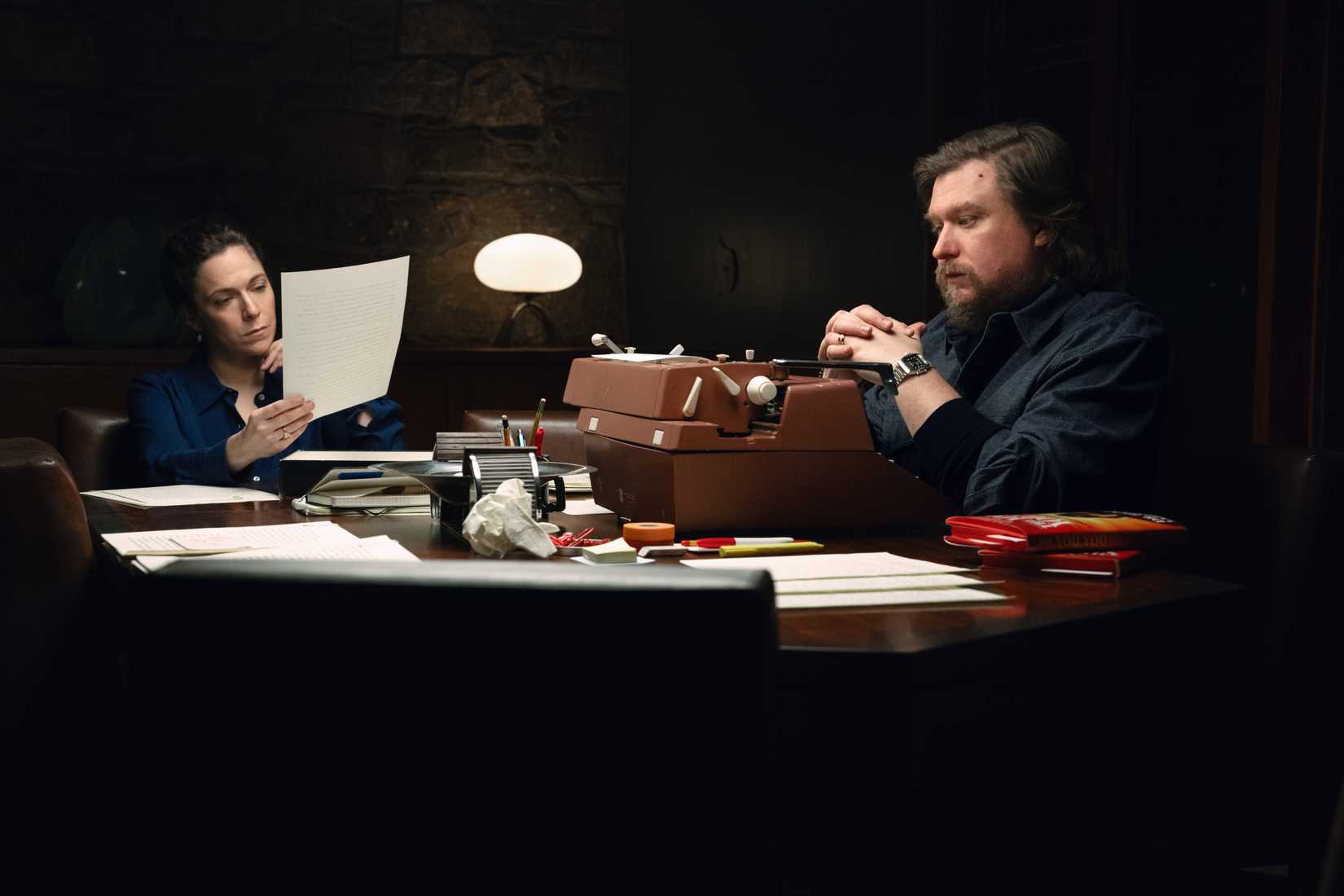 Photo: Jon Pack/Apple TV
That’s ironic, in a way, because art is one of the most powerful propaganda tools, capable of taking many forms and being used for many purposes.
Dan Erickson’s Severance follows a group of Lumon Industries office workers who have undergone a procedure that splits people’s memories between their personal and work lives. The show takes art propaganda to an impressive level: Lumon’s offices are characterized by their characterlessness, with their stark white corridor walls and sleek black doors. But between those corridors are hand-drawn and painted portraits and landscapes, often depicting Lumon founder Kier Eagan as a god-like entity.
In these paintings, Kier is an inspirational figure, used to keep Lumon’s workers devoted to their work and loyal to Lumon as a whole. But in 2025, season 2 established that Lumon’s art can also be a bludgeoning weapon to breed distrust between departments, as seen with the contrasting paintings The Grim Barbarity of Optics and Design and The Macrodata Refinement Calamity. Both paintings depict wanton slaughter, but who kills whom changes depending on the department. The paintings create tension between the Optics and Design and Macrodata Refinement departments, even though their teams have more in common than not. Keeping the two departments focused on each other distracts them from the movements of the real enemy: Lumon itself.
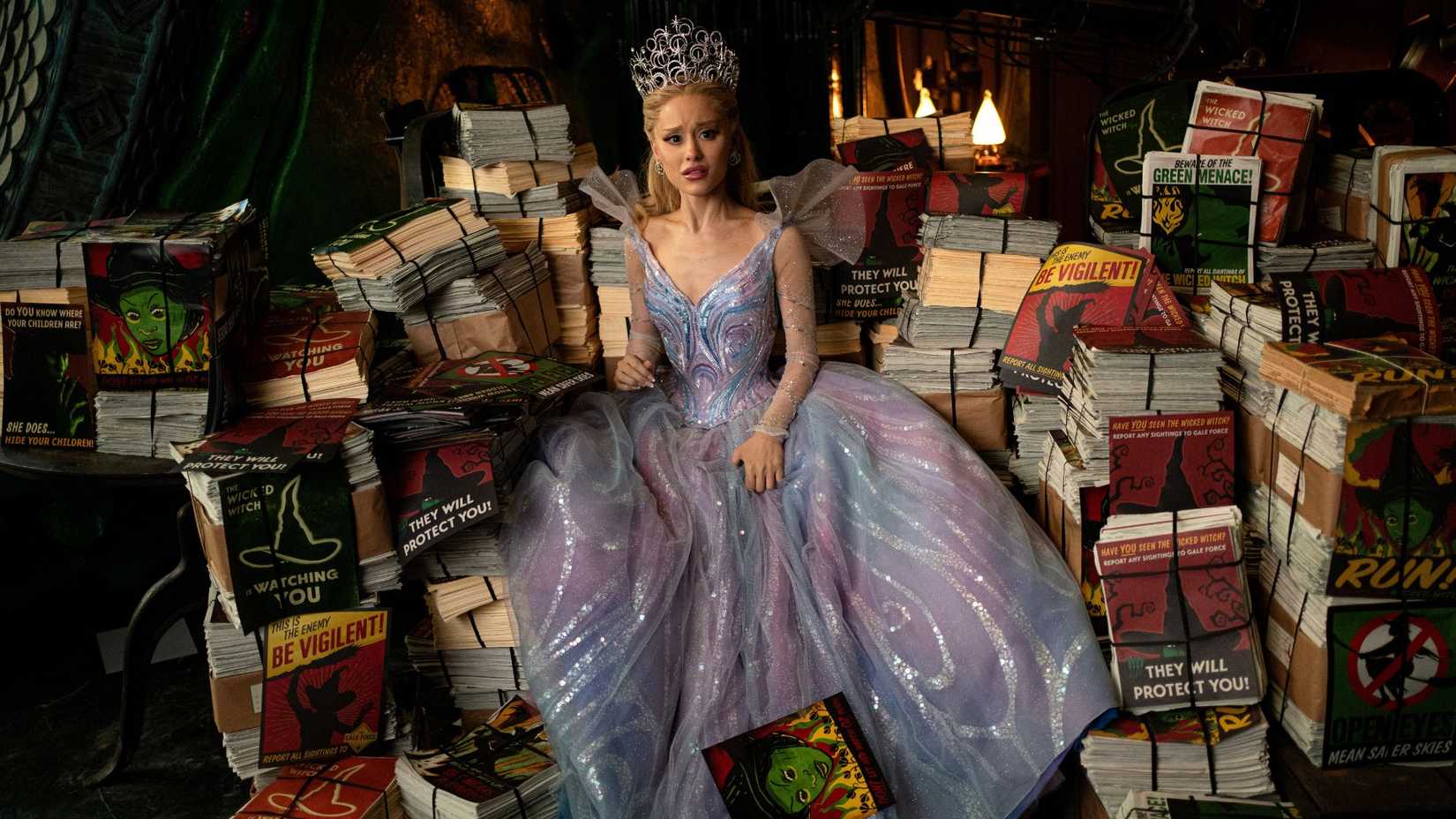 Image: Universal Pictures
Art is similarly used as a propaganda weapon to spread paranoia in 2025’s Wicked: For Good. After Elphaba (Cynthia Erivo) takes up her broom to fight back against the oppression of animals in Oz, her enemies, Madame Morrible and the Wizard of Oz, feed the Ozians' fear of her with fliers depicting her as a wide-eyed, growling monster, setting fires across Oz. Posters and banners across Oz feature slogans like “BEWARE THE GREEN MENACE” and “SHE IS WATCHING YOU,” with images that twist Elphaba’s features, making her look horrifying and demonic. Even the label “Wicked Witch of the West” comes from propaganda setting her up as an evil power, and boosting the reputation of Glinda the Good (Ariana Grande).
For Good conveys how easy it is for a ruling party that controls the media narrative to warp people’s perceptions, and build bandwagonism among the populace, creating a scapegoat for all a society’s problems and distracting from the oppressors actually creating those problems. The tragedy of For Good is that the propaganda ultimately works. Elphaba is vilified, and every good deed she tries to do backfires, due to the forces working against her and twisting her words. Even when she tries to spread her own truths by skywriting “Our Wizard Lies” in the clouds, Madame Morrible magically alters the message into a threat. The word of mouth against Elphaba cunningly plays on people’s prejudices against her skin color, and it’s so effective that she finds it impossible to fight back.
Not even The Man of Steel could escape propaganda manipulations in 2025. Director James Gunn has never hidden that his take on Superman is rooted in politics, and comes down on immigrants’ side. Speaking to The Sunday Times in July, Gunn said, “Superman is the story of America: an immigrant that came from other places and populated the country. But for me, it is mostly a story that says basic human kindness is a value, and is something we have lost.”
 Superman is getting arrested by Ultraman in SupermanImage: Warner Bros. Pictures
It was a timely message, considering Donald Trump’s anti-immigrant executive orders, attacks on student activists, and violent crackdowns on peaceful protesters throughout 2025, and the rising wave of resistance against it. When Lex Luthor (Nicholas Hoult) smears Superman (David Corenswet) and undermines support for him by targeting his origins and painting him as an invader, things quickly go south for the superhero. While Superman craves a normal life with love, friendship, and an ordinary job, Luthor creates a false narrative about his alien desires in order to villainize him.
Luthor’s manipulation of social media in particular holds up a mirror to audiences to show how something as simple as an online trend (who can forget “#Supershit”?) can help spread unreasoning, self-righteous hatred like wildfire across the internet. The way Luthor zeroes in on Superman’s background is particularly insidious: By othering Superman and making him appear dangerous, Luthor makes any violence against him feel like justice.
Violence and genocidal intent spurred by cunning, malicious misinformation ultimately triggers the Ghorman Massacre in season 2 of the Star Wars series Andor. After painting the Ghorman people as unreliable and greedy through a propaganda campaign, Empire leaders gun down peaceful protesters, inciting a riot. The Empire then uses media control to depict the protesters as violent and out of control, further spreading judgment against them across the galaxy.
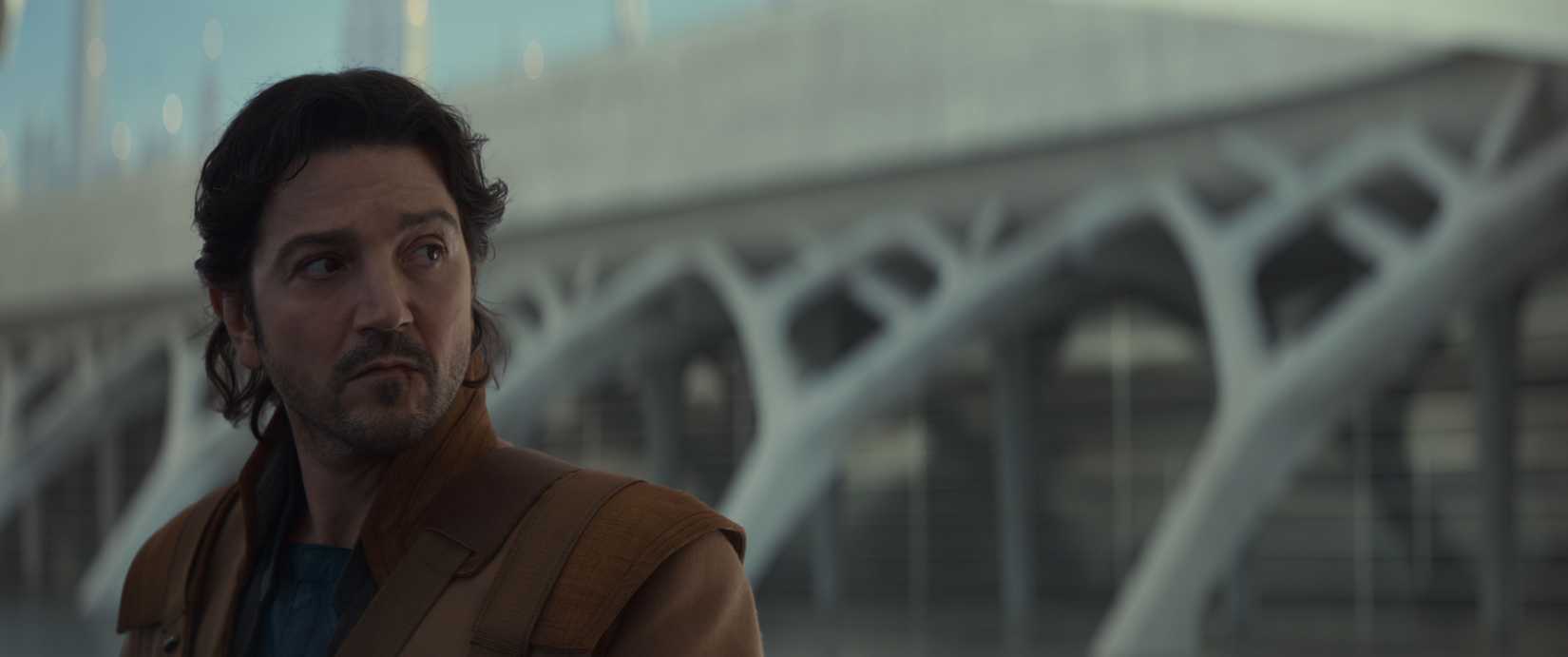 Image: Lucasfilm Ltd.
The Empire controls the press, shaping what reaches its citizens and what doesn’t — censorship that seems particularly ironic coming from a Disney product. The Empire’s arm of censorship extends even to attacking political figures, such as Mon Mothma (Genevieve O'Reilly), whose thrilling speech to the Galactic Senate spotlights the fabrications being spread about the events of Ghorman. Attempts to stop her are waylaid by resistance across newsrooms. The nameless characters pushing back against the Empire’s control convey that anyone, anywhere can resist propaganda — it isn’t limited to a few heroes. Even so, average citizens like Eedy Karn (Kathryn Hunter) — whose scenes unpack what she heard through the media or from her friends — fall victim to the false narrative all the same.
The winners write history, and in Edgar Wright's The Running Man, the wealthy elite have been winning for years. When Ben Richards (Glen Powell) is thrust into a televised, bloodthirsty game show for the amusement of The Network's execs and its rabid fans, he quickly learns that playing fair is for chumps. The Network frames him and the other starving, impoverished people forced into the games as lazy, entitled criminals who deserve to be murdered for sport. When he finds out that The Network is putting innocents in harm's way, his speech calling out the tyrannical system is edited to make it look like he’s gleefully bragging about killing officers who were sent to take him down. Via deepfakes and AI, The Network demonizes Ben and casts him as a villain, through a gross misuse of technology that feels especially relevant to the world we’re living in.
Genre fiction’s focus on propaganda will continue into the new year: The Hunger Games: Sunrise on the Reaping, the film adaptation of Suzanne Collins’ 2025 prequel novel, is set to release in 2026. Collins’ dystopian YA series follows young contestants who are pitted against one another in death matches, to entertain the elites and confirm the power of their rulers in the Capitol.
 Image: Lionsgate
Because of the propaganda around the Hunger Games, the majority of Capitol residents never question the morality of the games, and those who do are almost always silenced. Given that Sunrise on the Reaping is a prequel, we already know the protagonists don’t get a happy ending — it’ll take Katniss Everdeen, a generation later, to conjure up the spark of rebellion that brings down the Capitol. It’s more likely we’ll see the movie parallel the book’s much bleaker ending, which further highlights how, even in the face of innumerable horrors, the labor involved in critical thinking, the desire for peace of mind, and the ease of going along with the crowd will be enough to annihilate truth.






![ELDEN RING NIGHTREIGN: Deluxe Edition [FitGirl Repack]](https://i5.imageban.ru/out/2025/05/30/c2e3dcd3fc13fa43f3e4306eeea33a6f.jpg)
 English (US) ·