.png)
 5 months ago
57
5 months ago
57

Published Feb 13, 2026, 7:00 PM EST
‘It's important that the audience is faced with something impossible’
 Image: Briarcliff Entertainment
In the slapstick science fiction action movie Good Luck, Have Fun, Don’t Die, an alleged time traveler played by Sam Rockwell appears in a Los Angeles diner with a plan to avert the apocalypse. The world is about to end, he proclaims, if a group of volunteers can’t help him stop a child genius from creating an evil AI.
Director Gore Verbinski (The Ring, the Pirates of the Caribbean movies) and screenwriter Matthew Robinson (Love and Monsters) take this clever conceit to its absolute limits, as Rockwell’s unnamed hero and his ragtag group of recruits (including Juno Temple, Zazie Beetz, Michael Peña, and Haley Lu Richardson) make their way across the city while fending off a series of increasingly dangerous and surreal obstacles. But it’s all just build-up to a chaotic final act that threatens to break from reality itself.
In an attempt to understand Good Luck, Have Fun, Don’t Die’s biggest twists, Polygon spoke to Verbinski and Robinson, who offer their own interpretation of the movie’s trippy, open-ended conclusion.
[Ed. note: Spoilers ahead for the ending of Good Luck, Have Fun, Don’t Die.]
'Simulation theory was a big influence'
 Image: Warner Bros. Pictures
“There's a certain point where the audience is told, maybe don't hang your hat so heavy on the idea of this being reality,” Robinson says.
It’s unclear exactly what point the screenwriter is referring to, but one very good candidate is a moment near the end of Good Luck where our heroes encounter what Robinson describes as a “giant, massive centaur-cat.” That’s a pretty apt description for the building-sized creature, which is entirely composed of meowing cat faces and sprays confetti out of its giant, swaying penis. It looks like a ChatGPT fever dream, which fits nicely into the film’s anti-AI message.
At this point in the movie, you may begin to question whether anything the characters are experiencing on-screen is real. According to Robinson, that’s entirely the point.
“Simulation theory was a big influence on me in terms of this movie, the idea that we are all living in a simulation,” he says, pointing to The Matrix as an obvious inspiration. “I've been obsessed with that as a storytelling device. I wanted to write a movie that follows video game logic, but has characters who don't think they're in a video game.”
For Verbinski, the goal was less to have one obvious break-from-reality moment. Instead, he designed the movie to slowly transform from familiar to surreal.
"We want to start with something that smells like our world," Verbinski tells Polygon. "It's Norm's diner. It's high school. It's a birthday party. And then slowly twist that from analog to digital — toward something sonically mischievous, something sort of synthetic. As you go into the movie, things are getting a little stranger, and then a lot stranger. That was important."
'Two time travelers fighting to change the timeline'
 Image: Briarcliff Entertainment
At the end of Good Luck, Have Fun, Don’t Die, Rockwell and his surviving team members — particularly Richardson, as a woman who's allergic to technology, and gets debilitating headaches and nosebleeds around computers and phones — appear to successfully install ethical limits on the AI as it's being created. But as they emerge into a world that initially seems free of its influences, Richardson's allergies kick in again. It soon becomes clear that this seemingly happy ending is an illusion created by the AI, and the characters are in some sort of simulation. But were they in a simulation the entire time? Robinson doesn't want to say.
“I will not say whether or not I think this movie is in a simulation,” he says. “It was important that it could be interpreted either way.”
This raises another question. If the entire movie isn’t necessarily a simulation, how else can you explain the massive centaur-cat? In response, Robinson points out that Rockwell’s character isn’t the only time traveler.
As we learn at the end of Good Luck, the AI itself has also found a way to leap backward in time, and is essentially creating itself using a cloned human child, while also deploying hitmen to stop the heroes. So anything in the movie that seems to defy reality (such as the centaur-cat, but also earlier reveals like advanced cloning tech) could simply be explained as more time-travel shenanigans.
“I liked the idea of two time travelers fighting to change the timeline,” Robinson says. “We've got one lowly hero, Sam Rockwell, who's maybe the worst possible guy for this job, going up against the greatest intelligence in the galaxy, or the universe, or reality. Can a human outwit the greatest thinking robot of all time?”
Again, the answer is complicated.
'He's actually got a real shot now'
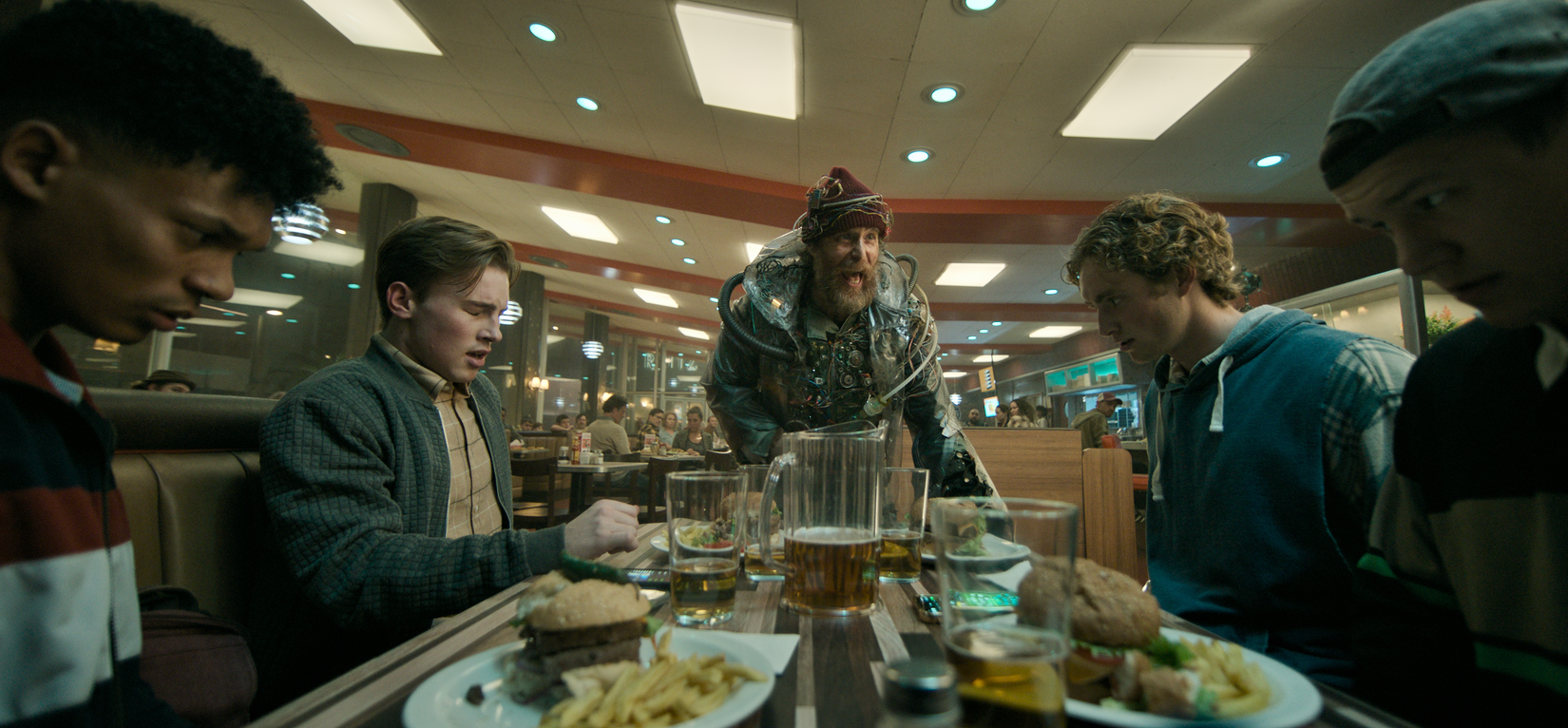 Image: Briarcliff Entertainment
Once the AI reveals its final trick, Rockwell activates his time machine and travels back to the diner he invaded at the beginning of the movie to recruit new volunteers and fight the machine again.
It’s not exactly a happy ending, but it still gets humanity one step closer to stopping the AI apocalypse once and for all.
“This version of the adventure ends in a loss,” Robinson says, “but in that loss, the man from the future learns something that will lead to them winning. He's actually got a real shot now.”
Good Luck, Have Fun, Don’t Die is in theaters now.


![ELDEN RING NIGHTREIGN: Deluxe Edition [FitGirl Repack]](https://i5.imageban.ru/out/2025/05/30/c2e3dcd3fc13fa43f3e4306eeea33a6f.jpg)
 English (US) ·