.png)
 5 months ago
122
5 months ago
122

Published Feb 6, 2026, 2:00 PM EST
The producer and director of Gulliver’s Travels share their memories
 Image: Hallmark Entertainment/Everett Collection
At the 1996 Emmy awards, one of the stand-out winners was the adaptation of a story that’s been told many times before — and many times since. Yet this two-part miniseries was such a stunning achievement at that time that it won the Emmy for Outstanding Miniseries, as well as additional awards for writing, art direction, hairstyling and visual effects.
That miniseries was Gulliver’s Travels, a co-production of The Jim Henson Company and Hallmark Entertainment, which aired on Feb. 4 and 5 on both NBC in America and Channel 4 in England. In addition to the categories it received awards for, critics praised the story for its sheer ambition, in part because, while most adaptations of Jonathan Swift’s 1726 satirical novel make significant abbreviations to the story, this version told all four of Gulliver’s adventures. Being a student of classic literature, this was something producer Duncan Kenworthy insisted on when he brought the idea to his boss Jim Henson in the late 1980s and remained committed to until the project was finally realized, six years after Henson’s death.
In honor of the 30th anniversary of Gulliver’s Travels, Polygon spoke with Kenworthy and director Charles Sturridge and asked them to share their most vivid memories from each of Gulliver’s adventures that were depicted. They also offered their early memories of getting the project made and the surprising casting choice of Cheers star Ted Danson to play the titular Englishman, Lemuel Gulliver.
A Jim Henson Production
 Image: Hallmark Entertainment/Everett Collection
According to Kenworthy, the miniseries was first conceived in the late ‘80s by major British film producer David Puttnam and Uberto Pasolini (a producer who worked for Puttnam at the time). Pasolini was close friends with Kenworthy, who was then head of production for The Jim Henson Company. As Kenworthy explains, “I was very keen on it because I read English at Cambridge and did a lot of literary properties, so we decided we would go ahead with it.” They even hired a writer in Simon Moore, who got to work adapting the 18th century novel.
Jim Henson’s personal involvement with the project was minor. “The one bit of advice he gave me was to have various points of view,” Kenworthy says. “Don't just dramatize it with a man just standing in the barn telling the story. Take it out into the world as much as you can.”
With that advice, they came up with a framing device to combine Swift’s four Gulliver stories: They depicted Gulliver returning home to England and recounting his fantastical adventures — and being found to be crazy as a result.
 Kenworthy (right) with Jim Henson (center) and John Hurt on the set of The Storyteller in the late 1980s.Image: Duncan Kenworthy
For the voyages themselves though, they remained very faithful to Swift’s work and never compromised on covering in all four voyages. “I was the literary person who wanted it to be done and wanted it to be done completely,” says Kenworthy. “If it was going to be done at all, we had to make it as true to the original novel as was possible.”
Eventually, after years of the project going nowhere, Puttnam’s company dropped out, but it remained with Kenworthy and the Jim Henson Company, even after Henson’s death in 1990. Despite Kenworthy constantly trying to push it forward, the project wouldn’t find any traction until after Kenworthy found big success producing 1994’s Four Weddings and a Funeral while on sabbatical from his job. It was then, finally, that he got Gulliver’s Travels moving with some help from his eventual, unlikely star.
Starring… Ted Danson?
 Image: Hallmark Entertainment/Everett Collection
In early 1995, Four Weddings and a Funeral had received a few Academy Award nominations, prompting Kenworthy to fly to America for the ceremony. It was during the trip that he met Ted Danson, and the two hit it off. “We somehow fell into friendship and I managed to persuade him to do Gulliver’s Travels and that changed everything,” Kenworthy says.
Just a few years after Cheers had ended, Danson was still a major star, but casting an American sitcom star to play the English adventurer still seems like an odd choice (he doesn't even attempt an accent). According to Kenworthy, Danson was right for the role because of his charm, a trustworthiness that made you root for Gulliver, and his playfulness with the part. The producer also notes that since Jonathan Swift always intended Gulliver’s Travels to be a satirical work, they had more creative freedom than usual.
Then again, director Charles Sturridge also attempted to make a more scientific argument to explain Danson’s accent in the film, or lack thereof.
“We had long talks about accent and should it be British? I said no because this is the period when the Brits were going to America. Americans didn't make the accent up. He's speaking late 17th century English, which is what gave Americans their accent,” Sturridge says. “I more or less make the case that he's more British than the Brits, who are talking in a Victorian accent, which is post-Jonathan Swift.”
“A Voyage to Lilliput”
 Director Charles Sturridge (right) with Edward Fox as General Limtoc. Image: Charles SturridgeImage: Charles Sturridge
“A Voyage to Lilliput” is the most well known portion of Gulliver’s Travels. In it, Gulliver washes ashore on the fictional country of Lilliput after being shipwrecked. The people of Lilliput are just a few inches tall, yet they manage to tie up Gulliver and drag him to their Emperor to see what they should do with him.
In the miniseries, this interaction between a giant Ted Danson and a miniature Emperor played by Peter O’Toole stands out as especially funny thanks to O’Toole’s self-important performance. Despite the fact that the giant could simply step on him, the Emperor rules over Gulliver like any other subject, a dynamic which Sturridge credits to O’Toole.
Sturridge recalls:
“During rehearsals I said to Ted, ‘Look, here's a ladder. Why don't you stand on the ladder and be much taller than them?’ So Ted climbed up this rickety prop ladder and Peter was on the floor and I said, ‘Let's just do the scene.’ So we read two or three scenes like that and, at the end of the rehearsal, Peter said, ‘I get the relationship.’ I thought, Yeah, he's big, you're small. But no, Peter said, “I'm a king. He isn't.” Peter had inverted the dynamic, which was very clever.”
 Image: Hallmark Entertainment
“A Voyage to Broddingdang”
“A Voyage to Broddingdang” is the inverse of “A Voyage to Lilliput,” with Gulliver visiting a land of giants. For this chapter, the scene of Gulliver being attacked by giant wasps is a standout, both for the audience and for Sturridge.
“Gulliver was done pre-computerized effects,” Sturridge says. “We were using entirely old technology. For example, the battle with the wasps, those are real wasps. We literally had a glass tank full of wasps and we shot tons and tons of wasp footage. Then the wasp that was doing the right thing at the right time got into the movie.”
 Image: Hallmark Entertainment
Giant wasps might seem like a good opportunity to take advantage of The Jim Henson Company and its creature design expertise. Sturridge wasn’t interested, but he eventually gave in to the pressure.
“Jim Henson’s Creature Shop was desperate to do something for Gulliver,” he says, “but there was nothing I wanted them to do. I absolutely didn't want puppetry, nor did anybody else. But, I knew all those guys because I'd worked with Jim Henson on The Storyteller and there’s a whole culture of puppeteers there and they desperately wanted to do stuff, so I had them build a giant wasp. The big wasp was the only thing I had them make and it was only in one shot. I basically put the shot in because we’d spent the money on the wasp.”
“A Voyage to the Country of the Houyhnhms”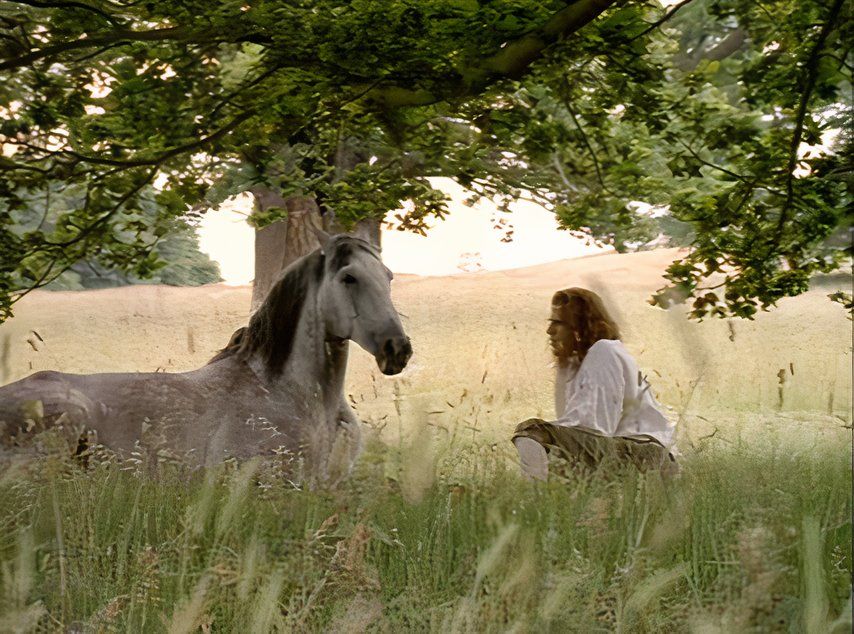
“A Voyage to the Country of the Houyhnhms” features Gulliver visiting a land populated by enlightened talking horses. It’s also the source of one of Sturridge’s most humorous experiences making the miniseries, which occurred at a ranch where he met with a trainer to select horses for the shoot:
“When I went to see the trainer, he said, 'Yep, I've read the script. I've got you some horses. Come and take a look.’ He showed me six horses, then he clapped his hands one way and they nodded their heads backwards and forwards. Then he clapped his hands another way and the horses dug into the ground with their hooves. So they had very simple tricks basically.”
“I said, ‘Here's the problem. I've got to make them look like they're the cleverest animals ever and they just look angry to me.’ He said, ‘Well, what do you want then?’ I was on my own at this point, there were no other production people there, so I said, ‘Let's go for a walk.’ We go for a walk through the stables of his ranch. As we're walking down this long corridor of horses, talking about what an intelligent animal might look like, one horse stuck his head out to see who was walking past. I said, ‘Look, curiosity! If we're looking for intelligence, curiosity has to be there!’ So he said, ‘So you want that one?’ I said, ‘Well, let's try that one.’”
“Out the horse came and the trainer said ‘So what do you want him to do?’ Obviously I had no fucking idea, so I said, ‘Why don't we just walk away and see what he does.’ The horse just stood there, then I walked up to him, stopping about 15 feet away, and I walked around him and he turned and followed me. I said, ‘Look, he is curious! I feel that's a place to start if we are looking for intelligence.' Then the trainer just says 'So we'll have that one.' And, yes, that was the one we ended up using for the main horse."
The response to Gulliver’s Travels
Gulliver’s Travels was a hit, but according to Sturridge, that might have had more to do with the marketing push behind it than anything else.
“It’s always difficult to fairly balance ambition and results,” the director says. “There was no doubt in my head that it was intended to be popular, and a lot of time was spent piecing together ways that would push you from one sequence to the next. It was built to be addictive. Also, NBC spent a lot of money promoting it, with painted buses and that kind of stuff. I think it got that big audience because it was sensationally well publicized.”
As for Kenworthy, who spent the better part of a decade shepherding the project though, he says the acclaim was “very, very gratifying.” He was especially proud that Gulliver’s Travels kept its sense of humor, which Kenworthy says was, “Probably a bit of Jim Henson's spirit coming through.”

![ELDEN RING NIGHTREIGN: Deluxe Edition [FitGirl Repack]](https://i5.imageban.ru/out/2025/05/30/c2e3dcd3fc13fa43f3e4306eeea33a6f.jpg)
 English (US) ·