.png)
.png) 2 months ago
29
2 months ago
29


Published May 5, 2026, 3:00 PM EDT
Murillo Zerbinatto is an Editor at DualShockers specializing in JRPGs, RPGs, reviews, guides, and lists. He has been writing professionally since 2018 and covering games since 2020, with previous work published at Xfire, RPGInformer, IndieGameCulture, and GameRant.
A longtime JRPG enthusiast, Murillo has played more than 250 JRPGs and earned over 100 platinum trophies, giving him deep hands-on experience with the genre’s progression systems, side content, collectibles, and completionist challenges. His coverage often focuses on franchises such as Final Fantasy, Dragon Quest, Trails, Tales of, and Star Ocean.
Sign in to your DualShockers account
It's a sentiment most JRPG fans know all too well. We dive deep for dozens, sometimes hundreds, of hours into a game, fall in love with its universe and cast, and find ourselves awestruck by the story. But as soon as we close the game, a massive burnout hits, and we don't want to see another 100-hour-long JRPG for three months. The problem is: we still want to play JRPGs.
During these breathers, my refuge is indie games, which offer a cozier, less overwhelming experience while still maintaining the quirks, personality, and timeless style of a JRPG. It was during one of these periods that I stumbled upon Regalia: Of Men and Monarchs, a cheerful and funny tactical RPG from Pixelated Milk.
 Related
8 JRPGs Born from Kickstarter Campaigns
These JRPGs only exist thanks to the collective funding of a passionate community.
Fast-forward a bit, I finished and platinumed Regalia: Of Men and Monarchs, loved the experience, and started following Pixelated Milk on social media. So, when they first announced SacriFire, I was in the front row, excited and with high expectations for what was to come. Finally, after a long time, I was able to test SacriFire at Gamescom Latam, and I must say many of my wishes are being granted.
A Tale of Two Cities
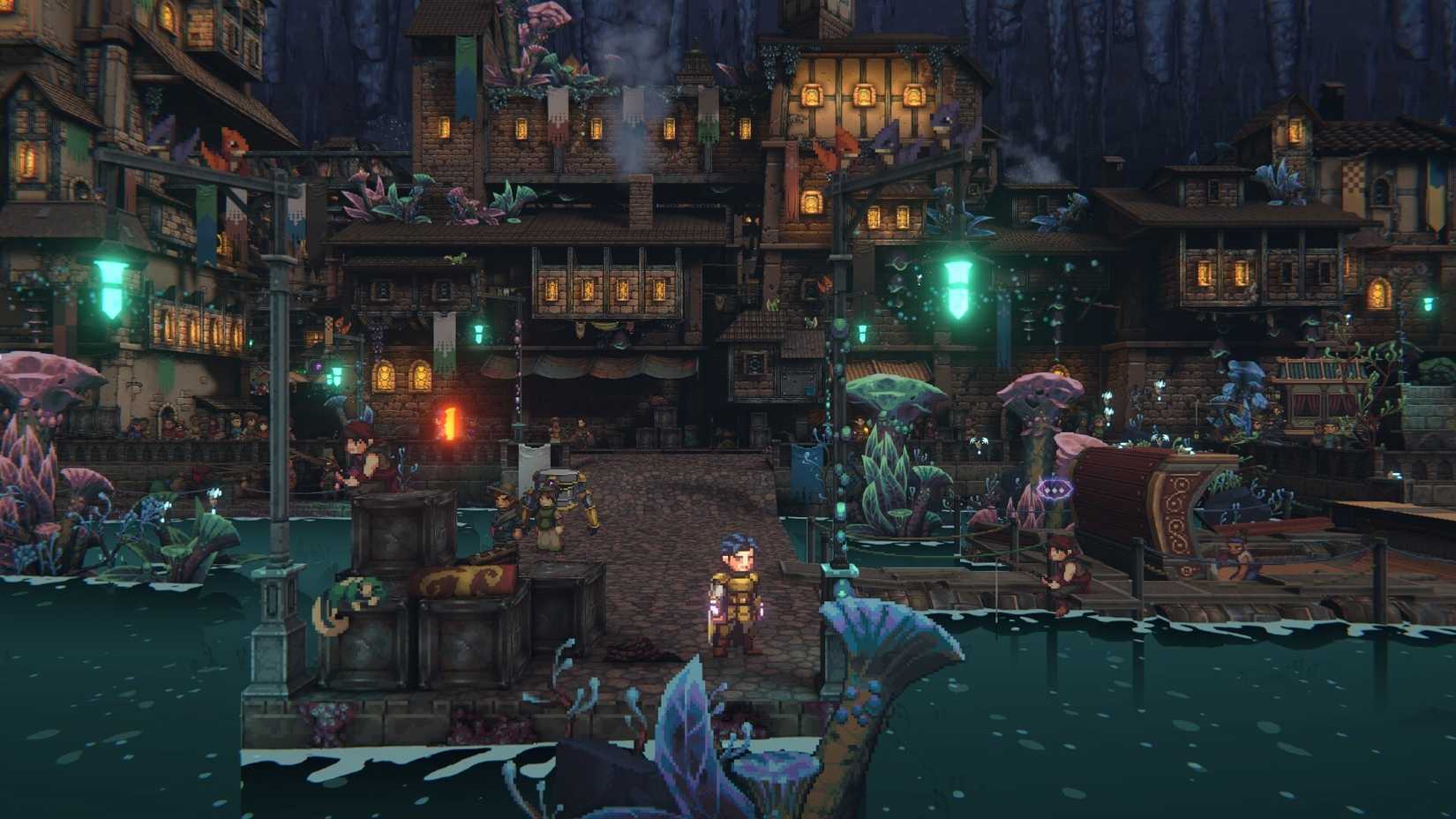
To be completely frank, paying attention to the story of a JRPG in the middle of a convention, with people passing by, loud voices, and countless distractions, is a tall order. However, I still managed to get a sense of the narrative, the dialogue delivery, the script, and, most importantly, the voice acting. Seldom does a pixel indie JRPG offer voice acting, as it is usually reserved for high-profile games like Octopath Traveler. So it was a pleasant surprise to start SacriFire and hear Ezekiel, the protagonist, speaking in English loud and clear.
We begin our adventure in Antioch, where the young priest Ezekiel Ridan, alongside some colleagues, is trying to join the elite of the Church of Sheol. His role is to defend this underground city from the monsters that roam the surface, but like every good JRPG, there is much more behind the scenes than this premise reveals. From what I can tell, there is already plenty of foreshadowing in the plot, both in terms of character development and the central conflict, though it's still too early to judge the overall quality. In short, I liked the beginning and the cast of characters I met during my brief stay.
An Exquisite Mix of Many Battle Systems

Nowadays, even though turn-based JRPGs are making a comeback, it seems illegal to make a system that is too simple or basic. We need timed inputs, a blend of action that converts to turn-based, perhaps real-time elements mixed with turns, or, in the case of SacriFire, a sprinkle of each system to create something unique and modern.
Finally, after a long time, I was able to test SacriFire at Gamescom Latam, and I must say many of my wishes are being granted.
Upon encountering an enemy on the field, we transition to the battlefield where the action unfolds. In the preview, I could only control Ezekiel, and I suspect that even if we end up having party members, we might only manage the protagonist. On one side, our hero; on the other, the enemies. Enemies only move and attack once we move, allowing us to analyze the battlefield and decide on our next actions before executing them. Using the trigger button charges APs, allowing for actions such as attacks and abilities. However, charging our AP makes enemies act, putting us at risk.
This is where the dance of battle and the weighing of actions begin. It's not just the enemies that stop whenever we are stationary, but their attacks as well. When they hurl a projectile at my face, I could stay still in my spot, and the approaching attack would just stay there. I could either move away from the projectile or use the dodge button, which costs AP. The catch is that if you spend too much time on evasive maneuvers, other enemies will also close in and attack, piling up their actions.
The secret is balancing the time spent charging AP and using it to attack with the time spent dodging. I know the battle system sounds confusing and, at first, it is, but when everything clicks, it's glorious. For instance, when I entered combat, three enemies came at me. I charged my AP and unleashed combos of light and heavy attacks, alternating between them to gain more AP in the process and keep hitting hard. Upon finishing, I saw the ranged enemies had already targeted me, so I prepared to dodge the attacks and, in the process, pick up AP scattered across the battlefield, which gave me more opportunities to strike.

There are also skills and items, but they were quite limited in the preview. The thing is, if you don't think and just mash the attack button, you will take a beating because every blow really hurts Ezekiel. It's a very interesting dynamic, and I would have loved to face a boss to see how elaborate and strategic high-level combat can get, but I didn't have that chance.
My only caveat is that these fodder battles took quite a bit to resolve. I faced the same opponents three times, and while the engagement changed slightly, it still took me a few minutes to finish them, which, considering they are common battles, hurt the pacing a bit. I believe Pixelated Milk is taking this into account in each dungeon to give an even cadence between exploration and battles because, oddly enough, I could already win conflicts in the field before transitioning to combat.
I'm all in for JRPGs that optimize my time when facing weaker enemies, but that's the main point: weaker enemies. From the start, SacriFire allowed me to unleash an energy blast on field enemies, defeating them instantly without transitioning to battle and earning 80% of the exp in the process. After five field kills, though, we need to enter a battle, otherwise, no more experience. It felt like a band-aid for a larger problem because, if you let players avoid common conflicts right from the start, how do you encourage them to engage in battles again? That remains to be seen and is something worth paying attention to.
 Related
10 JRPGs for Players Tired of 100-Hour Time Commitments
A JRPG doesn't necessarily need to take an entire month to finish.
Gorgeous Visuals and Seamless Exploration

Something that immediately catches the eye in SacriFire is its colorful, inviting 2.5D style. Ezekiel moves in 3D while the cityscape gorgeously sits in the background. In the dungeon, the camera was fixed in 2D, giving space to platforming. There was a lot of verticality, which expanded the scope of exploration and led me to find chests in some interesting nooks and crannies, as well as other secrets. Every action flows seamlessly, showing all the care and affection the developer has put into the game.
The visual effects and auditory feedback combine to bring a graceful experience that harks back to the JRPGs of the old era, but with that exquisite modernity reserved only for the most creative indie minds. To top it off, the JRPG features a soundtrack by none other than Motoi Sakuraba, the composer for franchises like Tales of, Star Ocean, Golden Sun, and even Dark Souls.
I know the battle system sounds confusing and, at first, it is, but when everything clicks, it's glorious.
SacriFire has already stated it draws inspiration from Vagrant Story and Xenogears, and it shows wearing them on its sleeve, especially in the battle system. If I was already excited about the game before, showering it with praise whenever possible, now that I've been able to test it, I'm even more pumped and can hardly wait for a definitive release date.
For now, SacriFire is slated for release in 2026, and the developer expects to give a final release date at the end of May. Initially, the game was going to come out first for PC and then consoles, but now that they have found a partner to help with the launch, the expectation is that it will be released simultaneously across all platforms.
 Next
Next
10 JRPGs Coming in 2026 That Already Deserve Your Attention
There are new JRPGs on the horizon that deserve your attention and a spot in your backlog.

Systems

Released 2026
Developer(s) Pixelated Milk
Publisher(s) Pixelated Milk
Number of Players Single-player
Steam Deck Compatibility Unknown





![ELDEN RING NIGHTREIGN: Deluxe Edition [FitGirl Repack]](https://i5.imageban.ru/out/2025/05/30/c2e3dcd3fc13fa43f3e4306eeea33a6f.jpg)
 English (US) ·