.png)
 5 months ago
36
5 months ago
36
When kids tuned in for the second season of the 1990s Iron Man cartoon on Sept. 23, 1995, they were in for quite a shock. Gone was the brightly lit intro that showed Tony Stark suiting up, followed by clips of the major villains in his rogues' gallery, each with a helpful sunburst label telling you who they were. Also missing was the theme music by rock legend Keith Emerson, which featured a mix of an electronic keyboard and pipe organ.
Instead, the new intro opened in pitch-black, revealing a shirtless Tony Stark covered in shadow, deep in his laboratory. A machine hands him a blacksmith’s hammer, then Tony pounds away on an anvil as images of his many Iron Man armors flash onto the walls. He grabs a giant chain and pours molten metal into a mold to form his new armor and then refines his work with a bit of welding before the finished pieces fly onto him as he suits up. Finally, Tony bursts out of the laboratory and into the night sky. A new, industrial-sounding theme song accompanies the dark visuals as a singer chants four words: “I am Iron Man.”
But the introduction was not all that changed for the second season of Iron Man’s two-season run. The entire show was essentially rebooted with a darker tone, more complex stories, and deeper characters. These changes were necessary to bring the fledgling series in line with the more mature superhero cartoons of the 1990s. Unfortunately, while the effort wasn’t too little, it most certainly was too late. Iron Man would conclude just 13 episodes later in February 1996.
In 1994, the biggest superhero cartoons on TV were Batman: The Animated Series and X-Men: The Animated Series. The former offered mature storytelling, bold design, and high production value. The latter boasted complex, multi-part stories with real social commentary. Both were groundbreaking. So when the first season of Iron Man debuted in September of that year, it looked and felt more like something that Marvel would have put out in the late 1970s or early 1980s by comparison.
The cartoon featured Iron Man as the head of a team called Force Works, which included War Machine, Spider-Woman, Scarlet Witch, Hawkeye, and the little-known Marvel character Century. In most episodes, the evil villain Mandarin hatches some plot to conquer the world with the aid of his stooge MODOK and a handful of other villains in his employ. Iron Man and his team would thwart the Mandarin’s plans before the half hour was up.
The show was under the supervision of the late Ron Friedman, who had worked on GI Joe and Transformers in the 1980s. But when Marvel wanted a change for season 2, the company turned to Tom Tataranowicz, who had been successful with another of its shows, Biker Mice from Mars.
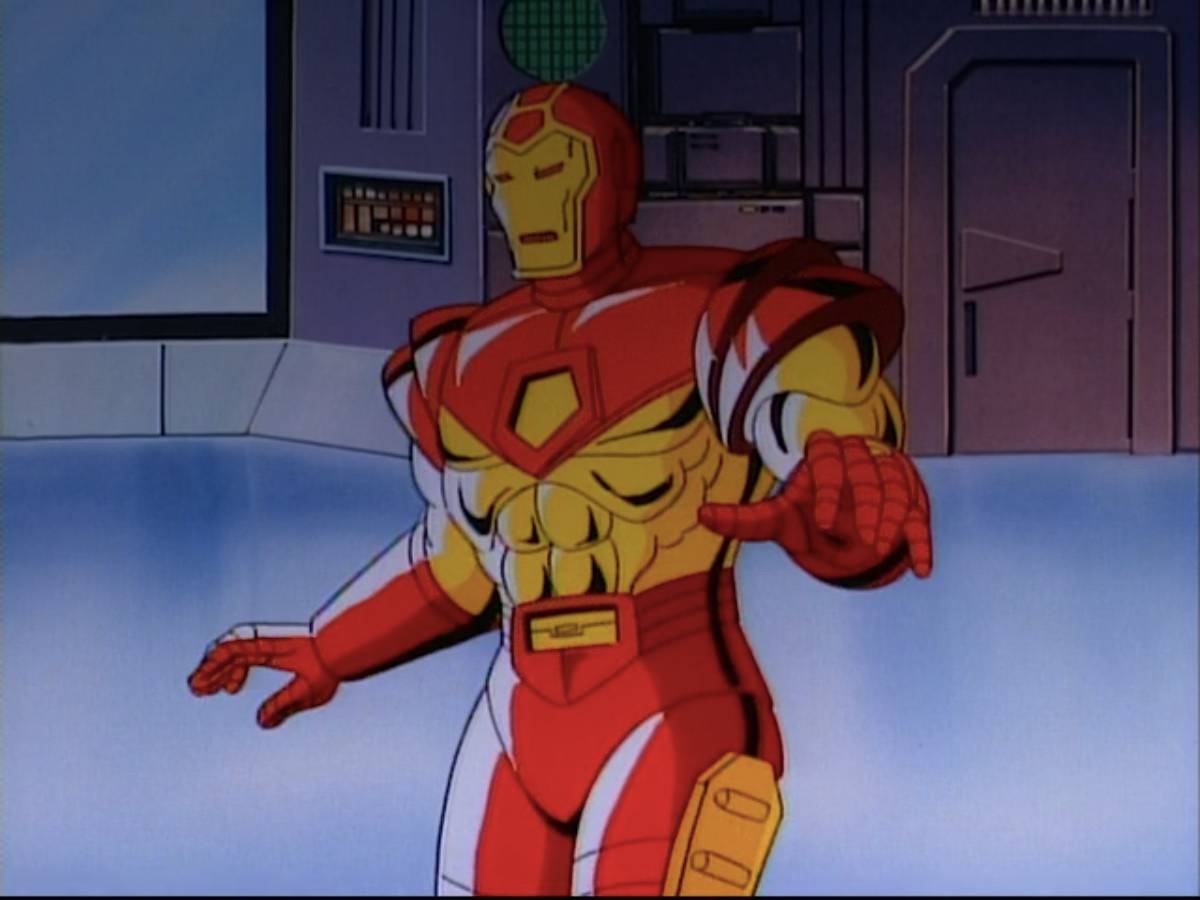 Image: Marvel/Disney
“Marvel wanted a better show, because it wasn’t performing as well as they hoped it would,” Tataranowicz tells Polygon in a video interview.
He set about making some easy fixes, including bringing in the episodes closer to the final runtime, as opposed to sending overseas minutes of extra animation that had to be cut down anyway. He also replaced much of the voice cast, though he kept Robert Hays as Iron Man.
On a more creative level, Tataranowicz felt the first season was too much of a commercial.
“They seemed like they were just trying to cram in as many characters as they possibly could into every show,” he says. “That's why, in my first episode, I got rid of everybody.”
Indeed, after Tony goes rogue on a particular adventure, his team gets fed up and quits, leaving only War Machine/Jim Rhodes as Tony’s loyal best friend and Spider-Woman/Julia Carpenter as his romantic interest.
Because of the involvement of Marvel’s toy company, Toy Biz, Tataranowicz knew he’d have to bring the rest of the team back eventually, so he planned to do it at the end of season 2. In the meantime, he dug deeper with the remaining characters.
“Tony Stark, in my mind, was an egomaniac narcissist,” Tataranowicz says. “So he's going to act like it and isolate himself from everybody. Tony's arc went from asshole to a guy who had put his act together a little bit by the last episode. He isn't the same arrogant guy he was at the beginning.”
 Image: Marvel/Disney
War Machine also got a more complex character arc. After a bad crash, Rhodes struggles to get back up for several episodes. While PTSD is never directly mentioned in the series, it's clear that that’s what he’s dealing with, which was incredibly mature for a Saturday morning cartoon.
Tataranowicz also demoted the Mandarin from arch-villain by having him lose his rings at the beginning of the season. Instead we see him in a series of one-minute standalone segments at the end of each episode where he finds another ring, which they then paid off with Mandarin’s return at the end of the season. “That pleased the toy company,” Tataranowicz says.
Tataranowicz also looked at what Warner Bros was doing with Batman and redesigned Iron Man to be sleeker, with less detail around the shoulders and boots and a simpler, more menacing mask. However, his most controversial visual change had nothing to do with Iron Man’s suite: He also gave Tony long hair.
“I did get a bit of grief about that [from Marvel],” Tataranowicz says, “but I wanted him to feel like he had changed from the first season. Plus, I thought Tony Stark with short hair always kind of looked like a gigolo to me.”
Tataranowicz credits Tony’s new look to storyboard artist and first-time producer Yi-Chih Chen. “I gave him a shot at doing the show and he did a really good job. He brought a nice aesthetic to it.”
But while Marvel let the issue of Tony Stark’s hair go, Tataranowicz faced even more resistance when he asked to remove the live-action introductions by Stan Lee at the beginning of each episode. Tataranowicz wanted to use those 35 seconds for animation, but The Man himself got upset about it.
Boy, did shit hit the fan on that!
“Boy, did shit hit the fan on that! He's going, ‘My fans want it!’ Then it occurred to me, Oh, he's a member of SAG. He gets residuals if he's on screen. That's what it was about,” Tataranowicz says. “So I told him, ‘Stan, I don't think they did you a service in that first series. You look kind of like a used car salesman sitting out on the desk, trying to huckster everybody. I'll give you 15 seconds and we're not going to have this room filled with all kinds of merchandise. You just tell us a little bit about the show and we're moving on from there.’ So we did that.”
Having implemented nearly all the changes he wanted, Tataranowicz was making plans for a third season of Iron Man, which he wanted to include the famous “Demon in a Bottle” alcoholism storyline from the comics, possibly under a DARE-like “scared-straight” script. Unfortunately, despite many changes that improved the show, viewership remained low.
“When it came out, it got a good reaction from fans, but it had lost a lot of viewers because I guess people weren't that crazy about the first season and they thought this was just more of the same,” Tataranowicz says. “Next thing I knew, they wanted me to do The Hulk.”
A few years ago I met Jon Favreau.
For the next 12 years, Iron Man remained strictly in the realm of comic books until director Jon Favreau and star Robert Downey Jr. launched the MCU with Iron Man in 2008, a film that, according to Tataranowicz, was influenced by his season of Iron Man.
“A few years ago I met Jon Favreau,” he says. “I went up to him and told him who I was and that I produced Iron Man. He goes, ‘I’ve got to tell you, one of the things that gave me the idea on what I was doing with the movie was that opening title.’ I go, ‘Really?’ And he goes, ‘Yeah — I am Iron Man — that's where I kind of got the idea.’” (It should be noted that Kevin Feige has said Robert Downey Junior improvised the famous line.)
So while not enough kids were watching the 1990s version of Iron Man, according to Tataranowicz, at least someone was paying attention.


![ELDEN RING NIGHTREIGN: Deluxe Edition [FitGirl Repack]](https://i5.imageban.ru/out/2025/05/30/c2e3dcd3fc13fa43f3e4306eeea33a6f.jpg)
 English (US) ·