.png)
.png) 2 months ago
33
2 months ago
33


Published May 16, 2026, 1:27 PM EDT
Melissa Sarnowski is a Gaming Writer at DualShockers who has been covering games professionally since 2022. She specializes in lists, reviews, and features, with additional experience writing guides for Hardcore Gamer.
Before joining DualShockers, Melissa contributed to Screen Rant, and she currently writes for CBR and Hardcore Gamer in addition to DualShockers. Her work focuses heavily on RPGs, horror games, MMOs, indie games, and simulation games, with recurring coverage of franchises such as Final Fantasy, Resident Evil, The Legend of Zelda, and The Sims. She holds a Bachelor of Science in English from the University of Wisconsin–Madison.
Subnautica 2 places you in the middle of an ocean, and the water is presumably full of salt. Unfortunately, that salt is of no use to you. Instead, you'll have to find some crystallized Salt to harvest if you want to craft with it. The good news is that Salt isn't the hardest resource to find and gather, even before you have the help of the Sonic Resonator to allow you to harvest the large nodes.
 Related
Subnautica 2: How to Get Titanium Ingots
Gain the power to repair with Titanium Ingots.
If you follow the instructions from NOA, you'll actually be sent right to the location where you can first gather some Salt after you find Anita's Black Box. However, you can go get Salt earlier than that point if you need to.
Finding Salt

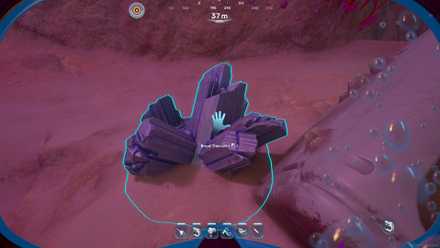
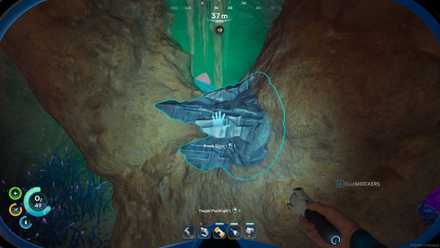
After you find Anita's Black Box, you're sent to find Chap's Black Box. The area outside of Chap's habitat is actually where you can find Salt that you can harvest without the use of a Sonic Resonator. While you won't be able to gather a lot of Salt from this location, you can start collecting and storing it back in your habitat for future use.
Chap's habitat is roughly 200 meters to the southeast of the Lifepod. You'll have to dive into a little cave-like structure to find the hatch for the habitat, and the ground outside that hatch is where you can find some small Salt nodes to gather. If you want to find bigger nodes, then you'll want to head about 230 meters to the southeast of the Lifepod, which puts you past Chap's habitat. However, that's where you'll find more little Salt nodes and large ones that you need a Sonic Resonator to gather.
Using Salt

Salt is used in a number of crafting recipes. Some recipes that require it are needed to craft other items, as you use Salt to make Power Cells and Power Storage, and you'll likely go through Power Cells once you have vehicles, because this is going to be how you power them. Salt is also one of the items that you can use for storage items, such as the Tailing Jar. You can even use Salt to craft Glass through the alternate recipe for it.
Otherwise, as you might expect, Salt is used in a number of cooking recipes and required for Isotonic Water. Isotonic Water hydrates you better than regular water, so it's worth having Salt on hand that you can use for food and water crafting. Unfortunately, since Salt is used in so many recipes, you'll want to gather a decent amount of it. That's going to be a difficult task without the Sonic Resonator, so you'll likely want to save your Salt for Power Cells and Power Storage until you have the Sonic Resonator to allow you to get more of it at once.
Similar to Titanium, you'll go through quite a bit of Salt. However, Salt is less abundant in this ocean than Titanium is, so you need to use it wisely until you're able to gather it in a reliable way. You don't need it for every food recipe or for normal water, so you need to be strategic about your Salt use in Subnautica 2 when you're still starting out.
 Next
Next
Subnautica 2: Where to Find Silver
Silver stocks are rising! Best get mining!
Systems


Released May 14, 2026
ESRB Everyone 10+ / Language, Fantasy Violence
Publisher(s) Krafton






![ELDEN RING NIGHTREIGN: Deluxe Edition [FitGirl Repack]](https://i5.imageban.ru/out/2025/05/30/c2e3dcd3fc13fa43f3e4306eeea33a6f.jpg)
 English (US) ·