.png)
 2 months ago
22
2 months ago
22

Published May 23, 2026, 11:15 AM EDT
The Mandalorian and Grogu expands the franchise’s obsession with fathers and sons with one of its strangest and most fascinating additions in years.
 Image: Lucasfilm
As a franchise, Star Wars has been around long enough that what makes a Star Wars project is malleable — the complex themes of Andor can theoretically exist within the same galaxy as the goofy antics of Jar Jar Binks. But there are certain ideas that flow throughout Star Wars like the Force, chief among them the complicated relationship between fathers (or father figures) and sons. Luke Skywalker and Darth Vader. Anakin Skywalker and Sheev Palpatine. Anakin and Obi-Wan Kenobi. Obi-Wan and Qui-Gon Jinn. Kylo Ren and Han Solo.
The title characters of The Mandalorian and Grogu technically follow in this tradition: the stoic bounty hunter and the adorable, Force-sensitive creature in his charge. (At this stage, the primary “conflict” is the tension between their different life spans: Grogu’s species can live for hundreds of years, and Pedro Pascal’s Din Djarin won’t be by his side forever.) But while the film does give us plenty of screentime between Din and Grogu, their relationship remains largely uncomplicated: they have a deep bond, and take turns protecting one another. Instead, the most interesting — albeit confounding — father-son dynamic comes courtesy of [checks notes] Jabba the Hutt’s buff son?!
[Ed. note: Light spoilers ahead for the plot of The Mandalorian and Grogu.]
Prior to release, far and away the most bizarre element of The Mandalorian and Grogu was the knowledge that the movie would feature Rotta the Hutt, the son of the infamous slug-like crime boss that terrorized Luke, Han, and Princess Leia in the original trilogy. Adding to the WTF-ery was Jeremy Allen White of The Bear fame voicing the creature. (Director Jon Favreau suggested that a shared connection to playing on-screen chefs — Favreau wrote, directed, and starred in 2014’s Chef — helped make the collaboration happen. My brain is fried.)
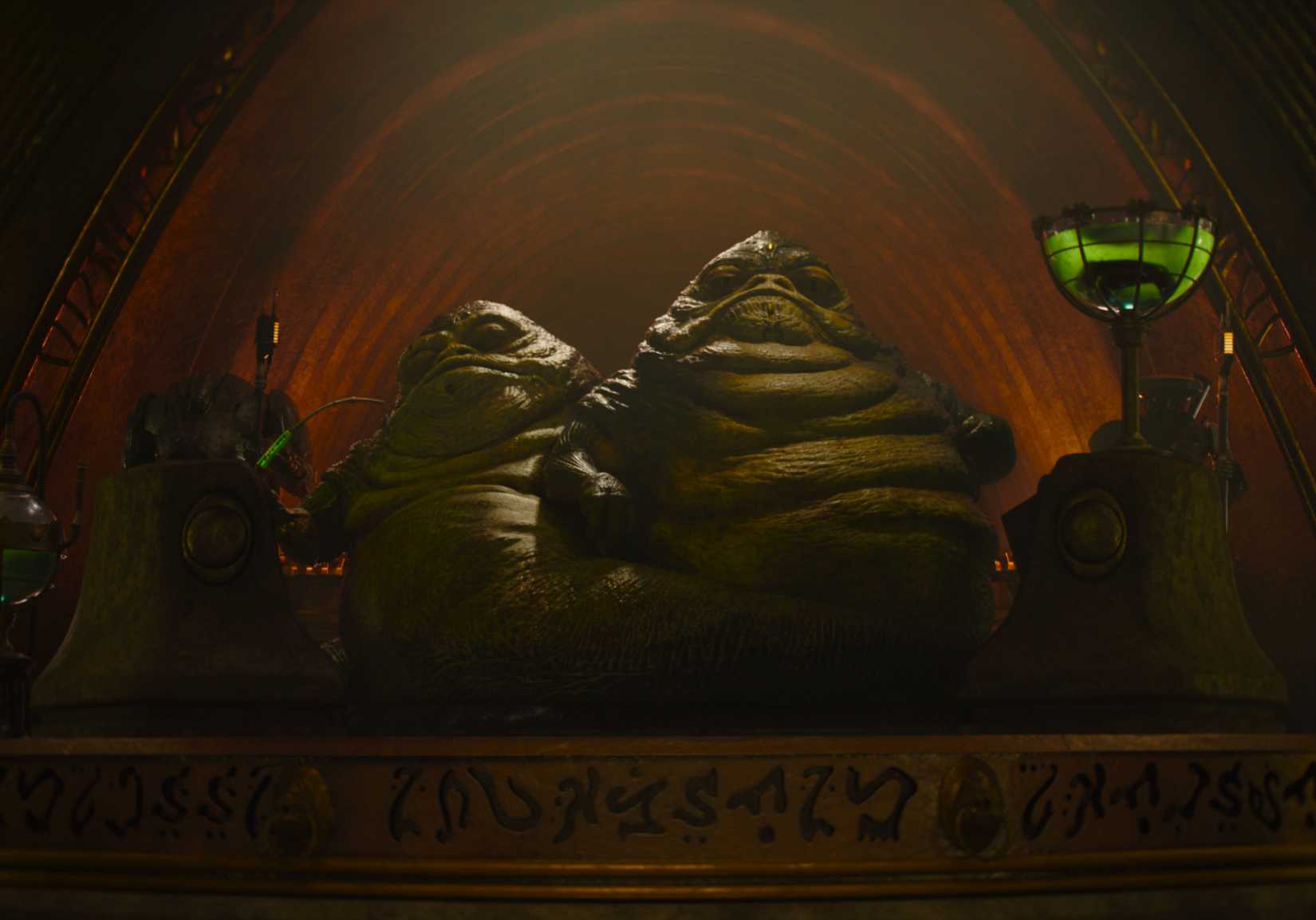 Image: Lucasfilm
In The Mandalorian and Grogu, Din is working for the New Republic to track down Imperial warlords still wielding power in the far reaches of the galaxy. Jabba’s cousins, known as the Twins (as previously seen in The Book of Boba Fett), have information on the whereabouts of an important Imperial officer. In exchange, they want Din to rescue their nephew, Rotta, who is being held prisoner and forced into gladiatorial combat on the planet Shakari.
When Din and Grogu arrive on Shakari, they instead find that Rotta isn’t being kept against his will as much as he’s embraced his life in the fighting limelight. Rotta explains that the Twins don’t want him back out of the goodness of their hearts, but to kill him and cement their control over Jabba’s criminal empire. Rotta isn’t even interested in the family business; he’s not like his father, he insists repeatedly.
It’s not surprising to see a Star Wars movie include a son expressing concern that the sins of their father will be passed down to them. What is surprising is when these themes are explored through a giant slug with washboard abs. That Rotta is such a key part of The Mandalorian and Grogu is a potential make-or-break moment for the audience, especially because the script (co-written by Jon Favreau, Dave Filoni, and Noah Kloor) isn’t anywhere as nuanced as you’d hope. Rotta’s character development is essentially repeating variations of “I’m not like my dad” and hanging out with Grogu. (I have no complaints about the latter.)
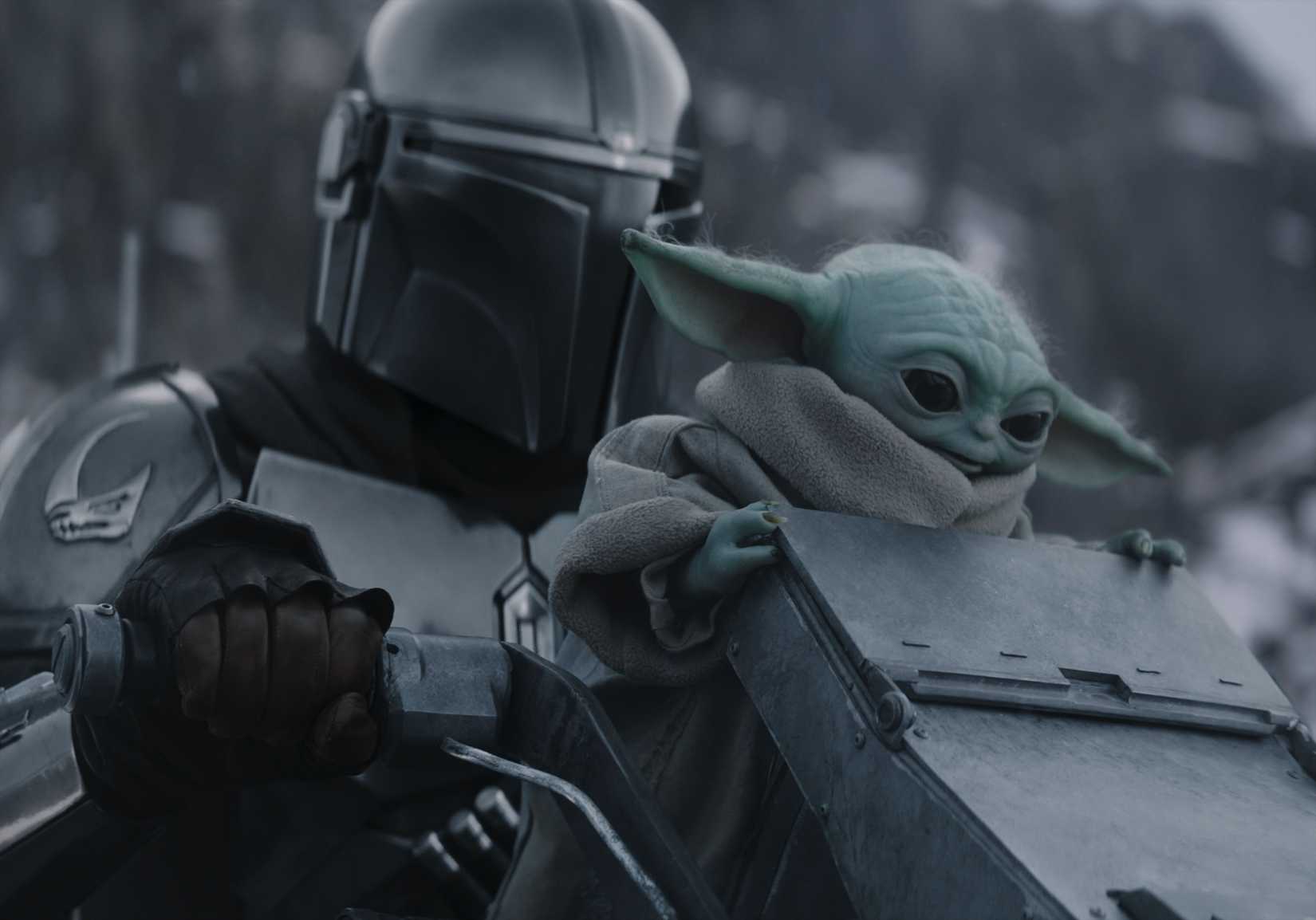 Image: Lucasfilm
The deeper issue is that The Mandalorian and Grogu never figures out what to do with the contradiction at the heart of Rotta’s character. On paper, there’s something compelling about Jabba’s heir rejecting the violent legacy he was born into. Star Wars has always been obsessed with inheritance — not just bloodlines, but the fear that identity is predetermined. Rotta slots neatly into a lineage that includes Luke refusing Vader’s path and Kylo Ren trying, unsuccessfully, to escape the gravitational pull of both the Skywalkers and the Solos.
But Rotta isn’t rejecting his violent legacy as much as the family business. He does kill characters, seemingly without remorse — a fighter in the ring, Stormtroopers in a chase scene — and even attacks Din before realizing that his captor, Janu, doesn’t want him to make it out of their gladiator arrangement alive. Like the rest of The Mandalorian and Grogu, it feels like the movie tried to speedrun through Rotta’s character development instead of letting the audience sit with the contradictions of someone who, despite rejecting a life of organized crime, has literally built his body around a life of combat.
 Image: Disney Plus
In an alternate timeline, you can imagine Rotta turning into a cult favorite character — the absurd visual of a swole Hutt playing with Grogu on a beach speaks for itself. And to be fair, it almost works. Rotta is memorable in a way that many modern Star Wars supporting characters simply aren’t. Non-human characters in this franchise tend to fall into a bucket of cute and plucky (Grogu) or straight-up terrifying (the Sarlacc), but Rotta occupies a rare middle space: funny by design, yet played with just enough conviction that he doesn’t feel like a punchline.
But memorable isn’t the same thing as meaningful. The strangest part of The Mandalorian and Grogu isn’t that Jabba the Hutt’s son becomes a central emotional figure in the story. It’s that the movie stumbled onto a genuinely fascinating continuation of Star Wars lore — but never quite figured out how to be as fearless and inventive as it clearly wants to be.

![ELDEN RING NIGHTREIGN: Deluxe Edition [FitGirl Repack]](https://i5.imageban.ru/out/2025/05/30/c2e3dcd3fc13fa43f3e4306eeea33a6f.jpg)
 English (US) ·