.png)
 4 months ago
63
4 months ago
63
Video game development is a battle against time. Studios are often at war with deadlines, rushing to hit milestones and complete features to stay on track (and on budget) with an upcoming game’s release date. Sometimes staff members lose those fights, and delays become an inevitability. That’s not always a sign of defeat. For Mio: Memories in Orbit developer Douze Dixièmes, it was practically divine intervention.
“We were a bit late, to be honest,” Douze Dixièmes co-founder Sarah Hourcade told Polygon in a video interview ahead of Mio’s Jan. 20 launch. “This is the second release date that we discussed with the publisher. The first one, that was never announced and we never talked to the public about, was actually the exact same date as Silksong.”
There was no way for Douze Dixièmes to plan for the Hollow Knight: Silksong hype train, since Team Cherry only announced its Sept. 4 release date a few weeks beforehand. Whether it was destiny or not, the narrowly avoided collision with one of 2025’s biggest games is just one example of time working out in the studio’s favor. (Other developers weren’t so fortunate, which resulted in last-minute delays.) Douze Dixièmes made every minute of the stylish new Metroidvania’s development cycle count, even down to the final months of development afforded to it by a miraculous internal delay. It wouldn’t be the same game without that calendar management.
Development on Mio: Memories in Orbit began five years ago. The team at Douze Dixièmes had just wrapped up its previous game, the puzzle-platformer Shady Part of Me, and were eager to try something new. As if they penned their own fate, the team started thinking about the very game that would have spoiled their initial launch plans had they not pivoted.
“The first weeks, we knew that we wanted to make a Metroidvania in a science fiction environment,” Hourcade said. “Half of the team was playing Hollow Knight at the time and we were thinking Silksong was going to take such a long time. When we made Shady Part of Me, it was a very linear platform game and at the end of it, we were very, very sick of playing it. We thought, next time, we want to make a game that after five years of making the game, we still have fun playing it.”
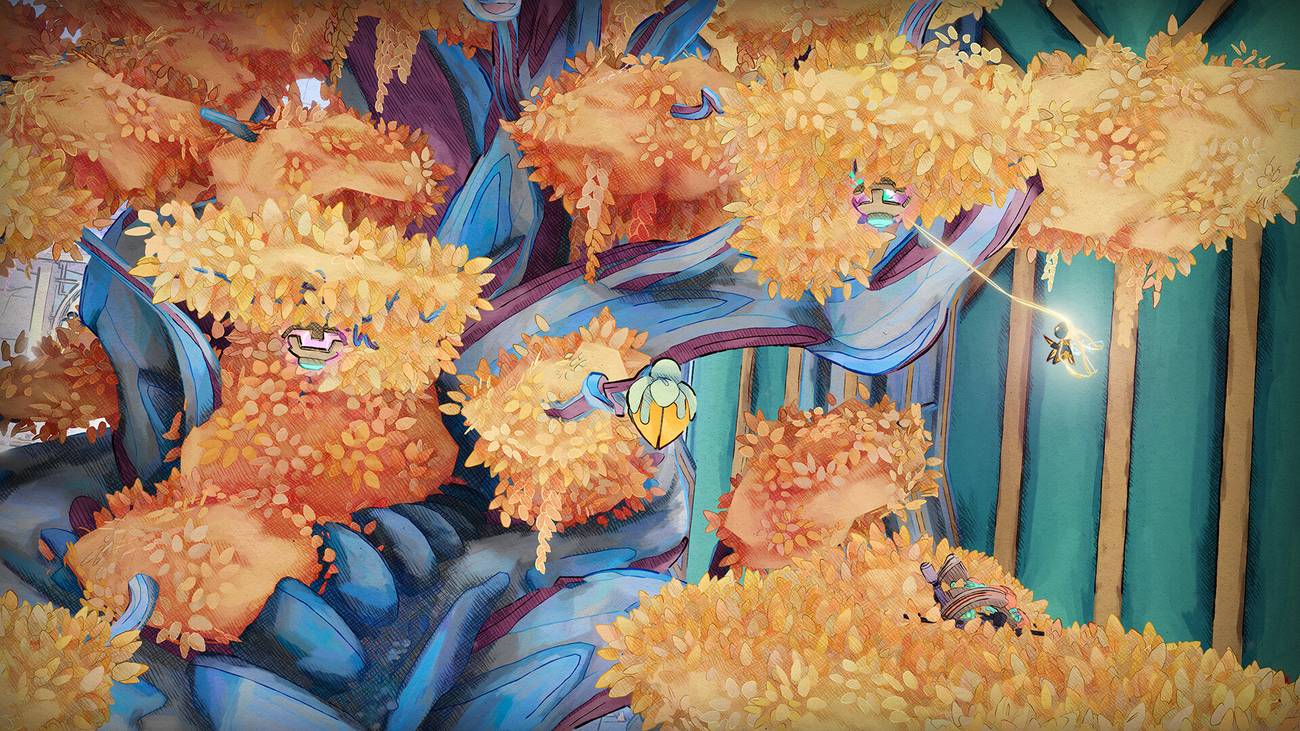
The small team got to work creating something that was inspired by several games. Hollow Knight was a north star, but the team was also thinking about Ori and the Blind Forest for art direction, as well as Chants of Sennaar and Tunic in terms of games that don’t tell you everything outright. It was an ambitious swing for a studio that had previously made a short and comparatively straightforward puzzle-platformer, and the reality of that started to stack up over five years of development.
“We had so many things that changed a lot because we didn't want inconsistencies,” Hourcade said. “And every time we found one, we were like, ‘oh no, not good.’ We lost so much time.”
Everything was changed in two months.
As a good example of that, Hourcade discusses the game’s map design. Mio takes place entirely on a spaceship called The Vessel. It's structured a bit like a human body, with everything converging back to a central room called The Spine. At one point, the team wanted to go all in on that idea and include only one checkpoint in that room — a complicated idea that was scrapped after the team accepted that they could only pull it off had they been working toward that goal from the beginning. (The final game features around 18 checkpoints, slashed down from 50 earlier in the project’s life cycle.)
While the team missed their window on some ideas, other key features came together in record time. If you’re struck by Mio’s art style, which makes every frame look as though it was hand-drawn in watercolor, know that it used to look very, very different before some quick work gave the game its distinct look.
“One of the main things that we decided to do to make this hand-drawn environment is something that we changed in the middle of production,” Hourcade said. “At the beginning we started like every other game. Artists are going to make things and then we're going to do the post-process on the render and everything. After three years of production, they decided to change everything. All rendering, all systems of material, all lighting, everything was changed in two months.”
The change there came from what Hourcade describes as a Photoshop-like post-processing method that allowed the developers to apply a consistent hand-drawn look to every frame. The team’s approach to lighting significantly changed in the move too. In the original art style, scenes were usually lit by multiple lights. In the final version, most scenes have only one light source instead.
Other big features came together much later in the development cycle. In fact, some likely wouldn’t have made the game at all had Mio stuck to its initial release date plan. The game’s final ending, for instance, was only written in the last eight months of production, Hourcade said. Other choices were even more down to the wire, including a feature so fresh that even Hourcade isn’t sure how players will feel about it.
“We had to make choices and we knew that from the start,” she said. “You can't be innovative in every area. You can't change everything. So some small changes are going to be unique because they serve their purpose. Some things were done at the very end of the project and we don't know yet if it's such a good idea or not, but we're going to just see how it goes. For example, the mechanic where you permanently lose your life... It arrived, I think, six months before release.”
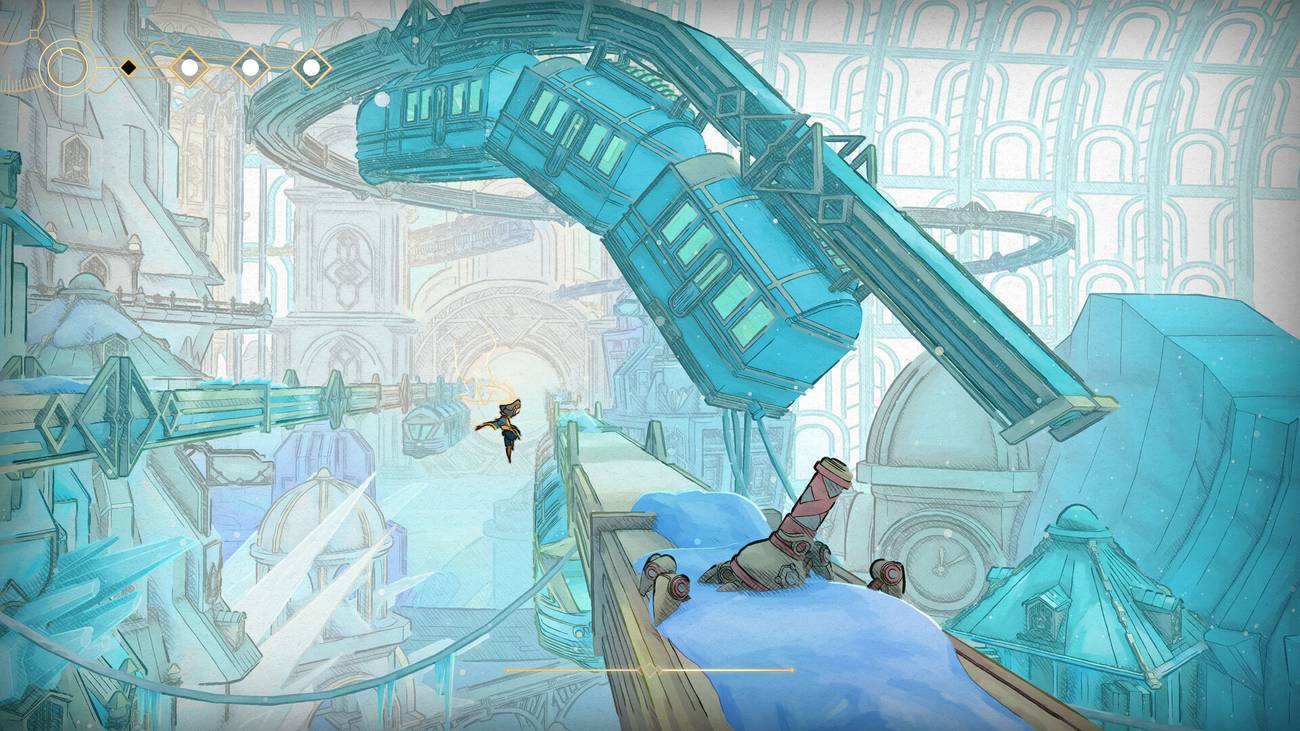 Image: Douze Dixièmes/Focus Entertainment
It’s not just that Mio changed a lot in five years; the world around it did too. The game tells the story of an abandoned spacecraft that’s run by AI caretakers. The robots have gone rogue, and it’s up to Mio, the game’s pint-sized hero, to set them straight. That story is way more loaded in 2026 than it may have been in 2021 thanks to the rise of generative AI in recent years, something that’s become a powder keg issue for the video game industry. The topic naturally wasn’t on the studio’s mind when it wrote hundreds of pages of background on the game’s universe, but some of that AI anxiety did make its way into what’s now a timely story.
“We can't live in a cage and not see what's happening in the world,” Hourcade said. “So we thought about it. But — it's very weird coming from a video games studio — we're not very tech involved. I think no one in the studio has an Instagram account or anything like that. We have no social media. We don't use AI. Of course we read the news and we know what's happening in the world, but we're a bit in our world. But I think it did inspire part of the story, because of course we read the news, we read everything, and it feeds what we write.”
Now launching in a quiet January rather than a crowded September, Douze Dixièmes’ knack for good timing is paying off again. Mio is the first major Metroidvania to release in the wake of Silksong, coming at a time when more people than ever are hungry for the genre. It’s a pleasant surprise for the studio, but a double-edged sword too. The close proximity to Silksong is sure to earn it a few haters who see it as a cash-in rip-off. Hourcade said that she’s already seen some comments on trailers to that effect.
Mio would not be what it is if Hollow Knight didn't exist.
While there’s some clear Hollow Knight inspiration in Mio, it’s very much its own game. It’s a more traditional Metroidvania that puts an emphasis on movement and mystery over combat. Where Hollow Knight is grim and whimsical, Mio is meditative and philosophical. Time shaped it into its own distinct entry into genre canon. Even with a little anxiety hanging over her head at one point, Hourcade seems confident that the team’s work will pay off.
“People are going to compare it to Silksong and some people are even going to say that we've made a copy of Silksong and we already know all of that,” she said. “It was something that had us very worried during production, to have too much inspiration from one game. But in the end, about 20 people worked on this game and everyone put their story, their feelings and everything in. It's just nice that we have amazing games to take inspiration from. And Silksong is a masterpiece! It's a very amazing game, so we're just very glad that it's there. We can play it now and will never know what would happen if it wasn't there. But Mio would not be what it is if Hollow Knight didn't exist. I think we're all working together.”
And if you’re hoping for a sequel in less time than it took Team Cherry to make Silksong, don’t get yourself too hyped up. Hourcade said that the team hasn’t talked much about turning Mio into a wider franchise. Even if the team wanted to, Douze Dixièmes will have to wait: Mio’s director is following the project up with a year-long vacation. Now that sounds like a good use of time.


![ELDEN RING NIGHTREIGN: Deluxe Edition [FitGirl Repack]](https://i5.imageban.ru/out/2025/05/30/c2e3dcd3fc13fa43f3e4306eeea33a6f.jpg)

 English (US) ·