.png)
 2 months ago
18
2 months ago
18
What will this summer’s Moana bring that the original version didn’t have? Polygon spoke to Thomas Kail, the director of the live-action version, to ask what we should expect from the new edition. Kail has plenty of experience with musicals: He directed Lin-Manuel Miranda’s Hamilton and In the Heights on and off Broadway. Similarly, he’s worked in other projects that transform musical stories from one medium to another: He shot Disney’s live-from-Broadway movie version of Hamilton, and Paramount’s live TV version of the musical Grease. What does that mean for live-action Moana? We discussed it in this preview interview.
This interview has been edited for clarity and concision.
Polygon: Why do we need a live-action Moana?
Thomas Kail: I was incredibly moved by the chance to memorialize [Polynesian] culture. Having this story told with human beings on-screen, there's an opportunity to make a companion to what came before. I'm from the theater, where the idea of doing a revival is commonplace. There's something about taking a text and having it evolve.
Obviously, we have scenes [in the live-action version] that don't exist [in the animated version]. In the live-action movie, we have lots of things that are different. But you trust the story and material, and you try to give it a reason for being.
There's something about putting a flesh-and-blood teenager in the middle of this story of building this village, and being in this village, and celebrating Polynesian culture. It just felt like a real opportunity to hear what it sounds like for these new voices to sing songs that we know. So that was something we really tried to seize.
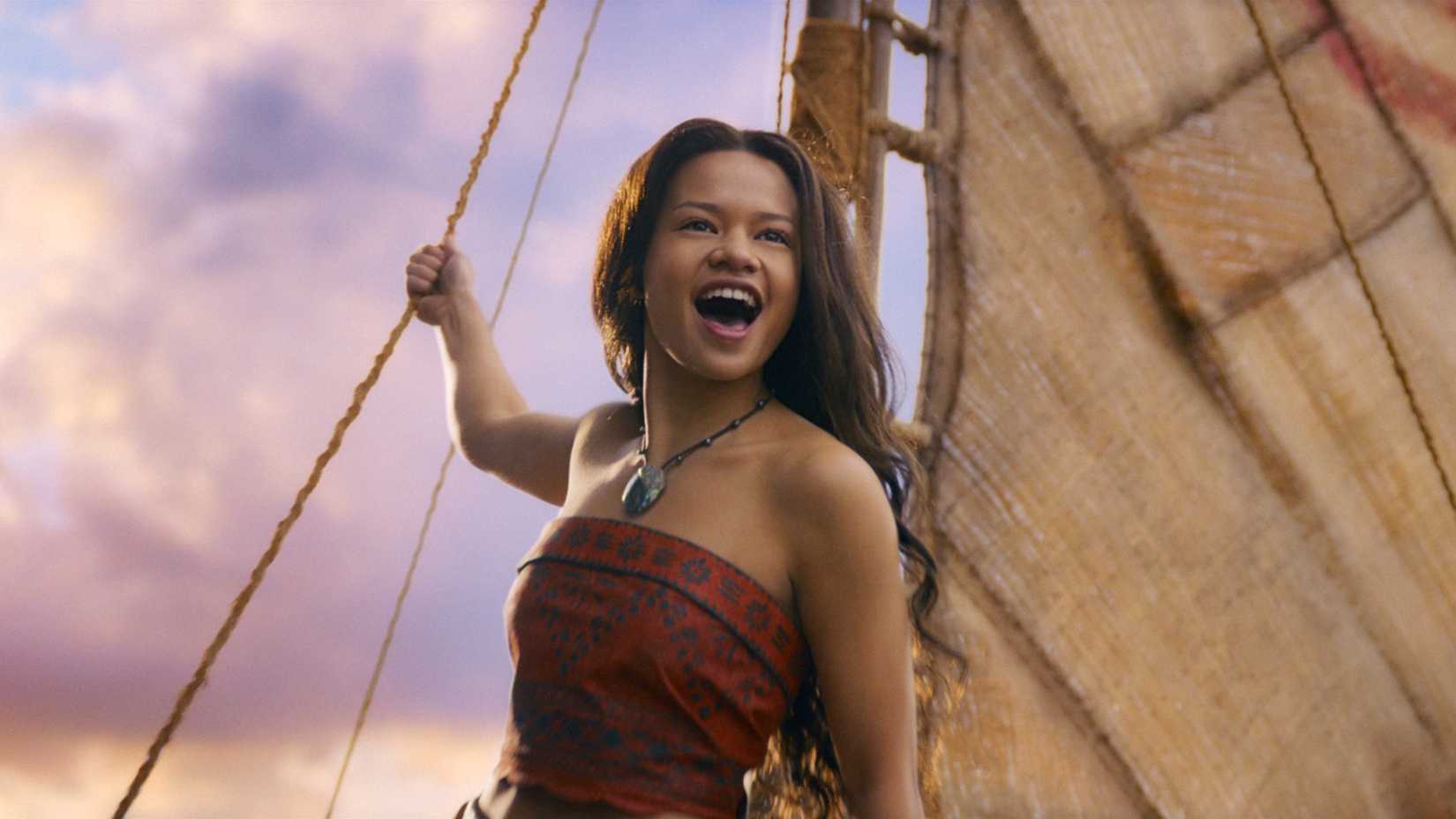 Image: Disney
When I talked to the director of the live-action How to Train Your Dragon, one of the things he said that surprised me most is that he was aiming it at the class of people who never see animated movies because they think animation is for kids. Do you feel this movie is most aimed at people who love the original, or people who have never seen the original?
It’s something we've certainly thought about and talked about. The audience for Moana, the people who care about Moana, are anywhere between the ages of 3 and 98. It really is vast. And I don't know that I've ever experienced anything quite like that.
I was certainly struck when we made Hamilton by how many young folks under the age of 10 found that show, and what it became for them. And now here we are, 10 and a half years after we opened that show, and there are 10-year-olds who are now 21, and it was something they had a chance to experience when we put that film out in theaters.
Animation has clearly proven over these last years and decades that it is for absolutely everybody. You can see how many people go to see it in the theater. But if this [version of Moana] opens up a new pocket of people who said, “Now I can go check that out," that feels like it feeds the animated version as well. My hope is that you see this and you think, "OK, well, what was the other [version like]?” Or if you saw the other, that you look at them again as these companions.
 Image: Disney Enterprises, Inc.
Filming a stage play to be presented as a movie and turning an animated movie into live-action are obviously very different disciplines — but you are adapting a story from one medium to another. Did you learn anything from directing the Hamilton movie that you applied to Moana?
Absolutely. One thing you do is trust the material — people invest in these characters. They know the music. When you make a musical, your relationship to whatever you're making has a chance to have a longer tail, because you listen to the cast recording five years, 10 years later. It can be the song that you run to, the song you go to sleep to.
One of the fundamental things that’s distinct about the transposition of Hamilton from stage to screen… I said this to our editor at the time, I said, "I don't know that you and I will ever work on anything where no one's telling us to cut for time, and they're not saying, ‘Why don't you swap those two scenes order wise?’” I was like, ‘So we don't have to worry about that, for this one instance of our life.’”
When you're doing something like Moana, there is a structure that exists. So there might be ways that you shuffle cards, but there are points along the way you need to honor. It’s also certainly about allowing interpretation so this particular form can be its own thing.
We filmed the Hamilton shows on a Sunday and then a Tuesday with an audience, and did about a day without an audience. It was about capturing the feeling — what does it feel like to be at the Richard Rogers Theater in June of 2016?
[With Moana], we’re making something that hopefully is not as tied to a moment — trying to make this film to be an always thing, and not about it just existing in that moment. And the way you talk about story and work on performance with an actor is the same. The difference with Hamilton, of course, is they played that 353 times by the time I got there. I didn't need to tell Jonathan Groff too much. Leslie Odom Jr. knew exactly what he was doing.
With this Moana, there was a process of discovery. But with Dwayne Johnson, who’s in both [versions], we had conversations based on the fact that he’d lived in the role for all these years, so in some way, it was a chance for him to explore new things and new dimensions.
 Image: Disney Enterprises, Inc.
What gave you trouble in translating the film to live-action? What kinds of problems did you have to solve for?
You have to solve for every moment! You say, “OK, we're going to tell a story — what if there's singing and dancing? OK. What if there's a lava monster? OK. Did you say there's a crab that sings? OK. Is there a mountain that also becomes an island that becomes a goddess? These are not things that you often have to grapple with, no matter what you're making.
One of the things we were struck by was, for a movie that has profound simplicity, there's also deep complexity in how it's made. So that was something we wanted to do to make sure that each of those moments felt grounded at the top [of the movie], so you could go battle a lava monster and have it still feel like it was that same young woman who was in that village, doing everything she could for her family.
How much is new in the live-action movie? Have any of the songs been cut or significantly changed?
I don't know that I can speak to all of that. What I will say is that the ability to interpret and reinterpret and have songs sung by different people, I think, just inherently brings texture there. I will certainly say that, especially working with Mark [Mancina], who did the score for the original, we were really keen to examine, moment by moment, "Does this still work?”
Some things work beautifully in animation, but because of the way a live-action adaptation might breathe, a scene might play differently, or the construction of it is inverted. What comes with us, and where can we continue to explore and express? Mark wrote a tremendous amount of new music throughout for the score. And yet also, some of those themes from before are still there. That to me was a microcosm of how we wanted to try to approach it — trust what works and also not be afraid to go and explore new things.
 Image: Disney
The Disney live-action adaptations have varied a lot in terms of whether they're scene-for-scene remakes or they’re doing their own thing. What was your intention? What was your approach?
This is certainly one where we were not afraid to deviate, or to have a scene that was in a different spot or a different circumstance. But those major plot points, the reasons you loved [the original], those characters and the way they interacted are there. But there's tons of new dialogue, lots of new jokes.
Some scenes that didn't exist in the [original] film are things we wanted to embrace and give ourselves an opportunity for reframing. “If this was done this way in animation, what if it was this, given the new circumstances, or this setting?” So we certainly were open to that.
 Image: Walt Disney Animation Studios
There are places where the animated movie goes very cartoony, particularly in “You’re Welcome,” which heads off into an especially visually stylized space. Did you want to try to reproduce that feeling? Or are you addressing that in your own way?
We wanted to give that moment its due. We're finally meeting Maui. We have Dwayne there, and you want to deliver that number. And it did feel like in many ways, that number has a very clear story. Let me not be the first to say it, but this Lin-Manuel Miranda kid can really write a song.
So we wanted Maui to sweep Moana up and mesmerize her so he could get the boat. How could we elevate from something grounded to build that? So we took inspiration from the way the 2016 version opened it up. Our version resembles it energetically, but it is quite different in many other ways. And yet I think it delivers that same “wow” factor that’s like, “All right, there's Maui, here we go.” That really sets you off, I think, for the back half of the film.
The live-action Moana opens in theaters on July 10, 2026.

![ELDEN RING NIGHTREIGN: Deluxe Edition [FitGirl Repack]](https://i5.imageban.ru/out/2025/05/30/c2e3dcd3fc13fa43f3e4306eeea33a6f.jpg)
 English (US) ·