.png)
.png) 5 months ago
49
5 months ago
49


Published Feb 13, 2026, 11:30 AM EST
Murillo Zerbinatto is a contributor from Brazil. He's an RPG enthusiast (with a focus on JRPGs) who has been around the world of games and content creation for more than five years now. He has a particular love for Final Fantasy and has absorbed all the content this long-running series offers, including its obscure spinoffs such as Dimension I & II, Explorers, and My Life as a King. While playing RPGs is already a time-sinking endeavor, Murillo doubles down by being a platinum hunter as well.
Sign in to your DualShockers account
The major difference between a list of hidden gems and obscure JRPGs is that hidden gems are often populated by great games that deserve more spotlight, whereas for obscure games, that isn't necessarily true. It could be just weird games, or unknown games, and yes, sometimes great games that never saw the light of marketing.
Sometimes, I like to delve into obscure JRPGs just to peek at the other side of crazy, wonderful, and novel ideas. More often than not, they don't stick, which is why those games remain obscure. But in rare occurrences, it's such a shame that a few titles are unknown because they had the potential to bring something new to the table, provided they stuck the landing.

In this list, I will show some of the most obscure PS2 JRPGs. Some you may already know or have heard of, others are simply, well, really obscure, which is the whole point of this write-up. Who knows, maybe one of them will tickle your curiosity, and your backlog will have a new addition.
I opted to add only games with international releases because, while it's easier to find unknown games released only in Japan, what's the point, right?
10 Tsugunai: Atonement
Atone by Blocking

Tsugunai: Atonement is a really eccentric game. First, the title: what kind of name is that? Secondly, it has all the basis of great ideas, but the execution is a bit dry or wonky. We play as Reise, a mercenary tasked with getting a sacred orb. He completes his mission, but once he does, the God of Light punishes him by separating his body from his soul.
Now, Reise must atone by helping several villagers in a nearby village. He can possess the bodies of others to complete quests, some of which involve fighting and all the stuff you expect from a JRPG, such as leveling up, getting money, and buying equipment. It's a really good premise, but it gets old fast. The combat follows the same trend. In it, you can attack, use magic, or use Strage, a sort of Limit Break.
The meat of the battle, however, is timed blocking. Every time an enemy attacks, we must press a button, and if timed correctly, we block, evade, or counterattack. What is only a means of making battles easier becomes increasingly essential to the point that if you don't master the block, you won't be able to proceed. And as you may have gathered, it also gets old way too fast. Good ideas, bad execution.
9 Stella Deus: The Gate of Eternity
A Straightforward Tactical Game
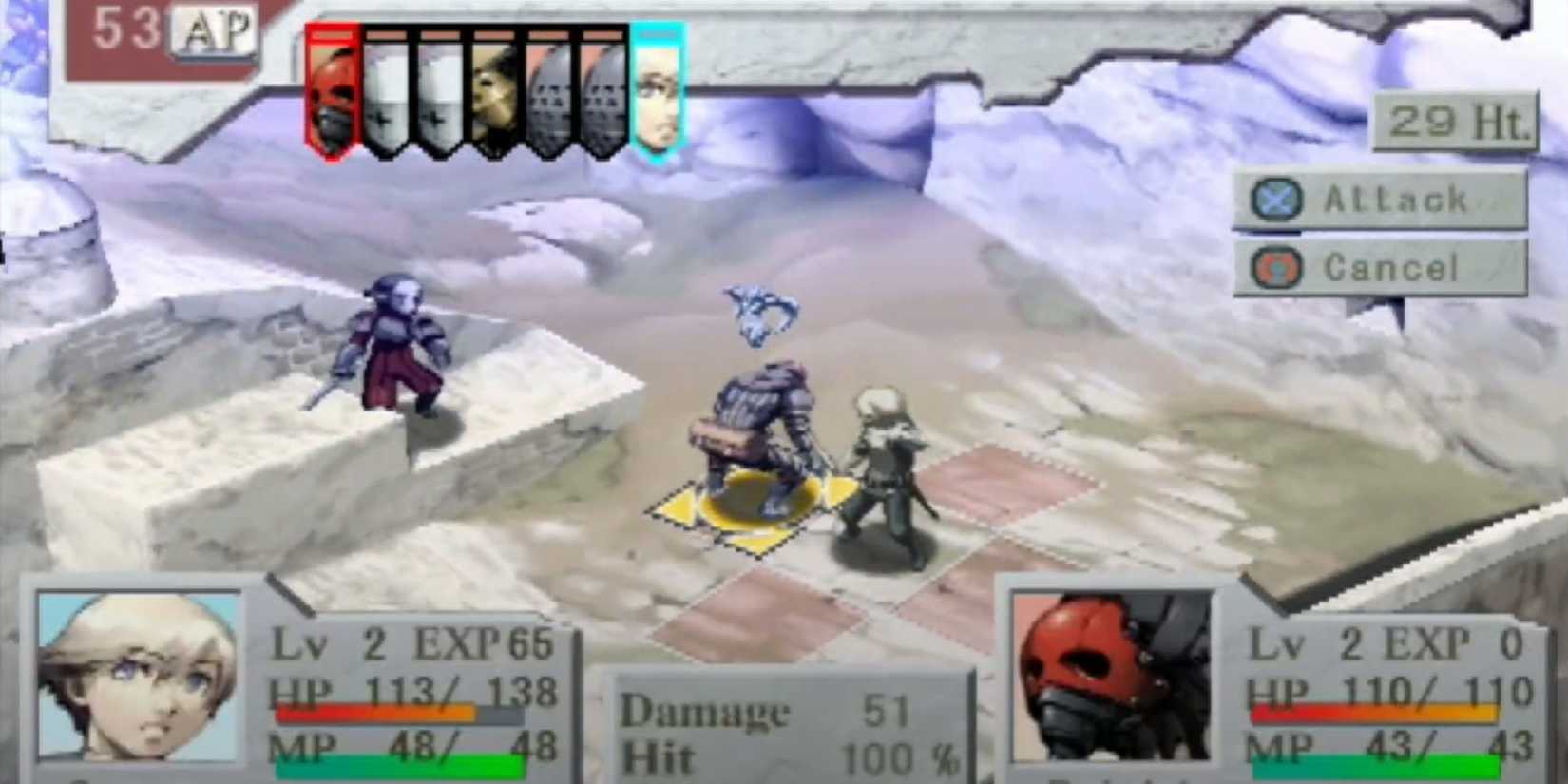
Stella Deus: The Gate of Eternity
During the PS1 and PS2 eras, we had a flood of tactical JRPGs being released. Many of these couldn't hold a candle to the most prestigious of them all, Final Fantasy Tactics, while some brought something new to the table and were a good time in their own right, like Disgaea. Unfortunately, Stella Deus: The Gate of Eternity was neither.
The game wasn't all that bad, but it wasn't exactly good. I played it back in the day on my PS2, and I barely remember it. There's a fog killing the world, and the church says death is imminent. A group of rebels, led by Spero, the protagonist, is searching for the Gate of Eternity, a magical structure said to dispel the fog.
Combat is purely tactical-based and as straightforward as ever. Characters move on grids, can attack enemies according to their range, like melee for fighters and distance for mages or archers, and sometimes they do a team attack if an ally is nearby. The most unique mechanic is weapon fusion, where combining two pieces of equipment creates a new one.
Mad Max JRPG

In 2022, I reviewed Metal Max Xeno Reborn. It was a quirky game, but it had its moments. It hit me then that I had already played a game where most of the traversal and combat is done inside a tank, so I scoured my completely original PS2 collection and found Metal Saga. Yeah, same series, similar blueprint.
Metal Saga takes place in a post-apocalyptic world that is really reminiscent of a Mad Max setting. We play as the son of a now-retired famous bounty hunter named Eddy. Instead of living as a mechanic, we also want the glory and enticing danger of a mercenary life, so we set out in a sprawling open world, hunting outlaws and taking on different quests.
Turn-based battles can be done on foot, but it's better in a vehicle. We can rent or customize our own, ranging from buggies to tanks, buses, and even fire trucks. The game doesn't take itself too seriously, and neither should you, if you want to enjoy a good, mindless time with it.
7 Crimson Tears
Red Ribbon Androids

If you know The Bouncer and see gameplay of Crimson Tears, you will notice similarities between the games. And for good reason: after all, both were developed by Dream Factory. But while the former was published by Square, Crimson Tears was published by Capcom, which surprised me because it simply never hogged the spotlight.
Crimson Tears presents three mutanoid characters, which are bio-engineered terminators. Their creator, Dr. Kusogi, disappears, and they set out to find him while kicking ass in the meantime. The gameplay loop is inherently repetitive since dungeons are randomly generated, and odds are you won't be strong or equipped enough to finish it in one go. I may be wrong in saying this, but the game has a knack for roguelite elements.
Battles are played in a hack-and-slash style that starts with simple button-mashing but evolves as we learn new combos or improve our equipment. If one character dies, another can delve into the dungeon until it reaches the fallen one to save its spoils. Then, spend money, buy new equipment, and try again until you, as the player, are proficient enough to tackle the challenge or your mutanoids are strong enough to just bulldoze your enemies.
6 Eternal Poison
Intriguing Storyline
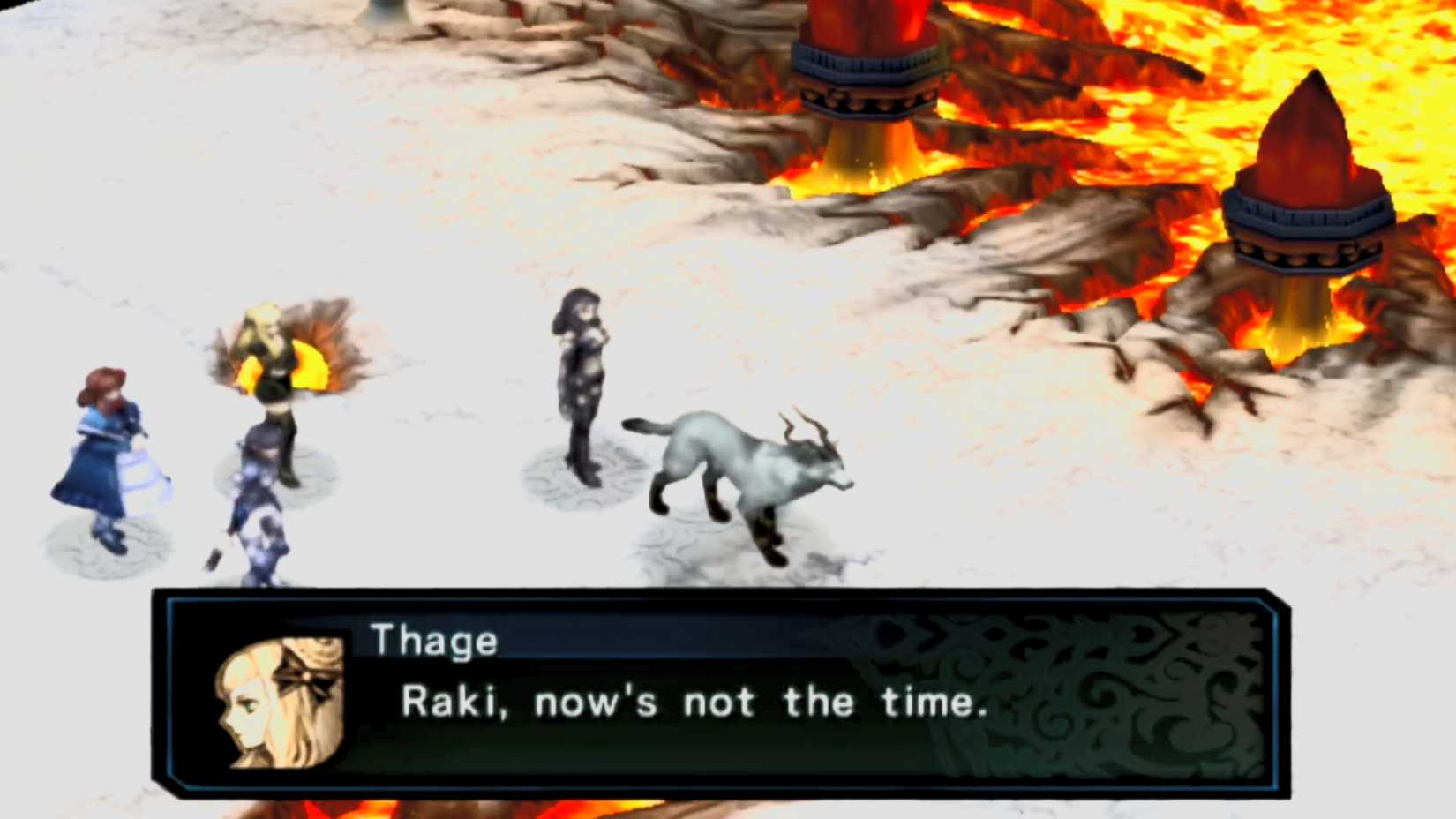
Eternal Poison is another one of those tactical JRPGs that found a home on the PS2. The demonic realm of Besek suddenly appeared in the Kingdom of Valdia, kidnapping the princess. The king asked for aid from adventurers, and a bunch of them allegedly will help, but behind the scenes, some have their own agenda for delving into Besek.
That's where Eternal Poison truly shines: in its multifaceted storylines. We follow the perspective of five groups in total, each with its own backstory and motivations. As they delve deeper into the demonic realm, they must face Majins, either defeating or capturing them. Captured Majins can be used in battles as temporary allies, destroyed to get new skills, or sold, which increases the goods available in shops.
Battle is the standard grid-based fare. The difference is that every enemy has a resistance or weakness. Since characters can have up to three different weapons and seven elements, we have to really think about which actions we will take against which enemy. Also, every time two characters engage in combat, an animation plays that is better turned off unless you want to watch the same repetitive movement over and over again.
Related
10 JRPGs That Don't Feel At All Like Anime
Just because they’re RPGs inspired by Japanese culture doesn’t mean they automatically have anime aesthetics.
5 The Sword of Etheria
Lowkey Inspired by The Wizard of Oz

Do you remember when Konami released new JRPG IPs left and right? Man, those were good times. And they might be coming back because the company just announced Rev. Noir at the State of Play. How wonderful! If you didn't know, Konami was quite prolific with new IPs. One such example is The Sword of Etheria, known simply as OZ, aka Over Zenith, in Japan.
In this 3rd-person action RPG, we play as Fiel, an orphan who's raised by his sister Dorothy. The siblings can tap into Etheria and draw on magical power to face the evil gods and warriors known as Katenas. If you play it, you may notice they borrow more than a few elements from The Wizard of Oz.
The gameplay is divided into chapters, with players traversing each new area freely while talking with NPCs, party members, and defeating enemies. The action is combo-oriented, and if you manage to keep the hits up with the help of your two AI-controlled allies, a gauge will increase. Once it hits the top, you can unleash a party deathblow and vanquish the enemy.
4 Orphen: Scion of Sorcery
Deserves the Obscurity

Some games are obscure due to a lack of marketing, failure to keep up with the trends of the time, or a mix of both. Others, however, are simply obscure because they're boring and no one deemed them worthy of talking about, leading them directly into the darkest corner of every gamer's shelf. That's the case for Orphen: Scion of Sorcery. I remember playing it back in the day and just hating my experience.
But since this list is all about shedding some light on these titles, let's get to it. In Orphen: Scion of Sorcery, we play as, you guessed it, Orphen, and his friends after they're stranded on Chaos Island. The game has some neat replayability due to a time-traveling object that can change some storylines, but that's pretty much it.
Combat is weird. There are barely any RPG elements and numerical statistics at play here. Most battles function as puzzles and rely more on timing your hits than picking the right command, if you can even pick a command. It's really eccentric and didn't make for a joyful experience. While it has some neat anime cutscenes, I suggest it remain in obscurity.
3 Baroque
Roguelike Dungeon Crawler Experience

This Baroque is a remake of a previous Baroque. Weird, right? That's why a subtitle is crucial, even though it may sound silly to call a remake a remake. Baroque was first released in 1998 for the Sega Saturn, then remade for the Wii and PS2 in 2007, which is the one I'm talking about here.
Baroque's premise is really intriguing. The world practically ended after a cataclysmic event named The Blaze. We play as an amnesiac survivor who must explore the Neuro Tower in search of answers about the apocalypse. In the process, he needs to purify Meta-Beings, creatures that are no longer human.
Using the Tower as its main setting, Baroque is essentially a dungeon crawler roguelike. It has action gameplay that helps us dive deeper into the Tower. If we die, we go back to our hometown, and we lose all items except the ones we previously stored inside an orb. Then rinse and repeat until the player completes quests, progresses through the main story, and expands the Neuro Tower further.
2 Magic Pengel: The Quest for Color
Doodling by Yourself

|
Garakuta-Studio, Taito |
|
Taito, Agetec |
|
June 24, 2003 |
Magic Pengel is a monster-breeding game, a genre that has always been in the zeitgeist thanks to Pokémon and more than a few JRPGs that wanted to hog that trend. Few managed to do so, and Magic Pengel wasn't one of them. However, the game had some really innovative ideas.
For instance, in the game's world, there are Doodles, creatures that come to life after fairy paintbrushes known as Pengels draw them. And by drawn, I mean you, the player. You can create a blob or something detailed, depending on your skills and the amount of paint available. Then a Doodle is created, and its statistics depend on the number of body parts and the amount of magic ink spent.
Battles are turn-based and operate under a staple rock-paper-scissors formula. They can be quite a slog due to their slowness. However, there's something whimsical about seeing our doodling come to life and fighting for us, and the surprising depth in the Doodle creation. Apparently, Magic Pengel: The Quest for Color is owned by Taito, who in turn is a Square Enix subsidiary. Magic Pengel HD-2D remake incoming?
1 Ar Tonelico: Melody of Elemia
Music Takes Alchemy's Place

Ar tonelico: Melody of Elemia
Ar Tonelico is probably the least obscure JRPG on this list, which is saying a lot. Developed by Gust, the makers of the Atelier series, Ar Tonelico: Melody of Elemia centers its themes on music instead of alchemy. In the world of Sol Ciel, an imminent virus is threatening the Tower of Ar Tonelico. One of the knights, the protagonist Lyner Barsett, must recover the Hymn Crystals to save the Tower and the whole world along with it.
The game's exploration is notorious JRPG-based fare. We traverse all sorts of dungeons, face enemies in random encounters, and go to town to buy items and whatnot. Every party member that joins us has their own advantages and skills, but the major difference is the Reyvateils, who have song-powered abilities. The longer a Reyvateil sings in battle, the better the magic they cast.
Ar Tonelico features the Cosmosphere, which further expands a Reyvateil's power. The player can dive into the Reyvateil's Cosmosphere, a section that plays much like a Visual Novel and enriches the character's personality. Deeper diving levels are unlocked as Reyvateil's relationships grow, creating a nice loop of interaction that bolsters the whole narrative.

Next
10 Most Obscure PS1 JRPGs
If you know five or more titles from this list, I've failed my mission.


![ELDEN RING NIGHTREIGN: Deluxe Edition [FitGirl Repack]](https://i5.imageban.ru/out/2025/05/30/c2e3dcd3fc13fa43f3e4306eeea33a6f.jpg)
 English (US) ·