.png)
 2 months ago
39
2 months ago
39
Employees and developers working on Magic: The Gathering Arena say they were hired with promises of remote flexibility, so they bought homes and built lives around those assurances. But they say they are now being told they may need to relocate to Washington state — or effectively lose their jobs.
Those concerns are a major reason why a supermajority of workers on the Arena team are attempting to unionize with the Communications Workers of America, under the banner United Wizards of the Coast. The group publicly launched its campaign on April 27, calling on Wizards of the Coast and parent company Hasbro to voluntarily recognize the union by May 1.
Instead, the company opted to proceed through a National Labor Relations Board election process now scheduled for June 2, during which eligible employees will vote on whether or not to form a union. With a simple majority, a unit will be formed. Wizards of the Coast has also retained outside counsel from Fisher Phillips, a prominent labor law firm that has represented employers in union campaigns and labor disputes across the tech and gaming industries. According to the NLRB filing, the proposed bargaining unit includes 97 eligible employees working on Arena.
 Related
Magic: The Gathering Arena developers seek to unionize at Wizards of the Coast
More than 100 developers behind Arena are pushing for protections around layoffs, remote work, and AI
“We have received the filing and are reviewing it carefully,” Hasbro said in a statement provided after the union announcement. “Our employees are the lifeblood of what makes us great, and we are committed to fostering a workplace where every person feels heard, valued, and supported.”
Workers speaking with Polygon via video call said the decision to unionize stems from years of growing instability at a time when both Magic itself and Arena appear to be more successful than ever.
“The thing that really kicked off the union conversations were the 2023 layoffs, where Hasbro laid off about a thousand people,” said Xib Vaine, a producer on MTG Arena and member of the organizing effort. “Everybody I talked to couldn’t understand why Arena was hit by those layoffs. By every metric, we were succeeding.”
The broader Magic: The Gathering brand is estimated to be worth more than $1 billion. Arena has 13 million registered players. According to data from Sensor Tower, Arena was downloaded 80,000 times and generated $2 million in revenue in April alone.
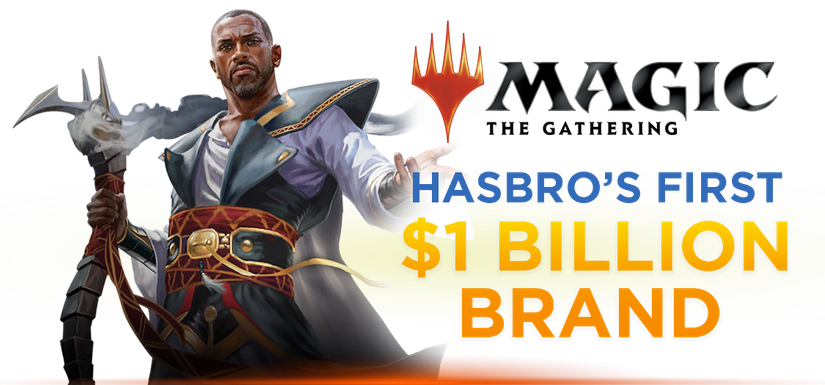 An image from Hasbro's website notes that Magic: The Gathering is the company's first billion-dollar brand.Image: Hasbro
Vaine said that five Arena employees were laid off in 2023, but there have also been continuous layoffs within Wizards since then that have affected departments the Arena team works closely with. In all instances, these layoffs deeply rattle morale across the studio, even among workers who remained employed.
“You walk in and somebody’s missing from over there, 20 people are missing from over there,” Vaine said. “You’re just watching the wave of layoffs get closer.”
Damien Wilson, a security engineer on Arena who joined Wizards of the Coast last year after more than a decade working in tech, said those experiences mirror a broader pattern across the industry.
“I’ve been laid off about eight times,” Wilson said. “If you work at these companies and you get a sense for how they work at the corporate leadership level, you come to learn that any mass layoff can never be well targeted. It’s not about finding whoever’s performing poorly. It’s about making the quarterly financials look good.”
Workers say conversations about organizing accelerated significantly in 2025 after Hasbro introduced a return-to-office mandate requiring employees to work from the office at least three days a week. According to organizers, many Arena employees were hired as remote workers in 2021 or 2022 — at the tail-end of the pandemic when remote work was the norm — and received assurances they could continue living outside Washington state.
“A lot of these people who are being forced to relocate are people who’ve never lived in Washington,” Wilson said. “They were given explicit assurances that if they started lives elsewhere, that it wouldn’t be yanked away from them.”
Vaine said many workers made major life decisions based on those expectations.
“Folks were asking, ‘Hey, I want to buy a house, but I can’t afford a house in Seattle. I’d like to move further away. Will I be forced to come back into the office?’” Vaine said. “They were told yes, it was okay. And then they bought a house and now suddenly the messaging was, ‘Just kidding.’”
 Official logo for the United Wizards of the Coast.Image: United Wizards of the Coast
According to the organizers, more than half of the Arena workforce now lives outside Washington or beyond what they consider a reasonable commuting distance. Arena itself has around 200 employees total, they said, with roughly 100 considered union-eligible.
The organizers also claim messaging around the return-to-office policy has been inconsistent and unclear, leaving workers unable to plan long-term. To date, there appears to be no firm deadline for employees to return to the office more regularly, yet internal messaging still positions it as a mandate.
“We do not feel like we can depend on any of the things we have been told until we get it in writing,” Wilson said.
Workers say relocation assistance is not guaranteed and may come with conditions requiring employees to remain at the company for years afterward, or risk having to repay the assistance if they leave or are laid off. Employees who decline relocation, organizers claim, may have their departures categorized as voluntary resignations, making them ineligible for severance.
Organizers say that uncertainty became a driving force in the push to unionize.
“The only recourse to fight this stuff is to organize,” Wilson said. “It is the only legal mechanism we have to get a seat at the table.”
The union’s public platform also cites concerns around layoffs, crunch, generative AI protections, career advancement, and ownership of employees’ creative work outside the company.
While Hasbro declined to voluntarily recognize the union before the group’s May 1 deadline, workers say they remain confident heading into the June election. According to Vaine, more than 75 percent of eligible Arena employees publicly signed onto the union effort before filing with the NLRB — more than enough needed to win the election.
“We have shown them through public support, through our voluntary recognition letter, that 75 percent of eligible Arena employees want a union,” Vaine said. “And yet the company is still delaying the opportunity for us to bargain for our working conditions.”
Even so, both organizers described the public response from Magic players and fellow game developers as overwhelmingly positive.
“We have gotten a tremendous amount of well-wishers and positive support,” Wilson said. “It has brought literal tears to people’s eyes to see some of the kind words people have sent our way.”
For workers behind one of gaming’s most successful digital card games, that support has become increasingly important as the union campaign moves toward its official vote next month. Both Vaine and Wilson ask that all supporters sign the group’s official petition.
“It’s going to be a stressful next few weeks for sure,” Vaine said. “But everybody, I think, wants Wizards and Hasbro to do the right thing. Now they just have to do it.”








![ELDEN RING NIGHTREIGN: Deluxe Edition [FitGirl Repack]](https://i5.imageban.ru/out/2025/05/30/c2e3dcd3fc13fa43f3e4306eeea33a6f.jpg)
 English (US) ·