.png)
 5 months ago
65
5 months ago
65

A look back at how crossovers are reshaping the trading card game's identity
 Image: Wizards of the Coast
Sign in to your Polygon account
Table of contents
The lists
The winners
The woofs
The trends
Magic: The Gathering didn’t just have a big year in 2025. It redefined what success looks like for a 32-year-old trading card game. Magic has more cultural visibility than ever before. Go into any Target, and you'll struggle to find any packs or decks at all for any of this year's sets. But Wizards of the Coast and parent company Hasbro are testing the limits of how much the brand can stretch before it stops feeling like Magic at all.
From a pure business standpoint, there’s nothing ambiguous about it: Wizards of the Coast, particularly Magic, is carrying Hasbro. In Q3 2025, Magic revenue grew 55 percent year over year, with CEO Chris Cocks pointing to a string of blockbuster releases led by Final Fantasy — perhaps the single best-performing set in the game’s history — alongside Edge of Eternities, Marvel’s Spider-Man, and high sales volume through various Secret Lair releases.
All this growth for Magic, however, cannot be separated from a structural shift driven by the success of crossover releases under the Universes Beyond umbrella brand. There’s no mistaking it. Like so much of the entertainment landscape, Magic: The Gathering puts a heavy emphasis on crossovers, for better or for worse.
No longer a side project
Universes Beyond began as a crossover experiment in late 2020 with a Secret Lair drop for The Walking Dead. Despite immediate backlash, it was a commercial success, leading to future drops for Stranger Things, Street Fighter, and Fortnite. Warhammer 40,000 Commander decks pushed things a bit further in October 2022. Then everything changed in 2023 with The Lord of the Rings: Tales of Middle-earth, a full crossover set with interesting mechanics and a bonkers chase card in the form of a serialized “The One Ring” that Post Malone eventually bought for $2 million. Hasbro later reported that the LOTR set earned $200 million in revenue over the course of six months, prompting Wizards of the Coast and its parent company to steer the Magic ship toward the great Universes Beyond.
2024 had Fallout as Commander-only decks that connected with players thanks to strong design choices that emphasized the thematic focus. That same year, Assassin’s Creed was released as a small, unconventional hybrid set that missed the mark from a design standpoint. That same year also saw major Secret Lairs like the Marvel Superdrop. But 2025 was the period that Wizards of the Coast and Hasbro finally pivoted to make Universe Beyond a major focus for Magic.
Along the way, Secret Lair has remained one of Magic’s most profitable product lines. Not only did Wizards double-dip with its main crossover sets in 2025, but it also had drops for Sonic the Hedgehog, various PlayStation game series, SpongeBob SquarePants, and The Office (of all things). Financially, Secret Lair continues to deliver. Culturally, it became more divisive than ever this year. Queue failures, fulfillment delays, and renewed calls for printing more cards to meet demands surfaced repeatedly throughout the year.
June’s blockbuster Final Fantasy crossover set, however, truly defined the year for the game, beating the LOTR set’s $200 million in sales on its very first day.
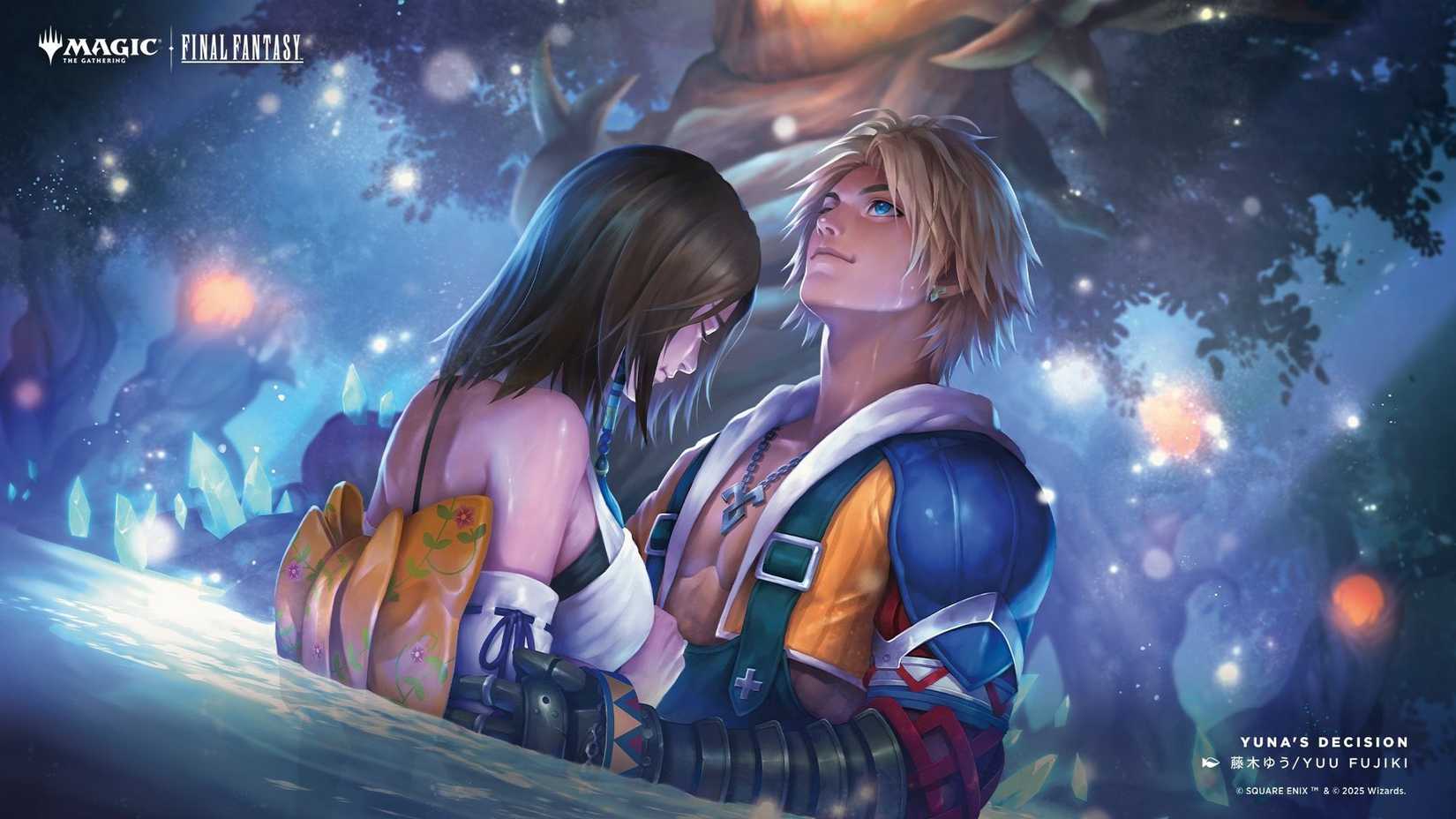 Art for the Yuna's Decision card depicts a big, romantic moment from Final Fantasy 10.Image: Wizards of the Coast
To ask how and why the Final Fantasy set did so well is a complicated question. In the culture surrounding video games, Final Fantasy fans are a diehard bunch. We all have our favorite games and our firsts in the series, and every few years, a new entry comes out to reignite our passion for the franchise. Which is to say that this passion never really goes away, especially when Square Enix has devoted so much time, money, and energy into developing the Final Fantasy 7 remake trilogy and top-tier remakes like Final Fantasy Tactics: The Ivalice Chronicles.
If you read through blog posts from Magic’s designers, like one published June 11 by set design lead Gavin Verhey, it’s abundantly clear that the Final Fantasy set was crafted with such great care and attention to detail by people who are big fans of both Magic and Final Fantasy. There’s a kind of fluency to so many of the cards that makes fans like me stop and say, “Oh they get who Aerith really is with this ability!” Cards tell stories that fans remember from the games while not going so far as to alienate those unfamiliar. All of the new mechanics introduced also come across as really intuitive, so even newcomers can understand them right away.
 Image: Wizards of the Coast
Crossover sets like LOTR and Final Fantasy often do well because of overlapping fan bases. We nerds tend to like lots of nerdy things, and are often willing to throw lots of money at our hobbies. But Magic players are also a discerning bunch. Cool art is a must when it comes to crossover cards, but if the mechanics don’t gel or if they miss the mark in representing something like Aragorn, Cloud Strife, or Peter Parker, in effective ways, people care.
All this to say that I don’t know if Wizards of the Coast will ever achieve the kind of lightning-in-a-bottle sales numbers of the Final Fantasy set, but that level of success indicates that even if Universes Beyond is a turn-off for Magic's most dedicated core playerbase (if the chatter on various social media platforms is any indication), there’s a ravenous appetite for more quality crossover content.
Wizards also didn’t waste any time. Marvel’s Spider-Man and Avatar: The Last Airbender sets came in the months that followed. Hasbro isn’t at the point in its fiscal year yet where the company would reveal sales numbers for those yet. While Final Fantasy was singled out on earnings calls as a record-breaking release, Spider-Man was discussed more generally as part of Magic’s expanding Universes Beyond portfolio.
Whereas the Final Fantasy set was a mechanical and commercial success, the smaller Spider-Man set was widely criticized for underwhelming card quality, awkward mechanics, and a thematic disconnect from Magic’s core fantasy roots. The Avatar set fared far better in terms of design. While the four elemental bending mechanics presented deliver great thematic flavor, their complexity makes the set at large less accessible than something like Final Fantasy.
Criticism of Universes Beyond has largely come from longtime players who worry that crossover sets, which were once little more than flavorful supplements, have come to define Magic’s core play formats. It’s not about simply seeing Spider-Man or Cloud on a card. It’s the idea that external IP now shapes and dominates Standard play, deck archetypes, and the game’s visual identity when Magic itself is chock full of decades worth of lore and story. Yet for five months after the Final Fantasy set launched, an overpowered little black mage from Final Fantasy 9 named Vivi Ornitier defined the competitive meta, showing up in the majority of pro players’ decks, until the card was banned. The more the game at large focuses on crossovers, the more likely it is that characters from other IP will continue to dominate the space.
The state of core Magic
Though it was technically last year, when talking about the state of Magic in 2025, you have to talk about Foundations. Released in November 2024, it was designed as a core set that’ll remain legal in Standard play for five full years. So, even with a lot of UB expansion, there’s still a literal foundation for Magic in Foundations that serves as a stable baseline. It emphasizes familiar mechanics with no big surprises and leans into typical color roles within the game. As a starting point for new players, you can’t go wrong with the Foundations Beginner Box.
The first half of 2025 then saw three releases before Final Fantasy: Innistrad Remastered, Aetherdrift, and Tarkir: Dragonstorm.
While Hasbro didn’t single out any of these sets in earnings calls (because sales numbers for them must pale in comparison to Final Fantasy), they still play an important role in Magic’s financial model, driving predictable sales with low risk.
 New artwork from the Innistrad Remastered set depicting the former Planeswalker Liliana, who is a renowned necromancer.Image: Wizards of the Coast
Innistrad Remastered, released in January 2025, revisits a classic Magic setting with reprints lifted from various previous Innistrad sets (think of it like a greatest hits roundup), all of which lean heavily on gothic horror. It’s a safe set that works wonderfully well for drafts, but since it’s not legal in Standard formats, that limits the long-term appeal somewhat. Fans have a lot of nostalgia for these classic sets, which is perhaps the greatest thing that Innistrad Remastered has going for it.
Tarkir: Dragonstorm arrived in April as a deliberate return to Magic’s fundamentals. Tarkir is a war-torn plane defined by five rival clans and a long, complicated history with dragons. As such, the set is full of dragons with familiar archetypes and mostly straightforward mechanics. A real highlight from the set is the five Commander precons, each representing a clan, each with three colors. These decks are all incredibly strong right out of the box, which isn’t always the case with precons. For anybody who wants to get into Commander, one of these is easily the best place to start.
For all of Magic’s shifting priorities in 2025, Tarkir: Dragonstorm was basically the only set that meaningfully moved the game’s overarching story forward. Set in the post-March of the Machine multiverse, Dragonstorm showed what a world looks like after the age of godlike planeswalkers, with the fall of the dragonlords and the re-emergence of Tarkir’s clans driven by internal change rather than outside intervention. In a year full of mostly commercial products, Dragonstorm reinforced Magic’s long-form narrative. Wizards quietly doubled down on that idea toward the end of the year, trickling out lore in November and December tied to the upcoming Lorwyn Eclipse, which will pick up those threads and push the game’s broader story forward in 2026.
Aetherdrift came in between Innistrad and Tarkir in February, and like August’s Edge of Eternities, it leans into sci-fi experimentation. (Perhaps both function as a precursor to 2026’s planned Star Trek Universes Beyond set, showing us how Magic can handle sci-fi elements?) Edge of Eternities is among the year’s best, but Aetherdrift is among its worst.
Despite an explosive vibe set in a new plane full of high-octane racing, Aetherdrift failed to deliver on the kind of high-risk, high-reward gameplay the premise implies. For the most part, the set wound up forgettable. Still, it’s an admirable experiment that tries something new, albeit one that nobody plays with except for a handful of solid cards.
On the flip side, Edge of Eternities leaned even heavier on science fiction themes with spaceships, aliens, and a cosmic scale. It wound up one of the year’s more interesting sets, not because it’s a crossover, but because it feels like a rehearsal for one. It pushes further from traditional fantasy than the game has ever gone before. The easy criticism one could make here is “this doesn’t look or feel like Magic.” But the art is splashy and fun, as are plenty of the mechanics at play, even if the set at large lacks cohesion. As an experiment that pushes the boundaries of Magic’s identity, Edge of Eternities was a surprising success.
Innistrad Remastered and Tarkir: Dragonstorm cater to veteran players by representing classic Magic whereas Aetherdrift and Edge of Eternities explore new in-universe possibilities that broaden the game’s scope, perhaps in the ultimate service of pursuing more Universes Beyond crossovers that stretch far beyond mere fantasy settings.
Where Magic goes from here
So what does all of this add up to? In 2025, Magic: The Gathering is starting to feel less like a single, coherent product and more like a portfolio that includes traditional fantasy worlds, nostalgic remasters, experimental in-universe sci-fi, and premium collectibles. Collaborations with major entertainment franchises are getting bigger and more frequent. That’s clearly paying off financially, which means Hasbro has no reason to slow down while Magic continues to post record growth and function as the company’s most reliable business line.
 Official art for The Incredible Hulk card due as part of the Marvel Super Heroes set.Image: Wizards of the Coast
At the same time, the year also made clear that Magic’s identity is no longer fixed. Universes Beyond has shifted expectations for what a Magic set can look like, while sets like Edge of Eternities suggest that even the game’s internal worlds are starting to look and feel like crossovers. Magic risks becoming a platform for other franchises rather than a self-contained fantasy universe. Wizards of the Coast seems comfortable with this flexibility, viewing Magic less as a singular genre experience and more as a rules system capable of hosting many kinds of stories. For longtime players, that feels unsettling. For new ones, that probably feels pretty normal given the state of entertainment at large in today’s world.
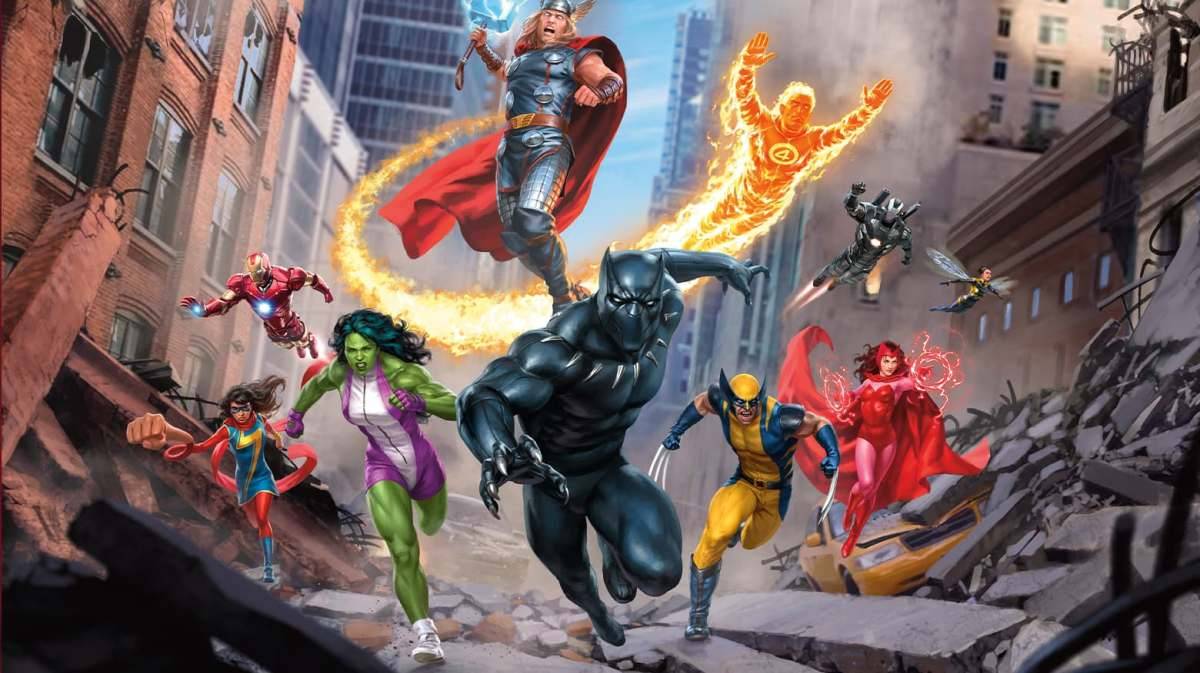
2025 had three Universes Beyond sets, three in-universe sets, and Innistrad Remastered. That ratio is getting flipped in 2026; there are four crossovers with Teenage Mutant Ninja Turtles, Marvel Super Heroes, The Hobbit, and Star Trek. Then Lorwyn Eclipsed, Secrets of Strixhaven, and Reality Fracture are all set in the multiverse of Magic. Each seems primed to focus heavily on the game’s ongoing story. But will that be enough when the wider game focuses more and more on those universes beyond what defines classic Magic?
The real test in 2026 won’t be whether crossover Magic can sell. 2025 has already answered that question decisively. It will be whether Wizards can continue to balance what’s starting to look like explosive crossover growth with a sense of narrative cohesion. Magic has never been bigger, but as it continues to bend and stretch in new directions, the challenge in the years ahead will be making sure it still snaps back into something recognizable when the dust settles.




![ELDEN RING NIGHTREIGN: Deluxe Edition [FitGirl Repack]](https://i5.imageban.ru/out/2025/05/30/c2e3dcd3fc13fa43f3e4306eeea33a6f.jpg)

 English (US) ·