.png)
 1 month ago
19
1 month ago
19

Published May 6, 2026, 9:00 AM EDT
The anti-war movie is now on Netflix
 Image: Tristar Pictures/Everett Collection
When Starship Troopers arrived in theaters 29 years ago, a lot of people didn’t get it. While the original 1959 novel by Robert A. Heinlein had a militaristic right-wing viewpoint, director Paul Verhoeven and screenwriter Edward Neumeier sought to lampoon those themes when they adapted it for the screen in 1997. Unfortunately, a number of critics mistook the movie’s satire for sincerity. The Washington Post, for example, called Starship Troopers “Nazi to the core.”
Over the years, Starship Troopers has been reevaluated as a sharp piece of commentary, not dissimilar to Verhoeven’s other film, RoboCop. Nearly three decades later, Starship Troopers’s themes remain sharp. Additionally, its exciting fight scenes and uniquely-designed aliens make it fun to watch even without the political commentary, which is why it's worth a revisit now that the movie is on Netflix.
Starship Troopers takes place in the late 23rd century. The people of Earth are no longer citizens of separate countries. Instead, all the world is under the control of the United Citizen Federation, a militaristic government that limits voting rights based upon whether people serve in the Federal Armed Services (FAS). In this future, high school graduate Johnny Rico (Casper Van Dien) enlists to follow his girlfriend (Denise Richards), who dumps him soon after he joins. While Johnny sometimes struggles with whether or not he belongs in the FAS, he seems to be a natural leader. When war breaks out after an attack on Earth that kills his parents, Johnny becomes fervently pro-war in the conflict with the alien bugs from the other end of our galaxy.
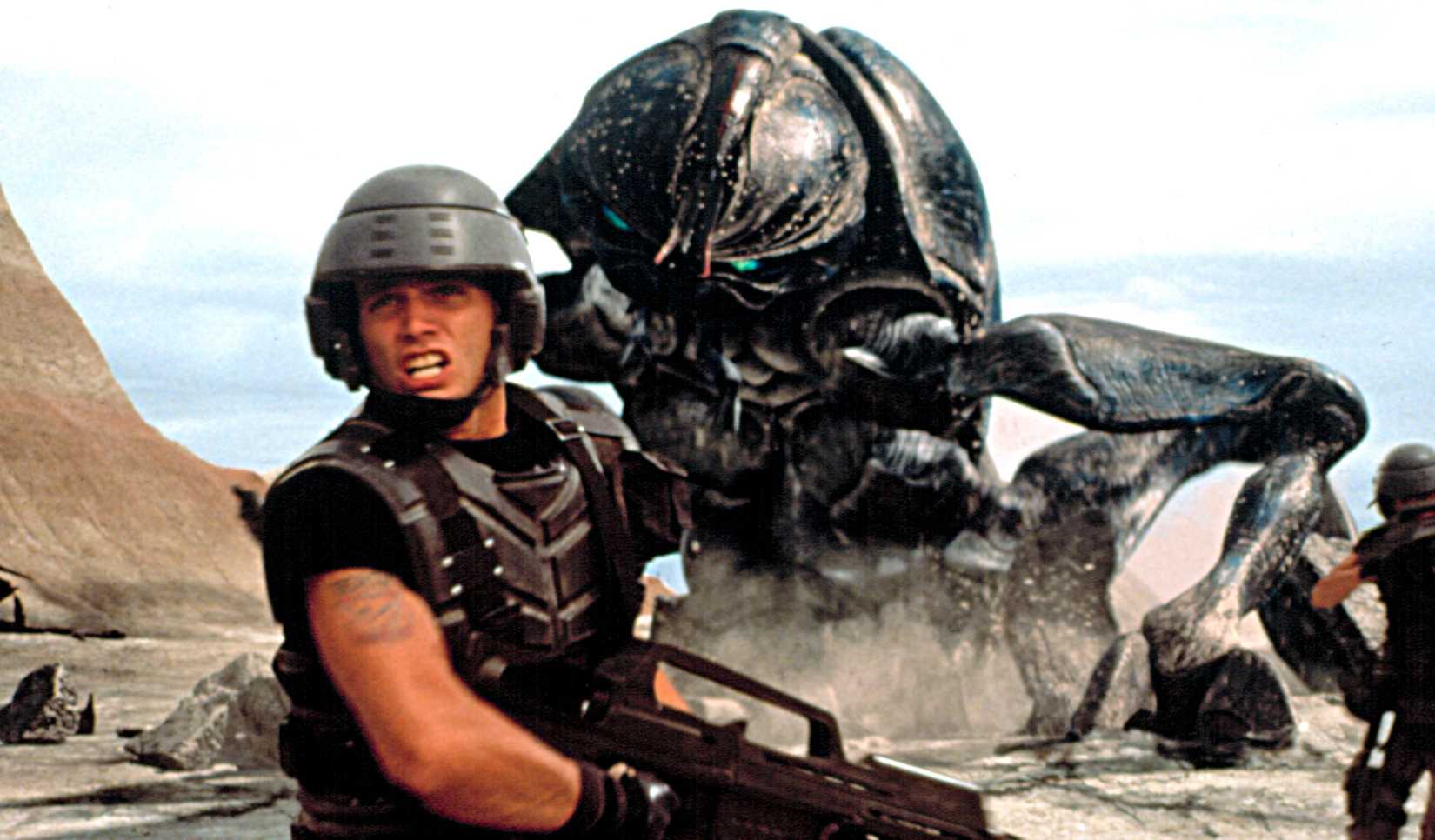 Image: Tristar Pictures/Everett Collection
Brought to life with both practical effects and CGI, the look of the aliens in Starship Troopers is one of the most impressive things about the film. The massive, killer “arachnids” have unique designs clearly inspired by the bugs of Earth, but way bigger, and with clamp-like mandibles for a head. While some of the bigger bugs suffer from the limitations of late 1990s CGI, they're all still interesting and menacing.
The battle scenes are also genuinely fantastic. As the soldiers charge headstrong into war, they’re stabbed and torn apart in a way that you’d never see in Star Wars. There are also some truly daunting moments where the human forces are utterly overwhelmed by countless alien bugs. While the acting in the movie is all purposefully heightened for the sake of the film’s commentary, there are times during the battles, and when the bloody aftermath is shown, that Verhoeven reveals the horrors of war and makes clear that this conflict between humans and bugs, which began because humans were encroaching on the bug territory, is as brainless as it is bloody.
 Image: Tristar Pictures/Everett Collection
For the most part, though, Starship Troopers rarely breaks from its militaristic facade. The characters are all loud, flat, and purposefully two-dimensional. They offer no depth or insight into themselves or the conflict in which they’re embroiled. Sometimes this makes Johnny and his compatriots a little boring to watch, but for the most part, it’s entertaining and it all works in service of what Verhoeven is really saying.
Perhaps that’s why so many people misunderstood the film when it came out, though watching it now, it's hard to miss the point. The acting is so flat, the characters are so broad, the messaging is so pro-military and the iconography is so pro-war and pro-fascist that it seems unmistakable as satire.
 Image: Tristar Pictures/Everett Collection
The fact Starship Troopers was directed by Verhoeven, who grew up during the Nazi-occupation of the Netherlands, also should have been a clue. Even if critics didn’t know that about Verhoeven’s personal history, they at least should have known him as the director of RoboCop. That film, even upon its release, was appreciated for being anti-corporate and anti-violence, which it communicated by being laughably pro-corporate and relentlessly violent.
With that, perhaps there’s yet another lesson in Starship Troopers about people not learning from history. While this sad fact seems to apply to critics watching Paul Verhoeven movies, it much more significantly applies to great military powers. As both history and Starship Troopers will tell you, starting unnecessary wars in some far-off region that doesn’t affect you still will bring about horrors to both sides of the conflict.






![ELDEN RING NIGHTREIGN: Deluxe Edition [FitGirl Repack]](https://i5.imageban.ru/out/2025/05/30/c2e3dcd3fc13fa43f3e4306eeea33a6f.jpg)

 English (US) ·