.png)
 2 hours ago
1
2 hours ago
1
If you were to ask a group of tabletop role-playing game enthusiasts the most important quality of a good Game Master, few would answer “laziness.” However, that’s exactly what Michael E. Shea has built his TTRPG career on. Mike is the creator of the Sly Flourish website, an invaluable resource for GMs, and the author of a dozen RPG books, including the Lazy Dungeon Master series. He’s also a member of the D&D Community Advisory Group established by Wizards of the Coast in June of this year.
The “Lazy Dungeon Master” title is as impactful as it is deceptive. Shea’s method is not about cutting corners, but about being a smart GM who optimizes prep time and understands an important truth about running TTRPGs: The only game that matters is the next game you play.
According to Shea, the “Lazy Dungeon Master” is someone who evaluates the efficiency of their preparation and play, focusing on what truly matters at the table. “That idea of efficiency and a focus on the next game that you're playing and the people who are going to be playing is the fundamental nugget,” Shea said in a video interview with Polygon. His latest book, Rise of the Lazy Gamemaster, just hit Kickstarter. It promises to expand the “eight steps of Lazy GM preparation” that he outlined in 2018’s Return of the Lazy Dungeon Master, thanks to the experience and feedback garnered over the past eight years.
 Image: Sly Flourish
For a seasoned GM like myself, Shea’s approach looks like heresy at first glance. The traditional image of a GM is someone who spends countless hours preparing their games, outlining every aspect of the world, sketching every path the players could take, and showing up at the table with a colossal binder containing every possible answer. Essentially, a TTRPG Batman. But that’s no longer the case.
Shea said that he started thinking in different terms 12-13 years ago, when Dungeons & Dragons’ 4th edition was on its last legs and playtesting for 5th edition (then called “D&D Next”) had just begun. He remembered talking to many game designers and professional GMs at the time who were thinking about how to prep in a way that encouraged more improvisation at the table. One idea started coalescing at the time as the core from which “the lazy GM way” would flourish: The only game that matters is the next game you play.
The central tenet of collaborative storytelling games is that you don’t know what direction things will go. Every GM has experienced the frustration of spending a significant amount of time prepping a specific scenario (be it a location or an encounter), only for players to go in the opposite direction. That’s wasted time, or worse: you could try to force your players in that direction, creating a feeling of railroading.
Shea’s first book, The Lazy Dungeon Master, tackled that problem with a simple prep system, which he then expanded in Return of the Lazy Dungeon Master through the “eight steps”: Review the Characters, Create a Strong Start, Outline Potential Scenes, Define Secrets and Clues, Develop Fantastic Locations, Outline Important NPCs, Choose Relevant Monsters, and Select Rewards. By focusing on these steps before each session, a GM can minimize their prep time (up to 15-30 minutes for a four-hour game) and boil down their pre-game activity to only the things that matter most and add value to the game.
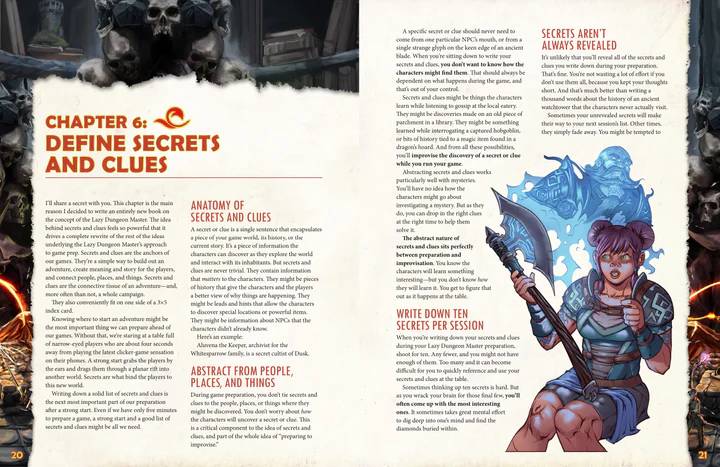 One of the eight steps of the lazy dungeon master as presented in Return of the Lazy Dungeon MasterImage: Sly Flourish
Rise of the Lazy Game Master will reaffirm all the advice given in the previous books. The eight steps are still there, but they’ve all been expanded by presenting different approaches to each. For example, the new book also looks at adventure types (dungeon crawl, exploration, mysteries, etc.) and shows how you can customize the eight steps depending on the kind of adventure that you're going to run. The GM Toolkit section has also been expanded with ideas coming from other TTRPGs besides D&D, such as clocks from Powered by the Apocalypse, the escalation die from Thirteenth Age, luck points and doom points from Tales of the Valiant, and more.
Clearly, this style of GMing relies heavily on improvisation. The “Outline Potential Scenes” step, for example, only requires you to write down a brief, loose outline for each scene, often no longer than a sentence. This made me think of famous GMs, like Brennan Lee Mulligan, who also popularized this style in recent years. But that’s easy to do when you’re a trained actor or improv comedian. Shea’s method, instead, feels more accessible. The “improvisation” it encourages is not based on acting skills.
“The kind of improvisation I'm thinking about is the ability to let the story flow in different directions when the characters go where you didn't expect,” Shea said. “And how do you make sure that the material that you have in front of you can support you when this happens.” Shea’s method is shared and inspired by many famous GMs, whom he quotes in his books, including Chris Perkins, Matt Colville, and Mike Mearls. At one point or another, they all stated something similar: The less you prepare, the better your games are.
 Image: Sly Flourish
After talking with Shea and reading Return of the Lazy Dungeon Master, I couldn’t help but think back to many memorable D&D games I’ve run and how the right kind of prep was the key to their success. In my opinion, the most important lesson that comes from this method, and the most important quality of a good GM, is learning to relinquish control.
Shea does not state it openly, but the truth is that the more you prep, the more you want to control the game. I’ve often seen on social media so-called “old school” GMs shaking their fists at how the current state of Dungeons & Dragons encourages collaborative storytelling: “It’s my world, you only get to play in it.” There’s nothing more wrong than that.
Shea’s most important advice for GMs is “let the story unfold at the table,” and I couldn’t agree more. “You're prepping to run a session, but the most fun you can have is when the session is going off in directions you didn't expect,” he said. Focusing on the characters is the second most important thing. “The players are interested in what their characters are doing, who they are and their role in the world,” Shea said. “They're not interested in your giant Bible of history of your world and the theology that goes back for five thousand years. The players care about the here and now. They don't need an entire geography of the planet.”
The way of the lazy GM is also the way of the good GM. At its core, there is the idea that the only game that matters is the next one you’ll play. By focusing your (often limited) prep time on the essentials, you automatically give your players more agency, trusting them to build an exciting and memorable story together.







![ELDEN RING NIGHTREIGN: Deluxe Edition [FitGirl Repack]](https://i5.imageban.ru/out/2025/05/30/c2e3dcd3fc13fa43f3e4306eeea33a6f.jpg)
 English (US) ·