.png)
 1 hour ago
1
1 hour ago
1

Published Jul 14, 2026, 3:00 PM EDT
The Incident at Galley House is a must-play deduction game
 Image: William Rous/Evil Trout Inc.
I’m furiously scrubbing through a computer database trying to track down a missing butler. Or at least I think that’s a butler. The last time I located him in a sea of video files, he was in a kitchen cleaning plates. He couldn’t have gone far; the Galley family’s manor only has so many rooms! And yet, here I am flipping switches on a faulty machine in search of a fading memory that’s so close to slipping away from me.
This uneasy tension powers The Incident at Galley House like an overloaded generator. The deduction game feeds on your panic, turning a simple round of Clue into a maddening murder mystery where it always feels like you’re hunting for a missing puzzle piece. A routine whodunnit becomes a captivating ghost story, where a house full of potential victims are faced with the horrors of forgetting.
If The Incident at Galley House, out today for Windows PC, doesn’t go down in history as 2026’s best mystery game, it’s certainly a lock for this year’s most unusual remake. The project is a total overhaul of 2025’s Type Help, a free text-based browser game where you search through computer files pertaining to a series of murders. Type Help was in part inspired by The Roottrees Are Dead, another free database mystery game that received an expanded remake last year. Following that project’s success, developer Evil Trout decided to pay it forward by giving Type Help the same treatment it gave The Roottrees Are Dead. The result is a more visual version of the game that requires a little less imagination from its players.
The freshly tweaked premise is that you’re a researcher called to an abandoned mansion to investigate a set of mysterious deaths that took place there in 1936. All you know, at first, is that there was some kind of dinner party at the home of one Rupert Galley that ended with a guest falling to their death. Everything leading up to that is much less clear. Using an old computer connected to a board of knobs, you’re able to view memories from the era and piece together exactly what happened. Where Type Help only asked you to type commands into a computer terminal, The Incident at Galley House makes sleuthing more tactile by having you turn dials and switches instead. It imagines the remake more of a gothic sci-fi mystery than a police procedural.
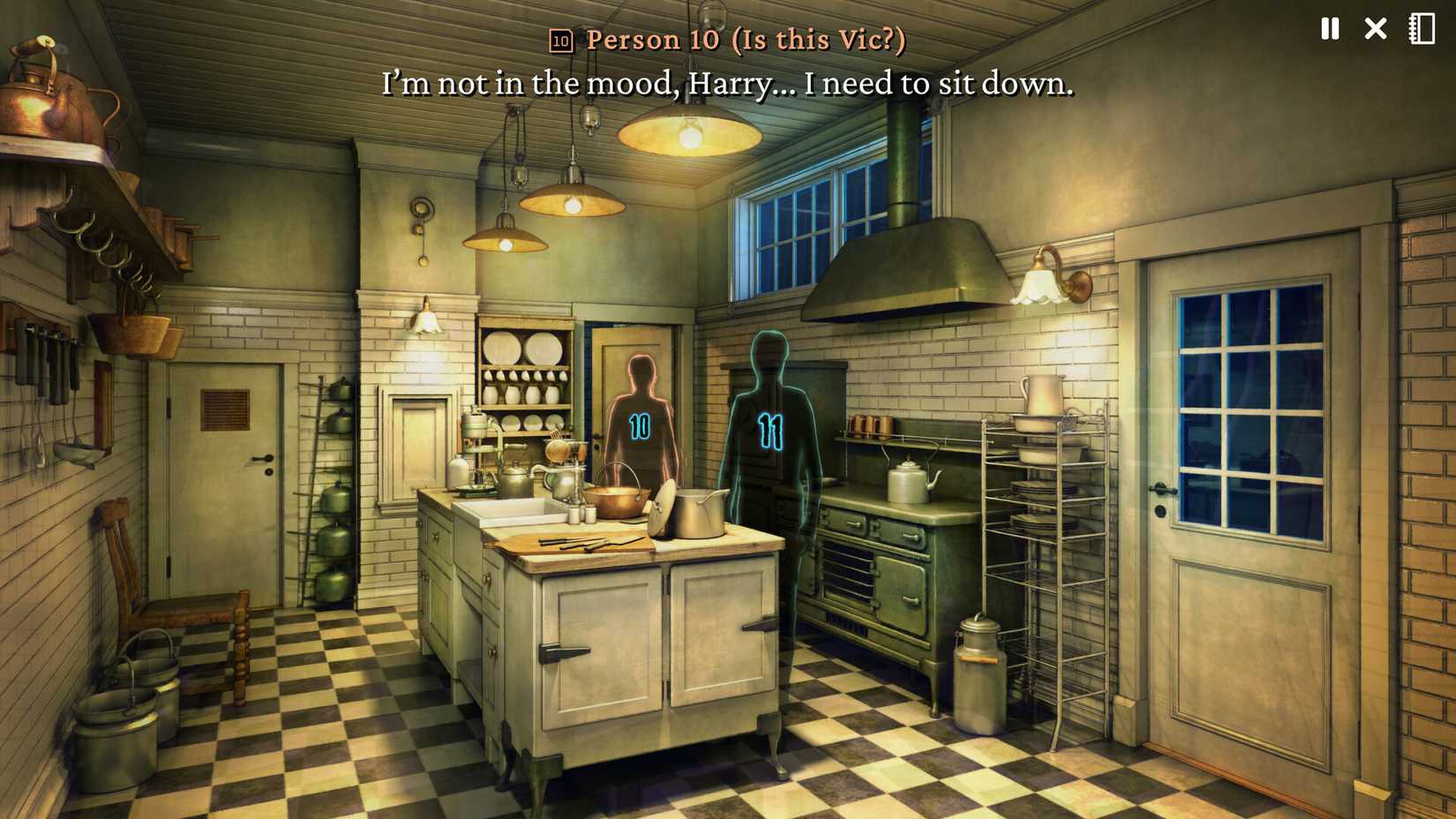 Image: William Rous/Evil Trout Inc.
That approach has its benefits that are sure to help a good mystery game find a wider audience. Memories now play out as visual novel sequences rather than in text, which makes it much easier to follow what’s happening in a scene. The illustrations are static and sound cues play out in text, but you can now visualize what each room of the house looks like and where figures are positioned as each scene unfolds. Those changes, in tandem with in-game tracking tools that let you mark important lines of dialogue and label unnamed characters, make for a significantly more approachable mystery that you don’t need an external notebook to solve.
The downside is that Type Help loses a bit of its mystique and psychological horror in the process. There is something unnerving about only reading the transcripts of a confusing tragedy through flat text in an ancient computer archive. Like hearing about a true crime case through a podcast, it left space for your overactive mind to paint the gaps pitch black. The Incident at Galley House tries to keep that feeling intact by presenting characters as formless silhouettes initially, but its full visuals ultimately depict the events as a pulp horror novel. It's devious and spooky, but not quite unsettling.
The Incident at Galley House treats death as a brain-altering catastrophe rather than a momentary blip in time
Though The Incident at Galley House loses something in its aura, it makes a mark thanks to a few brilliant puzzle layers indebted to deduction greats like Return of the Obra Dinn. In order to access a memory, you need to crack a code containing three elements: where in the sequence of events it took place, what room it happened in, and which characters were present. All of those pieces are puzzles within puzzles, tasking you with figuring out who characters are and what rooms exist in the house through context clues spoken within each discovered scene. The early-game satisfaction comes from observation-based codebreaking that has you figuring out the two-digit code associated with each room, and putting names and faces to the unidentified shadows that appear in memories.
You’ll likely crack those clever but short-lived puzzles by the halfway point of the 10-hour game. From there, it’s more about figuring out what exactly happened as you track where each character was at any given chunk of time, punching in the correct codes to locate missing scenes. You’ll need to listen to every conversation closely to suss out where someone ran off to (or if they left the room at all) at the end of a scene. You’ll feel like a genius detective every time you do so correctly, though the story’s structure gives too much away if you’re paying attention to telegraphed patterns.
Of course, you’re doing all of this while mentally keeping track of an intentionally disorienting mystery. To say anything about The Incident at Galley House’s story is to give away the game, but know that you’ll quickly feel that nothing adds up. It is built to gaslight you, with characters sometimes seeming to disappear out of thin air between scenes. Some conversations don’t make much sense, leaving you to pull your hair out wondering if the writers left in continuity mistakes or if you’re missing something. (The remake is at its weakest when it tries to over-explain the mechanics of the world in new content that wears great puzzle hooks thin.) That maddening dynamic is very much the point, and it makes for a mystery that’s hard to put down, lest it occupy your brain every second you’re away from it.
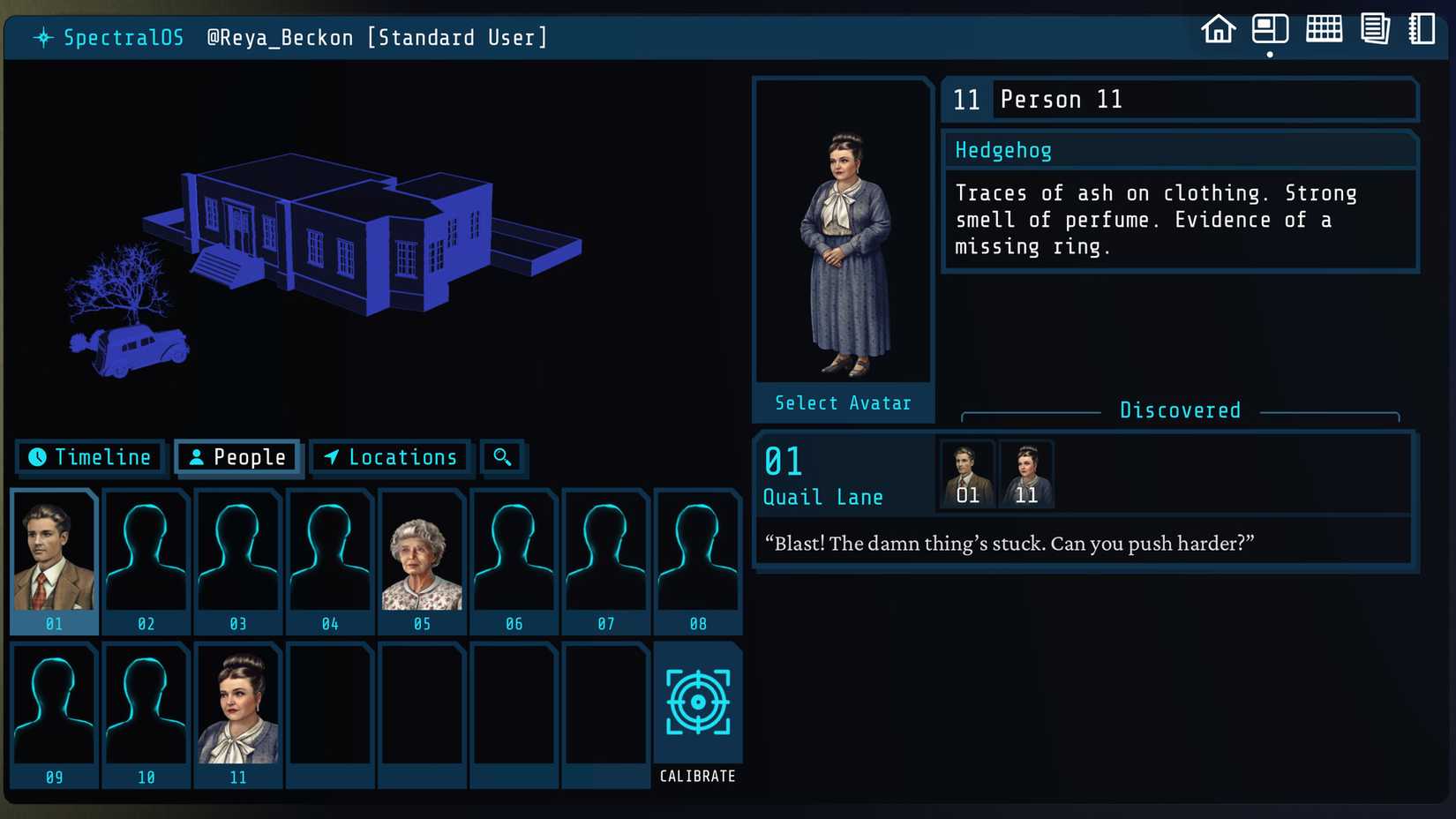 Image: William Rous/Evil Trout Inc.
It isn’t confusing just for the sake of engineering an unpredictable story — though the story certainly is unpredictable. The Incident at Galley House treats death as a brain-altering catastrophe rather than a momentary blip in time. Loss follows those who survive to mourn the deceased like a spectre. The guests of Galley House are witnesses to plenty of death during their stay, and you can feel the toll each takes on their minds as the bodies stack up. The hallways are thick with anguish that spreads like mold across the manor’s garish wallpaper.
But grief doesn’t look the way you’d expect it to in The Incident at Galley House. The cast isn’t tortured by their traumatic experiences; they’re terrified of forgetting them. Memory, and its role in processing death, is central to unlocking the vexing story. The panic comes from characters fearing that the dead will only truly be dead once there is no one left to remember them. The only thing keeping Galley House’s deceased alive in the future is a faulty machine that’s one lightning strike away from having its motherboard fried. The Incident at Galley House finds its slow-simmering horror in the idea that a human will inevitably become an unidentified silhouette in a digital graveyard once there’s no one left to hold on to their soul.
Type Help arguably hits that feeling harder through its haunting minimalism, but The Incident at Galley House still leaves an impression. By its conclusion, you’ll have put names and faces to a cast of ghosts entombed in a database. Call it an exorcism or a resurrection — either way, it’s an act of God.
The Incident at Galley House is out now on Linux, macOS, and Windows PC. The game was reviewed on Windows PC using a prerelease download code provided by Evil Trout Inc. You can find additional information about Polygon’s ethics policy here.







![ELDEN RING NIGHTREIGN: Deluxe Edition [FitGirl Repack]](https://i5.imageban.ru/out/2025/05/30/c2e3dcd3fc13fa43f3e4306eeea33a6f.jpg)
 English (US) ·