.png)
.png) 2 months ago
52
2 months ago
52

Published May 12, 2026, 9:30 AM EDT
Maddie is a Contributor at DualShockers covering JRPGs, survival horror, arcade games, retro gaming, shooters, and features. She has been writing about games professionally since 2011, with more than a decade of experience across lists, reviews, guides, and games journalism.
Before joining DualShockers, Maddie contributed to WhatCulture, GameRant, and NowLoading, and has written extensively about games across multiple websites over the years. She is also a writer, journalist, and game developer, bringing both editorial experience and development perspective to her coverage.
After Return of the Jedi in 1983, Star Wars wouldn't return to the big screen until The Phantom Menace in 1999, which marked the beginning of the prequel trilogy. As Star Wars found itself without a major feature film release during the late 80s and early 1990s, it was up to the video games to pick up the slack.
In this unusual interim period, a new side of Star Wars was being explored in the Expanded Universe, as the 90s saw George Lucas' space fantasy franchise shift its focus. The darker, criminal underworld of Star Wars began to identify the franchise in the 1990s. During this time, it wasn't unusual to see someone other than the traditional Jedi wielding a lightsaber and Force powers.
A key part of this transition for Star Wars was spearheaded by Jedi Knight, a series of games that focused on the ongoing adventures of Kyle Katarn. His complicated relationship with the Force and the Jedi Order spanned five video games, each showcasing a unique side of Star Wars that seamlessly wove in and out of the Skywalker saga while carving out its own compelling slice of the universe.
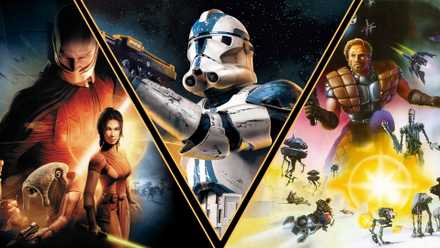 RELATED
10 Star Wars Games Everyone Needs to Play at Least Once
Gamers and Star Wars fans alike need to play these 10 Star Wars games at least once in their lives.
Following the Disney acquisition of Star Wars in 2012, Kyle and his exploits have been relegated to the non-canon Legends line. Though there have been rumors of new Lucasfilm president Dave Filoni bringing Katarn back into the fold, the Jedi Knight games remain lost to the pre-Disney era. The truly disappointing aspect of that isn't just the loss of Kyle Katarn, but the loss of a compelling flavor of Star Wars that is still frustratingly missing.
The Force is Strong with Katarn

In the Legends canon, Kyle Katarn was introduced in Star Wars: Dark Forces as a former member of the Galactic Empire who defected to the Rebel Alliance. His backstory also positioned him as a key catalyst to the entire Star Wars saga, as Kyle and his partner Jan Ors were responsible for stealing the Death Star plans prior to the events of A New Hope. That kicked off a sprawling tale that lasted from 1995's Dark Forces to Jedi Academy in 2003.
Over eight years and five games, the Jedi Knight series was able to create something that felt distinctly Star Wars, but had a fantastic sense of identity that a lot of other spin-off games didn't. Most Star Wars games at the time were focused on re-enacting events from the films or adapting them straight-up, which was fun and a source of many hours of fun for me, but Jedi Knight was really forging its own path within the confines of the universe as opposed to copying what they were seeing.

Dark Forces came out during a time when the canon of Star Wars was a lot more fluid. It was pretty much the Wild West, because it didn't really matter what crazy nonsense someone came up with, as creator George Lucas would veto everything he didn't like, but would keep things he enjoyed. It was a simple, clean system that produced some of the most amazing Star Wars games of all time.
Darth Vader appearing in Dark Forces was just normal, not some outlandish event. This philosophy would go on to influence the entirety of the Jedi Knight games, as well as every other title released during this time. The canon mattered, but it was not as restrictive as it would later become. For as selective as Lucas was in what he allowed to be a part of the canon, off-the-wall things were still allowed to not just exist, but thrive.
A More Civilized Age

Each Jedi Knight game feels like its own distinct, fully fleshed-out adventure that you can enjoy without any worries. Full disclaimer, I'm not a hater of Disney Star Wars, and in fact, I'd say I enjoy nearly all of it. What I miss, however, is the way the Jedi Knight games would function independently of the films, but also feel like they were intrinsically connected to their every breath.
The Jedi Knight series was able to create something that felt distinctly Star Wars, but had a fantastic sense of identity that a lot of other spin-off games didn't.
Kyle's story was deeply entrenched in the post-Return of the Jedi era of Star Wars at the time, and while I have a deep affection for Dark Forces, the series really found its voice beginning with the sequel. That would kick off an unprecedented run, where each game felt like its own Star Wars feature. That's not to say Star Wars games today aren't a big deal, as Outlaws and Respawn's Jedi games are incredibly immersive and cinematic.

What the Jedi Knight series offered, however, was a game world that felt less like a spin-off and more like a tangible next chapter of the Star Wars saga. The adventures that Kyle and Jan went on were a major influence on the rest of the Expanded Universe, as well as being legitimately innovative in terms of their technology.
The appropriately named Sith Engine, which powered Dark Forces II, was remarkably impressive in its speed and ability to push high-quality polygons. The massive scale of the levels is still impressive today, as its ability to create a sense of scope is supremely impressive. The ins and outs of the engine were so fascinating to me that it jump-started my lifelong obsession with PC building.
Like a Fine Wine

By the time the curtain fell on the series with 2003's Jedi Academy, it had truly found its own sense of identity. It had refined itself into an impeccable, confident action-adventure series that combined first and third-person perspectives. Beginning with Dark Forces II, the series deftly mixed both styles of gameplay, forging something that had such an alluring sense of chaos to it. Being able to swap between perspectives, as well as utilize a lightsaber, was just outstanding.
For as selective as Lucas was in what he allowed to be a part of the canon, off-the-wall things were still allowed to not just exist, but thrive.
Dark Forces II was the first game to let you swing a lightsaber around in 3D, and it's hard to describe what kind of feeling that was back in the day. That design would carry over into every other installment of the series, where it would be perfected with Jedi Outcast in 2002. The way these games prioritized swapping between a blaster and a lightsaber was just fabulous, and is exactly the kind of game that would be welcome in a contemporary Disney Star Wars game. There are elements of that in Respawn's Jedi series, which feels as close to a modern-day version of that as we're likely to get.

What I think is really missing, however, is that sense of being simultaneously beholden to the canon as if it's the gospel, yet also being wild enough to tell the most unhinged Star Wars story ever. That's what the Jedi Knight series did so well. There was an odd sense of normalcy to the characters, where the metaphysical nature of the Force almost felt routine. It made the Force and lightsabers feel approachable, as it showcased how anyone with the will to fight could look cool swinging around a laser sword.
 NEXT
NEXT

Systems


Released March 8, 1995
ESRB t
Engine jedi, imuse




![ELDEN RING NIGHTREIGN: Deluxe Edition [FitGirl Repack]](https://i5.imageban.ru/out/2025/05/30/c2e3dcd3fc13fa43f3e4306eeea33a6f.jpg)
 English (US) ·