.png)
 2 months ago
18
2 months ago
18
When I was playing Saros for review, I had a few conversations with other folks who were playing the game pre-release as we collectively tried to untangle the many dangling narrative threads of Housemarque’s latest roguelike shooter/psychological mystery. Though it’s not quite as abstract as Returnal, it does have a lot of mythology and character relationships that lend themselves to multiple and varied interpretations, and among the reviewers I spoke to, there was one prevailing theory that added layers to protagonist Arjun’s internal struggles. Now, however, actor Rahul Kohli has weighed in on this interpretation in a way that kinda makes me wish I could put the genie back in the bottle.

 © Housemarque / Kotaku
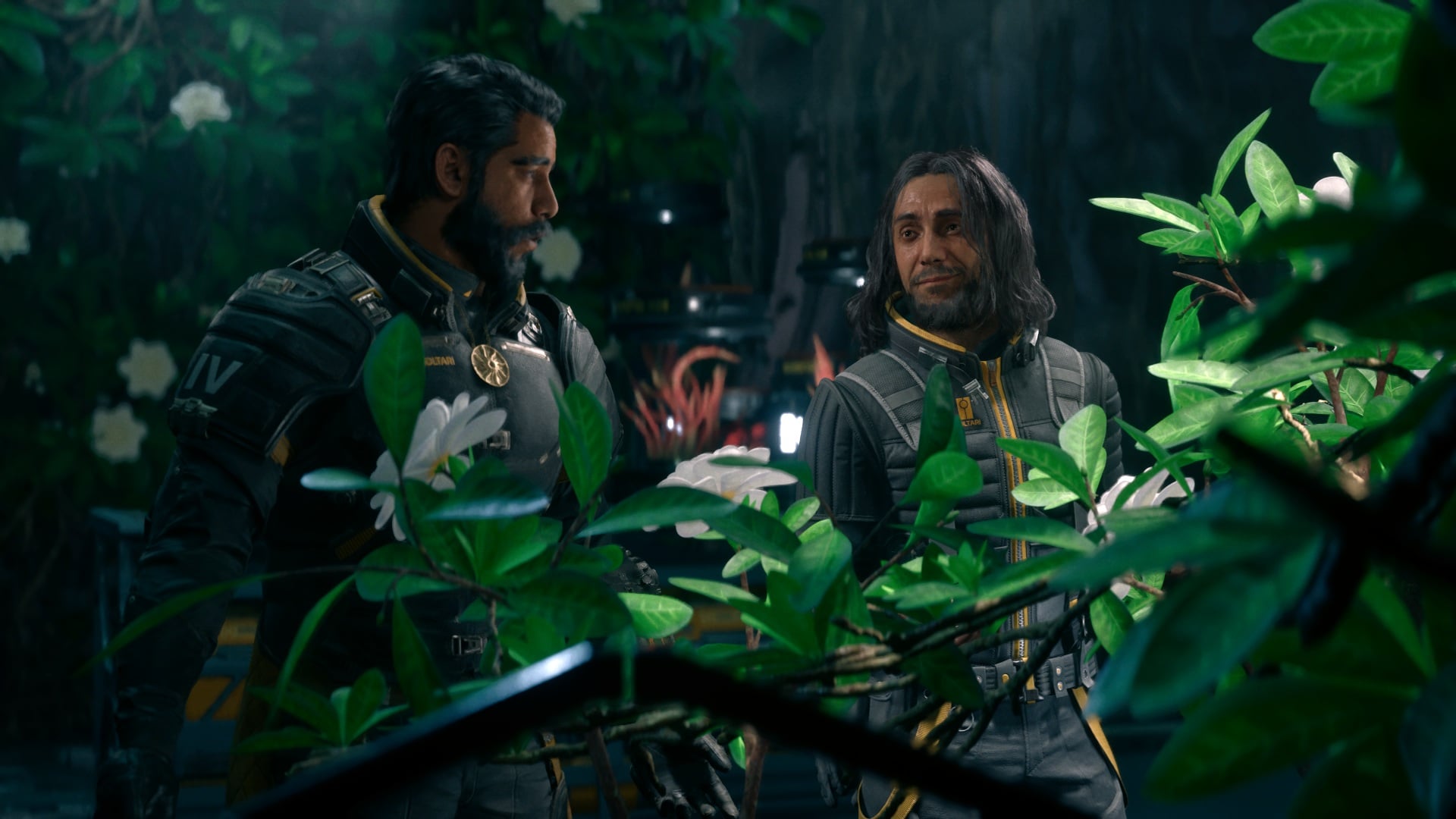
Your home base in Saros is the Passage, and it’s here that, between runs, Arjun can sometimes talk to his fellow surviving crew members of the Echelon IV expedition. Among these people, tucked away in a back corner of the Passage, is a man named Sebastian. From the way they speak to each other, it’s clear that Sebastian and Arjun have history back on Earth, having worked together in some fashion before our “hero” flew across space to find his wife Nitya on the time-distorting planet of Carcosa. Though they greet each other warmly, it soon becomes apparent in the conversations that follow that their relationship is strained for some reason, though neither of them get too specific, instead speaking in ominous, cutting lines about blame and guilt. Nevertheless, Sebastian stays at the base, tending to plants while Arjun fights monsters and the rest of the crew loses their minds under the influence of Carcosa’s sun.
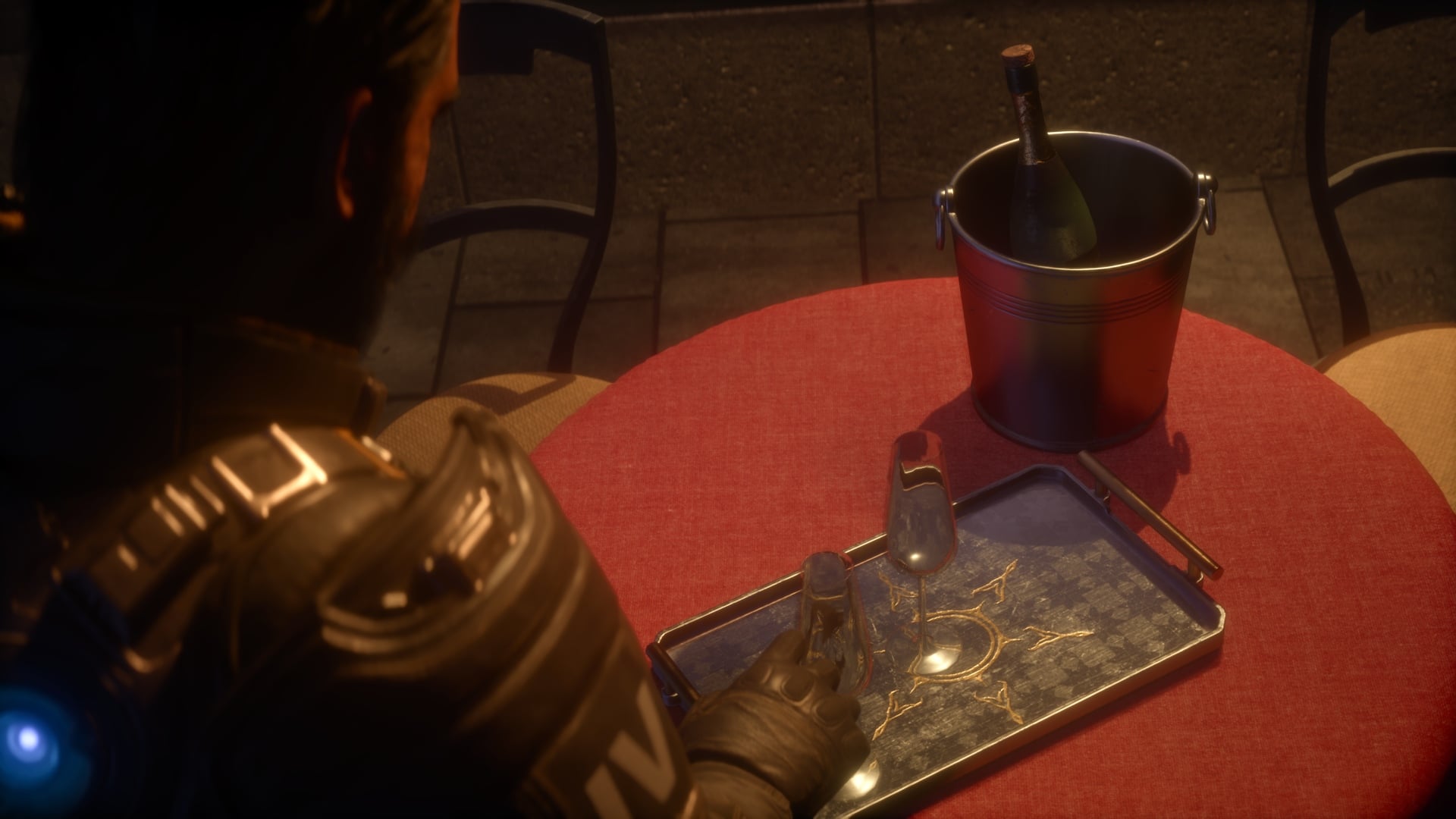
Sebastian’s little nook on the Passage is next to a tree in which a portal periodically opens and, once entered, shows glimpses of Arjun’s past that gesture at some major happenings from before the events of Saros. In these visions, Arjun walks through a recreation of an alleyway back on Earth, one that sits between a night club he used to frequent, drinking his nights away, and a hotel where he seems to have been engaging in extramarital affairs with someone other than his wife. During one of the flashbacks, Arjun sees what looks like a dinner date setup, and as he examines the empty wine glasses sitting on the table, he mutters that whatever he was doing behind Nitya’s back “didn’t mean anything.”
At first, it seems like we will never actually learn who Arjun cheated on Nitya with, but when I played the game, I started putting some clues together that made me think this mystery person had been right under my nose.
 © Housemarque / Kotaku
None of the other members of the Echelon crew interact with Sebastian, and Arjun never brings him up to anyone either. As more people on the team die or go missing, Arjun realizes that no one else has seen Sebastian, and there’s no record of him being part of the team sent from Earth to find out what happened to Nitya’s team. This former colleague is nothing but a hallucinated manifestation of Arjun’s inner guilt…but for what?
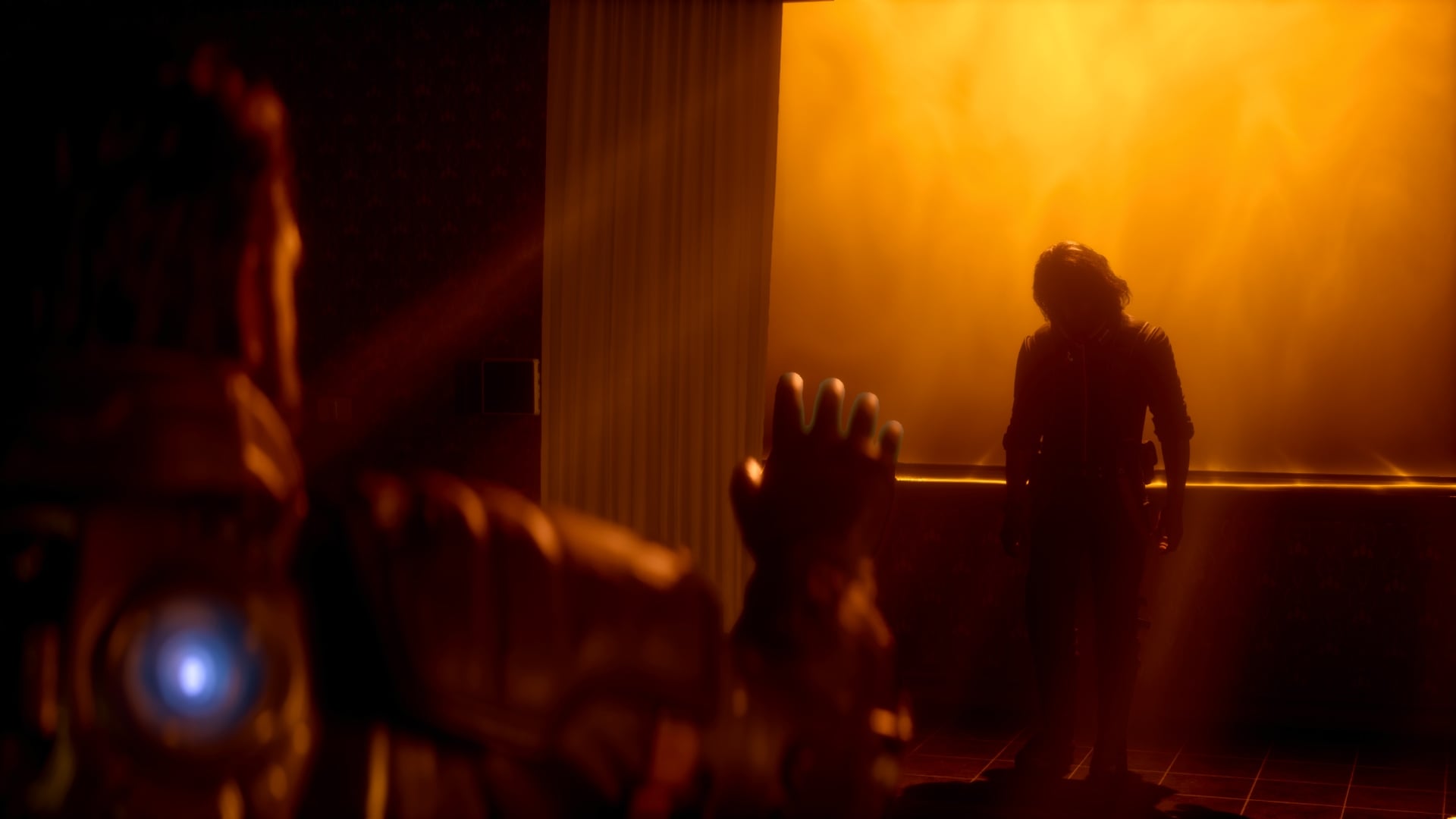
Flashbacks and text logs reveal to us that Sebastian died on Earth under mysterious circumstances, but Saros gestures at the truth as it repeatedly drags Arjun through his past. We go back to the hotel room he cheated in and see Sebastian appear, nonchalantly examining the window before it shatters, leaving Arjun muttering inconsolably when he comes to in the present day. The implications are strong, but we don’t hear Arjun admit to what has happened until much, much later.
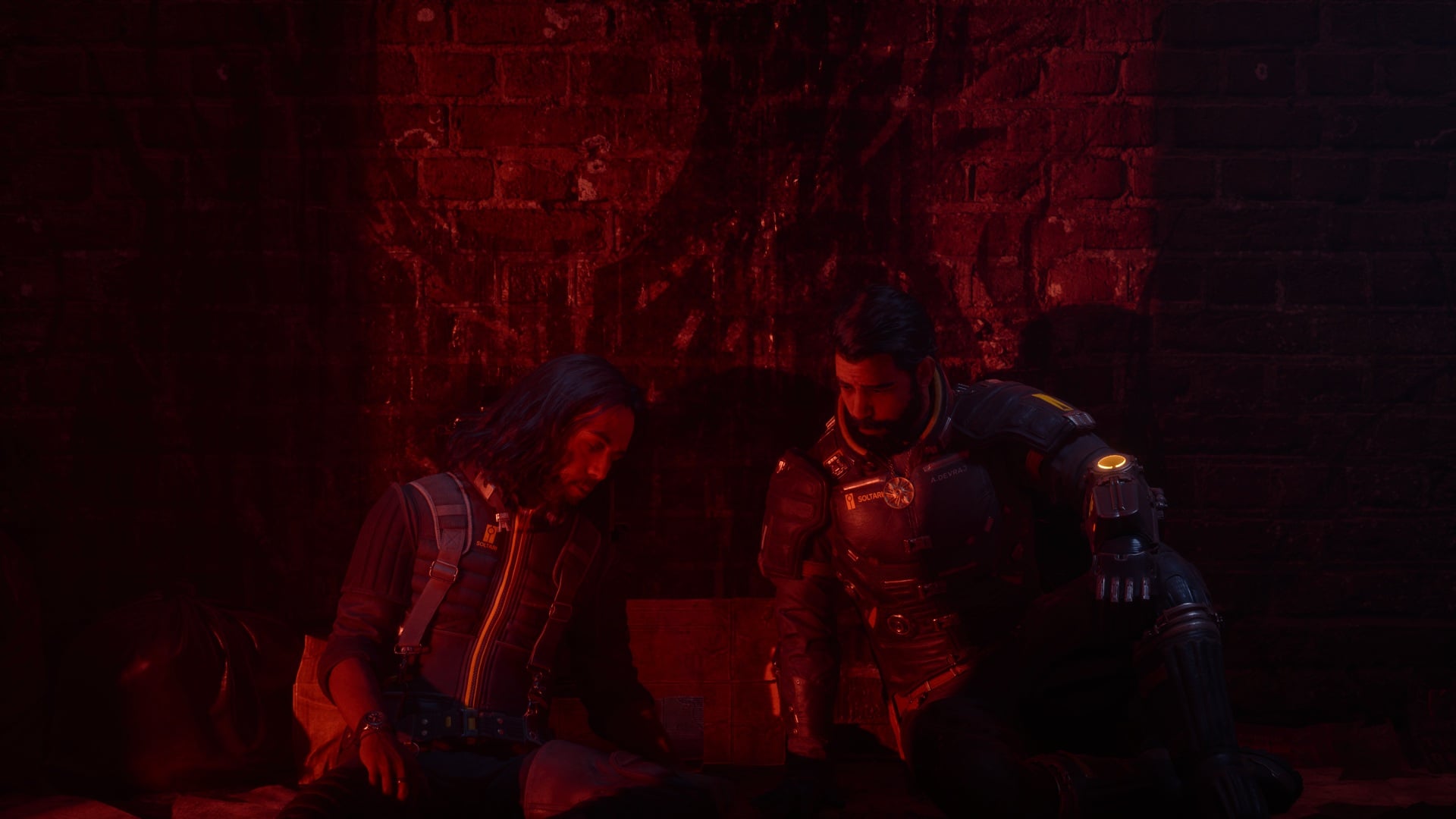
In Saros’ final stretch, Arjun essentially goes on an apology tour, trying to make up to the people he’s done wrong or who were abandoned as he spent what turned out to be decades of real time chasing ghosts. One of his last stops is the portal where Sebastian once spent time tending to plants and tossing out snide remarks. Inside, we get confirmation that Arjun is a person of interest in Sebastian’s death, and find the latter hunched over against a wall next to the hotel, bleeding out.
With his last breaths, he asks Arjun one question: “What was I to you?”
For me, Arjun’s answer cleared the fog around so many of the game’s mysteries: “You were nothing..that’s what I told myself,” he says. “I didn’t deserve your trust.” The last time Arjun said something didn’t mean anything to him, he was looking at a dinner arrangement for whoever it was he was having an affair with. The understanding that Sebastian had been Arjun’s secret lover, and that he killed him to keep up appearances and cover up his lies to Nitya about late nights out with coworkers, hit me like a wrecking ball.
 © Housemarque / Kotaku
I was frankly floored by how much Saros clicked into place for me when I came to this conclusion. Saros spends its flashbacks painting Arjun as an absolute bastard, one whose worldview was shaped by an abusive father who raised him on a foundation of sacrosanct masculine ideals that led him to lash out at his wife and himself, a byproduct, in my view, of the internalized homophobia he felt as he kept his relationship with Sebastian secret. My read on Saros was by no means a happy gay love story, but the older I get, the more I appreciate queer stories that underline that we are just as broken and capable of doing wrong as anyone else. It added so much texture to Arjun as a character and to Saros as a story, it became pretty central to what made the game’s failed road to redemption work for me.
This was the theory myself and numerous other reviewers I spoke to all came away with, and yet, when the game launched, I only saw it coming up sparingly in the public eye. Saros isn’t quite as obtuse as Returnal, but it is still a story built upon interpretation, so I figured that as long as some people had this reading, it wasn’t entirely out of left field. Now, however, Arjun’s actor Kohli is on the post-launch interview circuit, and has put a dent in the whole thing.
In an interview with Reforge Gaming, Kohli talks about how the “what was I to you?” line has been interpreted, and says that Housemarque never gave him or Sebastian actor David DeSantos any direction that the two’s relationship was meant to be romantic.
There’s the line again that I saw which is being kind of interpreted in different ways, which is when Sebastian asks Arjun, “What was I to you?” And he said, “you were nothing. That’s what I told myself.” People are looking into romantic things about that. When we played it on set, the idea was what was I to you in terms of my friendship? What was my death to you? Yeah. How were you able to compartmentalize what you did and then move on? How were you able to have blood on your hands and tell me that we were, tell me that you cared about me, that we were boys or whatever and do it. And Arjun’s way of handling it was I told myself you [were] nothing. It is what it is. Casualty of war. So that’s what our intentions [were]. I saw some people read into Sebastian and Arjun being in a relationship. Um, yeah? If you think so? I mean it’s up to you. That’s not what I played, you know. That’s not what me and David were playing. I do think if we were playing with an idea that Arjun and Sebastian had hooked up, I think the Housemarque [folks] would have told the actors that there was more to their relationship than something platonic. IIt wouldn’t help us to not let us into that. So, I was never told that. Neither was David who played Sebastian.
To be clear, Kohli’s not done anything wrong by talking about this. Actors and developers talk about their projects, the process of making them and the intention behind them, every day. However, Saros, which uses ambiguity and abstraction to its advantage, is by design a story that lends itself to interpretation. This is the kind of story that generates hours-long video essays breaking down mythology, obscure references, data logs, and subtle pieces of dialogue to illustrate a broader thesis about what it all means. The dissection is just as much a part of the experience as the shooting and swerving through brightly colored bullets.
Saros isn’t the only story that’s making me think about this issue right now. Recently, Obsession director Curry Barker has been giving interviews about his (incredible) romantic horror movie, and has also been more or less “confirming” parts of the story that were once up to interpretation, and while I still love the film, I feel like the clarity these responses have provided has, paradoxically, only served to muddy my understanding of the film. Parts of it now make less sense to me than they once did.
The trouble is, as much as there’s an audience for abstract storytelling, there’s just as much of an audience for AI-voiced explainer videos, lore breakdowns, and Wikipedia trivia bullet points that break everything down into a perceived “objective” truth. Typically, this is a futile effort, as anything you put out into the world is up to the interpretation of the audience, but a lot of that magic and debate goes away when you have creatives outright telling fans what the intention was, and it’s especially hard to talk about abstract works without stepping on interpretations fans have latched onto; now, when Saros fans who see Arjun as straight debate its story, they’ll have ammunition against the SebastianxArjun truthers, as if queer readings don’t already face enough scrutiny when it’s plausible that the creators of a work intended for it to be read that way. Saros has some explicitly queer characters and relationships in its supporting cast and lore, but it felt pretty bold for a male main character in a AAA game to potentially be queer, even in a story as tragic as this.
 © Housemarque / Kotaku
So now, what am I left with? Saros is still one of my favorite games of the year, and I can still hold onto the view that Arjun is a narcissistic bisexual bastard that traveled across the galaxy for a humility lesson. But my admiration for the swings the game takes doesn’t feel quite as strong as it did when I could believe that might have been the intention. Despite my job of talking to creatives about the games they make, I tend to take the most from fiction when it’s able to speak for itself. My favorite games are often the ones I’ve never heard the creators say a word about. It’s a hard line to walk because I love hearing someone passionately explain the ideas or inspirations or experiences that led to the creation of something, but more than that, I love to see what introspection their work brings out in me, whether they intended it or not. Saros is the kind of story I like best when its meanings are left entirely to my own imagination, and today the battle between creator intention and player interpretation is often fought in black-and-white absolutes. I miss when I thought I saw more colors; now I have to squint and look at Saros from a different angle just to make sure they were there in the first place.




![ELDEN RING NIGHTREIGN: Deluxe Edition [FitGirl Repack]](https://i5.imageban.ru/out/2025/05/30/c2e3dcd3fc13fa43f3e4306eeea33a6f.jpg)
 English (US) ·