.png)
 2 months ago
41
2 months ago
41
After conquering the box office with Oppenheimer, Christopher Nolan returns this summer with a classic story that's even more monumental than the creation of the atom bomb. The Odyssey looks like Nolan's most epic film yet, and months before its release, it's somehow already sparked a wave of bad-faith criticism, mostly focused on the movie's perceived "woke" casting. In the wake of this drummed-up controversy, plenty of naysayers pointing to a surprising, early 2000s movie as the so-called "right" way to adapt ancient Greek mythology for the big screen, but a closer look at that movie reveals how little these critics actually understand about the film they're claiming to celebrate.
When Troy premiered in 2004, much of the conversation surrounding the film focused on its scale. Historical epics like 2000’s Gladiator were still fresh in everyone’s minds. The Lord of the Rings had concluded with Return of the King just a few months prior. Troy arrived with all the expected ingredients: massive armies, political betrayal, blood-soaked duels, and an ensemble cast of beautiful movie stars.
Most of the discourse at the time reduced the movie to a shallow blockbuster adaptation of Greek mythology headlined by Brad Pitt as the demi-god Achilles. Film critic Roger Ebert wrote at the time that the movie “sidesteps the existence of the Greek gods” — which are prominent in Homer’s original epic — “and turns its heroes into action movie cliches.” He’s not wrong, but as Ebert later touches on in his review, Pitt portrays Achilles with a kind of emotional complexity that feels surprisingly modern all these years later. His is a kind of powerful swagger that is characterized by vulnerability. You might as well call it non-toxic masculinity.
Twenty-two years ago, I adored Troy for delivering something similar to Peter Jackson’s Lord of the Rings trilogy. (We even get a fresh-faced Orlando Bloom playing the Trojan prince Paris — also wielding a bow and arrow!) Revisiting Troy all these years later, I still find the big action set pieces thrilling, but what I found most surprising was the nuanced humanity Pitt brings to the role of Achilles. We remember Troy as bombastic, but it’s a much more emotionally complicated film than it’s given credit for. "Pitt is modern, nuanced, introspective; he brings complexity to a role where it is not required,” Ebert also wrote. Again, he is not wrong.
Troy is loosely based on the Iliad, one of two ancient Greek poems attributed to Homer. The events of the movie are more or less presented as fact, though even to classical scholars today, the war itself and the people involved are largely considered myth. The ruthless King Agamemnon (Brian Cox) has united just about every Greek kingdom under his rule, thanks largely to the fierce warrior Achilles (Brad Pitt). Meanwhile, princes Hector (Eric Bana) and Paris of Troy visit Sparta to broker a peace deal with King Menelaus (Brendan Gleeson) after a long period of tension.
 Related
The Odyssey will be the biggest movie of the year regardless of box office
Avengers: Doomsday might be seen by more people, but it won't penetrate the culture in the same way
Sparta is one of the southernmost kingdoms on the Greek peninsula. Across the Aegean Sea to the east (in modern day Turkey) lies Troy, a city-state with vast walls that have never been breached. Paris falls in love with Menelaus’ wife, Helen (Diane Kruger) — and she sails back to Troy with him. And so, Greece goes to war against Troy. Helen became “the face that launched a thousand ships,” as Christopher Marlowe wrote in 1604.
Despite his hatred of Agamemnon, Achilles sails to war after a conversation with his mother Thetis (Julie Christie), a figure who appears human but speaks in prophetic and ethereal ways that allude to her mythical status as a sea nymph. In the Iliad, she’s a lesser god of water, which makes Achilles a literal demi-god. Seeing Pitt’s Achilles in battle, his combat prowess does indeed make him seem supernatural. In the movie’s opening scene, he defeats the hulking champion of Thessaly in a single blow. Thetis tells her son that he can stay in Greece to live out a happy, fulfilled life. But he’ll be forgotten. Yet if he does go to war in Troy, he’ll die in the glory of battle and be remembered forever. The pursuit of that glory is Achilles’ chief concern, though we never fully come to comprehend why.
On paper, Achilles should come across as the ultimate relic of early-2000s blockbuster masculinity. He’s introduced as an invincible warrior who humiliates enemies, scoffs at kings, and treats war like theater. He’s arrogant, reckless, and almost impossibly self-assured. And yet, Troy consistently reveals a version of Achilles driven less by domination than by intimacy, grief, and an almost painful awareness of mortality.
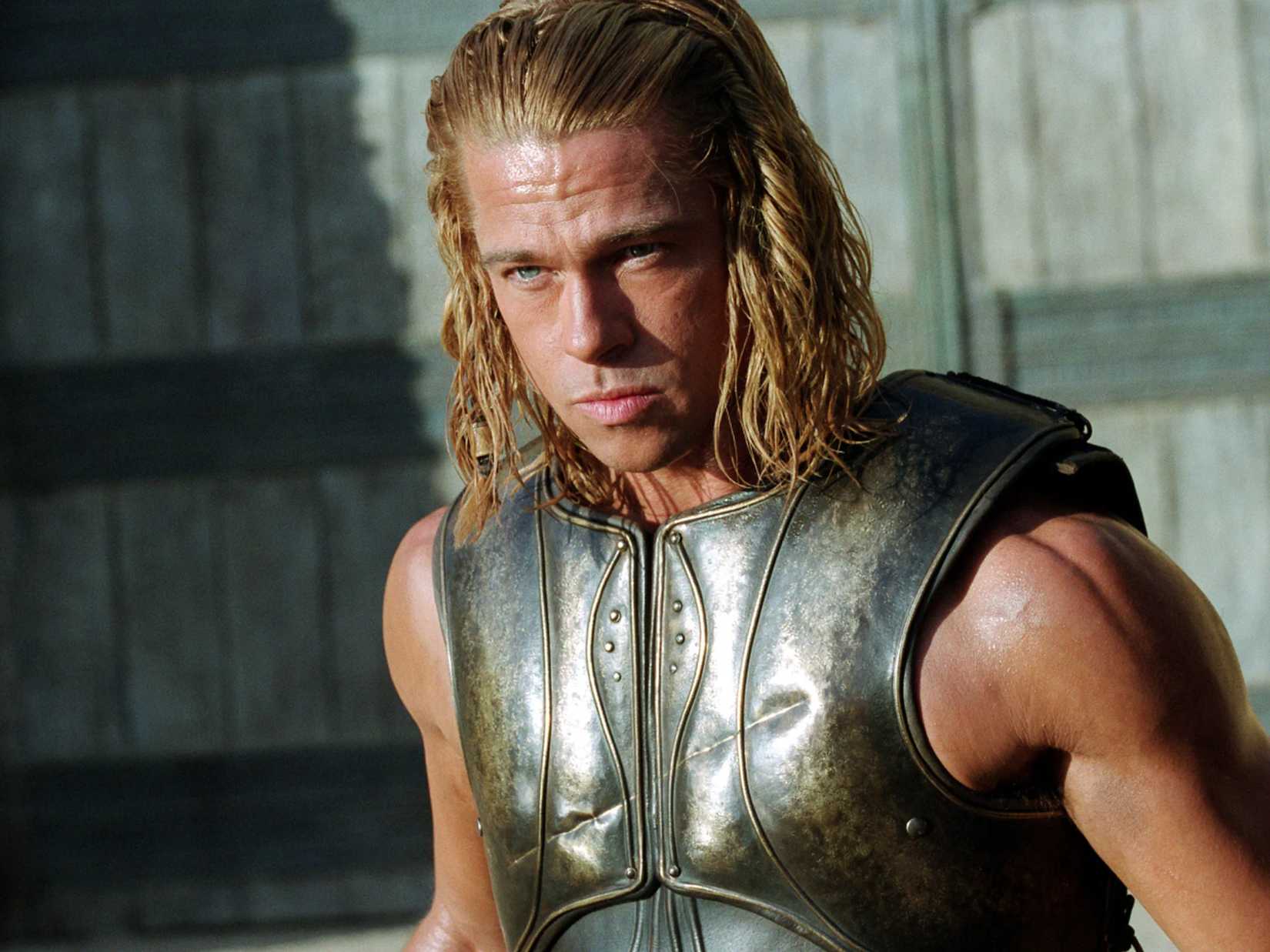 Brad Pitt as Achilles in Troy.Image: Warner Bros. Pictures
One of the film’s most revealing scenes arrives early in the invasion of Troy. Achilles corners Hector inside a temple after storming the beaches. He has every tactical reason to kill the prince. Instead, he lets him walk away.
A lesser version of this character — or perhaps simply a more conventional blockbuster from 2004 — would frame Achilles as a man obsessed with proving his superiority. But Pitt plays him differently. Achilles isn’t searching for easy victories. He’s searching for meaning. He recognizes something honorable in Hector. It presents a startling contrast to see Achilles demonstrate this kind of dignity, mere minutes after he beheaded a golden statue of Apollo and let his Myrmidon troops ransack the temple.
The gods envy us because we’re mortal.
The dynamic between Achilles and Hector becomes the emotional core of the movie. Hector represents duty to family, responsibility, and sacrifice. Achilles initially appears to represent selfishness and ego. But Troy slowly reveals that Achilles may actually be the more emotionally vulnerable man. When they inevitably clash, Achilles wins easily and drags Hector’s body behind his chariot — but only because Hector had killed his beloved cousin Patroclus in battle. His rage here is driven by catastrophic grief, and he winds up regretful of his actions.
Perhaps most surprising, Achilles risks his own life infighting Greek troops to protect a Trojan priestess named Briseis, a cousin to Hector and Paris. Why would such a heathen go out of his way to protect a priestess? Achilles is capable of great and terrible deeds, so much so that you expect him to keep doing awful things. Yet he treats Briseis with respect. As the two become lovers, we see more humanity in Achilles than you’d expect.
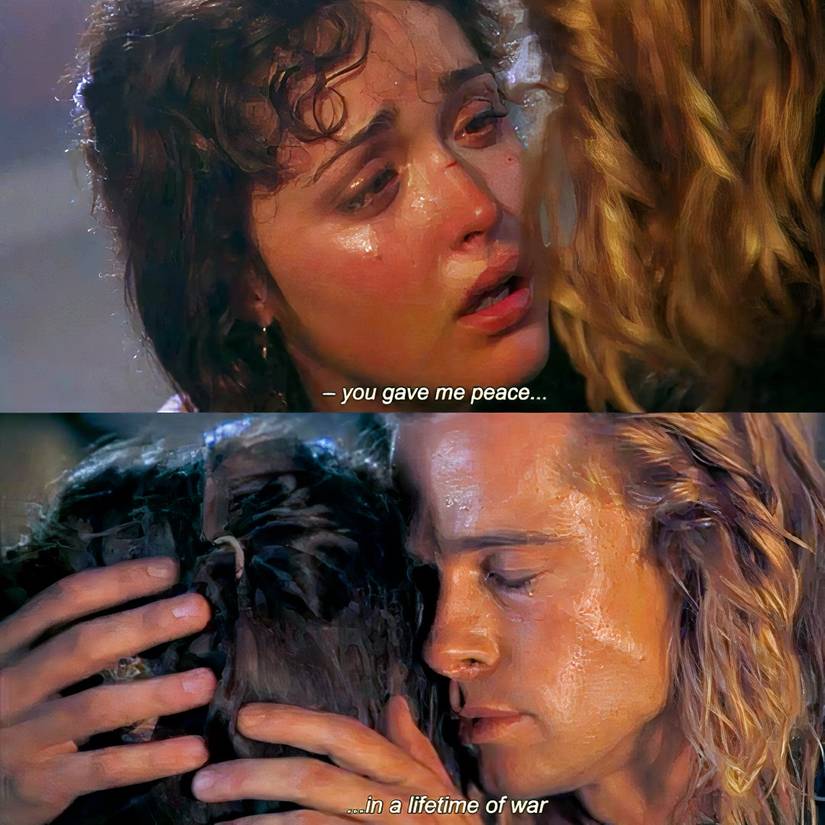 Achilles makes one final confession to Briseis.Image: Warner Bros. Pictures
Achilles’ most famous line, which he says to Briseis, lands differently today: “The gods envy us because we’re mortal.” As a teenager, that sounded rad. Revisiting it now, it feels mournful. Achilles understands that mortality is what gives love, memory, and human connection meaning in the first place.
That emotional transparency is part of why Troy feels oddly ahead of its time in 2026. Modern audiences increasingly gravitate toward male heroes who are emotionally expressive rather than repressed. Over the past decade, many male protagonists have challenged older assumptions about masculinity by embracing vulnerability instead of hiding from it. Achilles, strangely enough, fits neatly into that conversation.
That’s also what makes Sean Bean’s Odysseus so interesting in retrospect. Compared to the passionate Achilles or the honorable Hector, Odysseus feels cold and pragmatic. He’s political where Achilles is emotional, strategic where Hector is principled. Even in Troy, you can already see the shape of the weary survivor who will eventually anchor The Odyssey.
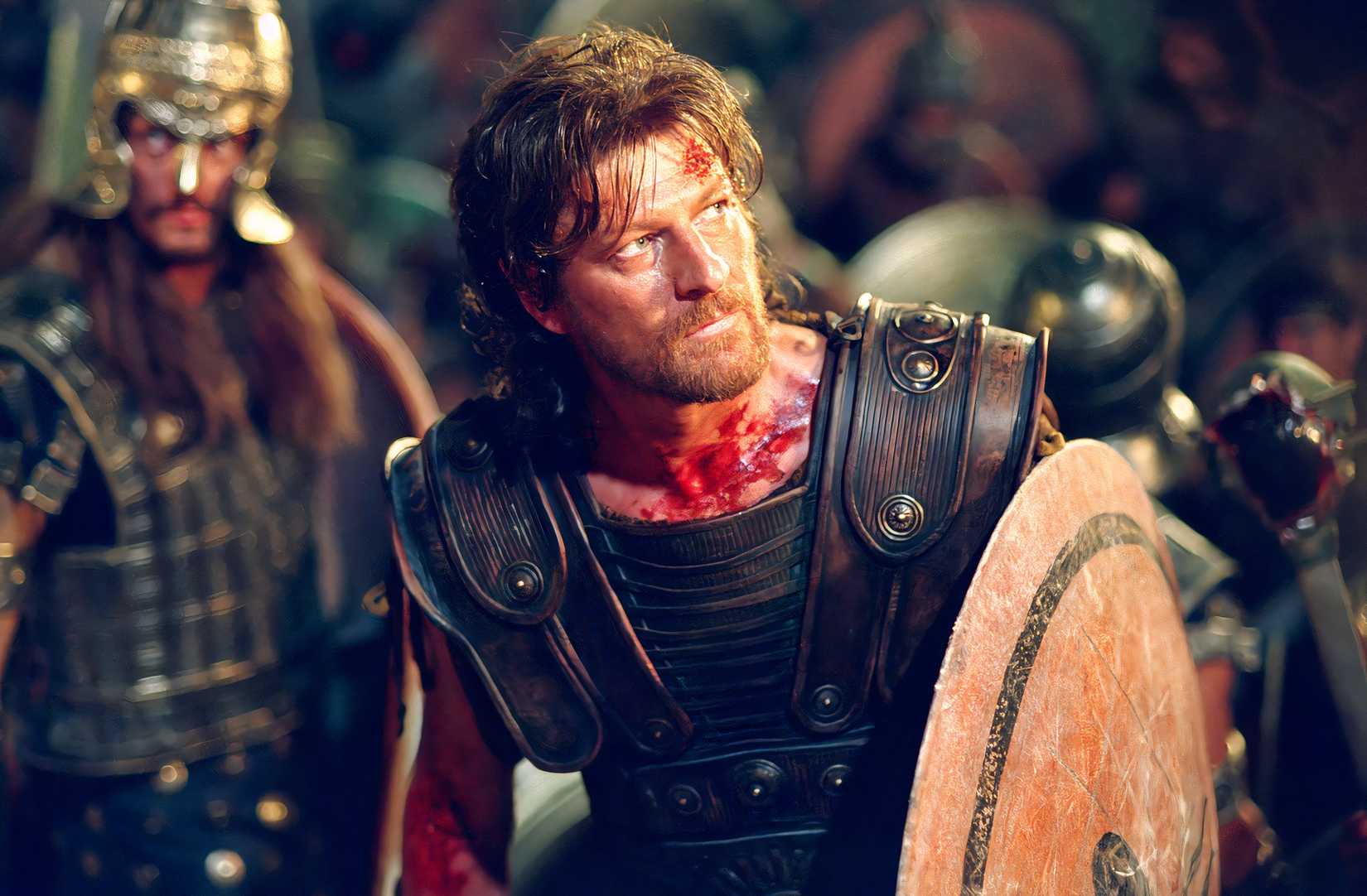 Sean Bean appears in Troy as Odysseus in a somewhat minor but important role.Image: Warner Bros. Pictures
Troy understands that Achilles belongs to a dying age of heroism. In the end, he dies for love trying to save Briseis and still becomes immortalized in myth. Odysseus represents what comes next: a man who survives not because he is the strongest warrior, but because he adapts. That’s partly why Christopher Nolan’s The Odyssey feels so interesting right now. Maybe modern audiences are finally ready for mythological epics that prioritize emotional vulnerability as much as spectacle.
Ironically, Troy may have arrived years too early for that conversation. Screenwriter David Benioff — who went on to produce the Game of Thrones show alongside D. B. Weiss — even admitted in a 2004 interview that the story could have worked better as “an eight-hour miniseries” exploring “all the different phases of the characters.” Given more time getting to know the various players in this epic, we might better appreciate the emotional stakes at play.
Today, that version of Troy feels easy to imagine. Prestige television has conditioned audiences to embrace morally messy heroes, slower emotional storytelling, and sprawling political dramas rooted in character rather than spectacle alone. But constrained to a three-hour blockbuster, Troy still managed to preserve something surprisingly intimate at its core.
Benioff said he wanted to “concentrate on the human story” rather than the mythological spectacle. That decision ultimately strips Achilles of some of his divine mystique, transforming him from an untouchable demi-god into something much more recognizable: a powerful but emotionally vulnerable man grappling with love, grief, legacy, and mortality.
Twenty-two years later, that may be the real reason Troy still works. Not because it rejected the gods, but because it understood the humanity underneath the myth — and the notion that a stronger vision of masculinity is one rooted in vulnerability. The question now is whether Christopher Nolan’s The Odyssey will understand its hero as deeply as Troy unexpectedly understood Achilles.

![Spider-Man: Brand New Day post-credits scene explained: How [spoilers] sets up Avengers: Secret Wars](https://static0.polygonimages.com/wordpress/wp-content/uploads/2026/07/mcdspma_sp140_h.JPG?w=1600&h=900&fit=crop)



![ELDEN RING NIGHTREIGN: Deluxe Edition [FitGirl Repack]](https://i5.imageban.ru/out/2025/05/30/c2e3dcd3fc13fa43f3e4306eeea33a6f.jpg)
 English (US) ·