.png)
.png) 1 month ago
19
1 month ago
19

Published Jun 7, 2026, 10:58 AM EDT
Linda Güster is a Contributor at DualShockers and a German, UK-based gaming journalist specializing in video games, esports, industry analysis, features, lists, reviews, interviews, and news. She has been writing professionally since 2020 and began covering video games and esports in 2025, turning a lifelong passion into her professional focus.
Before joining DualShockers, Linda worked as content lead for Esports Insider DACH and The Escapist Magazine Germany. She previously worked in software engineering and digital media, giving her a strong technical background and the ability to explain complex systems clearly. Across her career, she has written thousands of news pieces and covered gaming culture, esports, technology, and broader industry developments.
There is a question that has been making its way into game development conversations over the past several years, and I don't think it has fully surfaced in the public discourse yet. It isn't a dramatic question. It doesn't come with a manifesto or a formal announcement. It just sits there in the room during early design discussions, getting louder every time another indie game nobody predicted goes viral on Twitch and sells five million copies in a month. The question is this: are we building something people will want to watch?
 Related
How Is Minecraft Still So Popular? A Closer Look from TwitchCon Europe 2026
A game from 2011 with more monthly players than ever. Minecraft isn't just surviving the competition, it's barely even noticing it.
That question did not exist in any meaningful way fifteen years ago. It barely existed ten years ago. And the fact that it exists now – and that some studios are clearly already answering it in the way they design their games – feels like one of the more significant shifts in the medium. I had the pleasure of attending TwitchCon Europe 2026 in Rotterdam, where I spoke to people who think about this from multiple angles, and what I came away with was a picture that is both more deliberate and more nuanced than I anticipated.
The Shift Mary Kish Is Already Seeing
 Mary Kish via Instagram
Mary Kish, who works on the community side at Twitch and streams regularly herself, has a perspective on this that is worth taking seriously. She is not speaking theoretically – she is embedded in the streaming community, she watches what happens when certain games get picked up and others don't, and she has seen the correlation between streaming momentum and commercial performance play out enough times to have genuine conviction about where things are heading.
The question is this: are we building something people will want to watch?
"I think games are learning very quickly that, if they can unlock the streaming community, they have a hit," she told me. That is a significant prediction from someone in a position to observe these patterns directly. And the examples she gave to support it were not abstract – they were specific, and they were instructive about what actually works, as opposed to what theoretically should.
Cult of the Lamb and the Clever Integration
 YouTube via ThiccyMouse
The first example Mary raised was Cult of the Lamb, the 2022 indie Roguelike from Massive Monster that became one of the most talked-about games of that year. On its own merits, it was a genuinely excellent game – charming, funny, mechanically satisfying, with an aesthetic that somehow made running a sinister cult feel adorable. It would have done well regardless. But it did considerably better than well, and a significant part of that came down to a Twitch integration that was, frankly, one of the smartest pieces of streaming-aware design I have seen.
The game allowed viewers to become cult members inside the streamer's game – appearing with their username, interacting with the world, becoming part of the story. And then, if the streamer was in danger of dying, they could sacrifice a community member to survive. "The streamer could interact with their cult members and if they died in the game, they could sacrifice a member in their cult to keep living," she explained to me. "So I could kill my community member and their username and everything would be shown in the game. And our communities ate it up."
The genius of that design is that it doesn't feel like a marketing feature bolted on after the fact. It feels like it belongs in the game – because thematically, it absolutely does. You are the leader of a cult. Of course your Twitch chat should be your followers. Of course you should be able to sacrifice them. The integration works because it serves the fantasy of the game at the same time as it creates an irresistible dynamic for a streaming audience. The game sold over a million copies in its first week and peaked at over 140,000 concurrent Twitch viewers on launch day.
PEAK and What It Says About 2025
 Steam
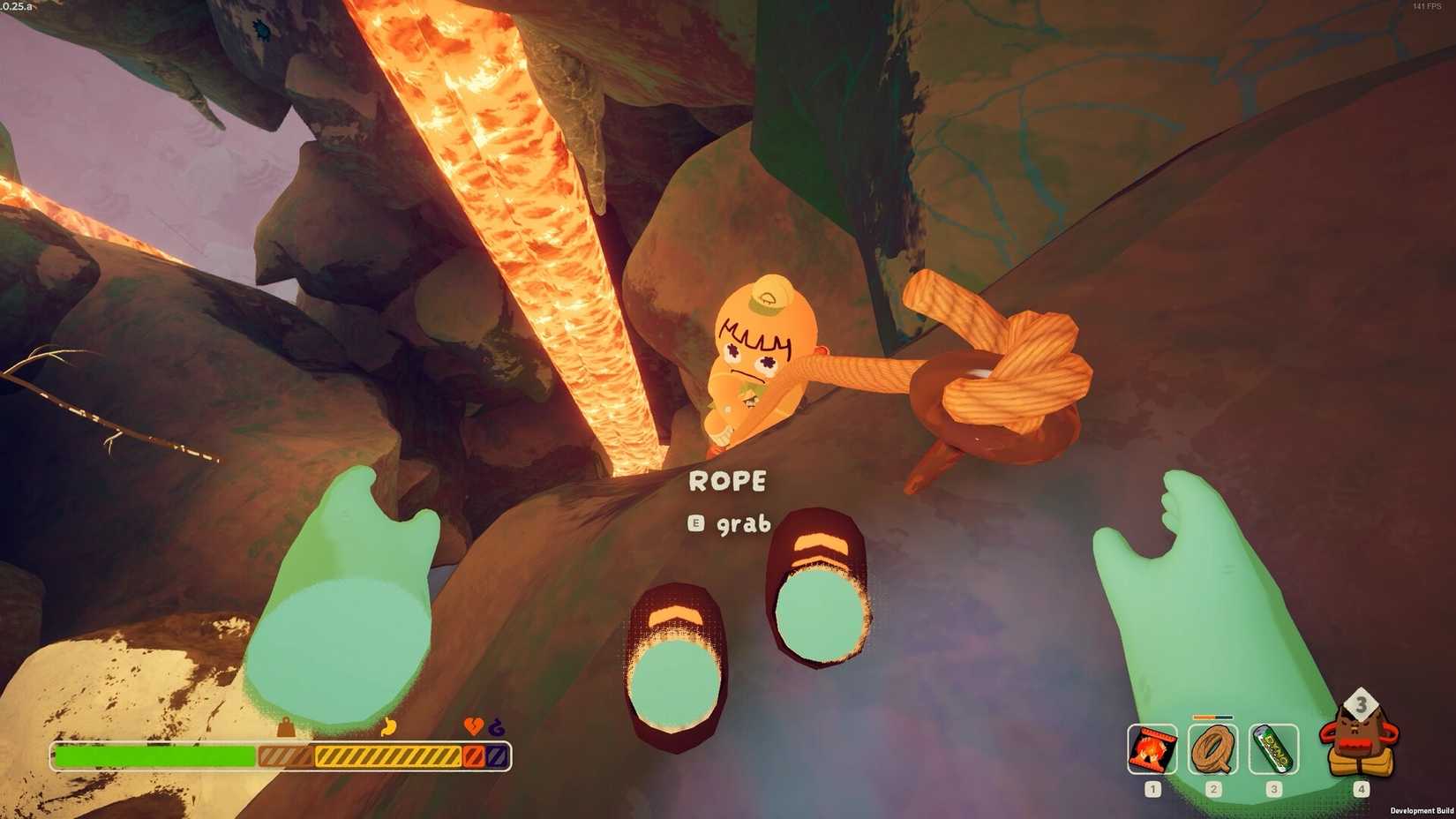
SteamIf Cult of the Lamb was an early proof of concept, then PEAK – released in June 2025 by indie studios Aggro Crab and Landfall – is the most recent and arguably most striking example of what streaming-aware design looks like when it comes together without anyone necessarily planning for it. The developers built the game in four months as a collaborative game jam project. They did not have a massive marketing budget. They were not expecting what happened next.
PEAK sold a million copies in its first week. It hit over 100,000 concurrent players on Steam. By the time Gamescom Opening Night Live came around in August, it had sold ten million copies, a figure confirmed on stage by Geoff Keighley. The developers had reportedly planned to go on holiday immediately after launch. That plan did not work out, after connecting with the reality of what they had created.
What made PEAK so immediately, explosively watchable? Mary described it in terms I found very useful: "collaboration is very strong on Twitch for streamers." PEAK is a co-operative climbing game. Up to four players try to scale a mountain together using ragdoll physics, proximity voice chat, and an endless supply of ways to inadvertently ruin each other's progress.
It is a game where things going catastrophically wrong is not a failure state – it is the content. Every slip, every accidental shove, every moment when someone falls and takes the entire group with them is a clip. It is shareable by design, not because anyone sat down and engineered shareability, but because the core mechanic is inherently chaotic and inherently social.
"That was a cool ass indie game," Mary told me. "That was not a massive studio, but they cracked the code." And I think she's right. What they cracked is the understanding that the most watchable games are the ones where anything can happen, and the humans involved are the source of most of the drama.
 Related
The Nintendo Switch Changed How We Play, And There’s No Going Back
We celebrate the Nintendo Switch for good reason, but its success changed more than just how we play.
The TangyTD Story That Surprised Everyone
 Cakez via YouTube
There was a third example Mary raised that I had actually seen go viral in real time. She mentioned a streamer called Cakes77, who had been building a tower defence game called TangyTD entirely on stream – developing it live, in front of an audience. At TwitchCon's opening ceremony, a clip was shown of Cakes77 checking their day one sales, and when that clip went viral, something remarkable happened.
"People started flocking to his stream," Mary said. "I was checking him out. He had 300 viewers watching him live, fixing some bugs in the game, because that's what he does." The clip kept spreading. More people found the stream. More people bought the game. "He had a quarter of a million in sales from this tower defence game that he built on Twitch."
What that story illustrates is something slightly different from the design conversation – it is about the relationship between process and audience in the streaming era. Cakes77 didn't just make a streamable game. He made the making of the game the stream. The development was the content. And when that content found the right moment of visibility, the sales followed. That is a genuinely new creative model, and the fact that it works should be giving studios of all sizes something to think about.
What Anadege Freitas Calls the Authenticity Factor
 PopeHilarius via YouTube
Anadege Freitas, Director of Content and Partnerships at Twitch, approached this question from a slightly different angle when we spoke. Her background spans Nintendo, Hasbro, and Activision Blizzard – she was heavily involved in the launch of Call of Duty: Warzone – and she brought that long view of the industry to a conversation about what has actually changed in terms of how games reach players.
Her core argument was about authenticity, and it connects directly to the streaming question. "Nowadays, especially when we are talking about the new consumers, they don't want to only be reached by ads. They want to have something that is meaningful to them." The implication being that a streamer playing a game they genuinely love, in front of an audience that trusts them, is doing something fundamentally different from a television advertisement. It is organic exposure, and it carries a credibility that paid media simply cannot replicate.
The games that are positioned to benefit most from that credibility are the ones that give streamers something interesting to work with. Games with emergent moments, with social dynamics, with the capacity to surprise both the person playing and the people watching. "Having a game that is very good on the watchable side is a way that you can get organic exposure for your community," Anadege told me. That's the design philosophy in a single sentence.
This Is Not a Cynical Development
 YouTube via Epiic SoNiickzZ
I want to be clear about something, because I think it would be easy to read all of this with a degree of suspicion. The idea of games being designed to perform well on camera could sound like a compromise – form following function in a way that diminishes the experience for the person actually holding the controller. I don't think that is what is happening, and I don't think the evidence supports that reading.
The games that succeed on Twitch are, almost without exception, also the games that are most enjoyable to play with other people. PEAK is not a lesser game because it generates incredible stream content. It is a better game because the same qualities that make it watchable – the chaos, the unpredictability, the proximity voice chat – also make it a joy to play. Cult of the Lamb's Twitch integration doesn't undermine the solo experience. It adds a layer that is entirely optional and which deepens the game's central theme.
What streaming-aware design actually looks like, at its best, is simply good multiplayer and social game design with an awareness that those experiences extend beyond the room. Studios that understand this are not compromising their creative vision. They are expanding their thinking about where the game lives, and who gets to be part of it.
 Related
From Guild Raids to Stardew Valley: The Search For Belonging
MMOs built real communities once, now cozy games are filling the gap they left behind. The reasons why tell you everything about modern life.
The Studios Not Paying Attention Yet

The flip side of all this is worth naming. There are absolutely studios that have not caught up to this shift, and there are ways in which the gap between streaming-conscious design and everything else is going to become more visible as time goes on. Games that launch with slow openings, no social hooks, no shareable moments, and no reason for a streamer to keep returning to them are increasingly swimming against a tide that didn't used to be nearly as strong.
That doesn't mean every game needs a Twitch integration or a proximity voice chat system. Sometimes, it can be a conscious choice not to participate in the streaming era. What it does mean, however, is that the question of "how does this game live in the world beyond the person playing it alone" is one worth asking during development, not after launch. The studios doing interesting things right now – the ones generating genuine momentum on streaming platforms without paying for every second of it – are the ones that asked that question early and let the answers inform what they built.
Mary put it simply: "I am predicting that, in the next five years, there will be an explosion of games that are meant for the streaming community to enjoy, because they are seeing a correlation between the streamers picking up their games and sales." We are already seeing the early wave of that explosion. The studios paying attention to it are finding audiences in ways that traditional marketing could never guarantee. That seems like a pretty compelling reason to start paying attention.
 Next:
Next:
10 Indie Games that Truly Felt Like the Beginning of an Era for an Entire Generation
These games were responsible for transforming our impression of the interactive medium from their releases onwards.

![ELDEN RING NIGHTREIGN: Deluxe Edition [FitGirl Repack]](https://i5.imageban.ru/out/2025/05/30/c2e3dcd3fc13fa43f3e4306eeea33a6f.jpg)
 English (US) ·