.png)
.png) 3 months ago
63
3 months ago
63


Published Apr 22, 2026, 2:09 PM EDT
Daniel has been playing games for entirely too many years, with his Steam library currently numbering nearly 750 games and counting. When he's not working or watching anime, he's either playing or thinking about games, constantly on the lookout for fascinating new gameplay styles and stories to experience. Daniel has previously written lists for TheGamer, as well as guides for GamerJournalist, and he currently covers tech topics on SlashGear.
Sign in to your DualShockers account
I love grand-scale JRPGs, the kinds of worlds and stories you can utterly lose yourself in for a good hundred hours. I am also, however, a working adult who gets tired during the day, so I unfortunately don’t have the time or energy to get properly invested in that kind of game more than a couple of times a year. It’s frustrating, but that doesn’t mean I’m locked out of JRPGs as a whole. It just means I need to be a little more picky about the ones I get invested in.
Related
8 Best JRPGs That Aged Like Fine Wine
These JRPGs can still teach a thing or two to their modern counterparts.
JRPGs are a very broad genre; despite the name, they’re not even exclusively made in Japan anymore. In the current genre paradigm, you can find old and new JRPGs that, while not exactly a brief jog through the park, can have their critical content and some side stuff enjoyed in a relatively timely fashion. If you’re feeling a 100-hour time commitment for your next JRPG adventure, try one of these experiences that can be completed in half that time, saving up your cumulative gaming energy for the next mainline Persona or Final Fantasy game. You know, when you really need it.
All the following time estimates are pulled from HowLongToBeat.com. We’re shooting for sub-50-hour main story times here.
10 World of Final Fantasy
35-47 Hours

As one of the JRPG progenitor franchises, Final Fantasy games are typically pretty bulky affairs, moreso the newer, fancier ones like Final Fantasy 16 and Final Fantasy VII Rebirth. If you want a lighter Final Fantasy experience, a good jumping-off point would probably be one that originated as a portable game, such as World of Final Fantasy.
Originally released on PS4 and PSVita, then ported to Steam, Switch, and Xbox, World of Final Fantasy is kind of like Pokémon through a Final Fantasy lens. Your heroes, Lann and Reynn, can fight for themselves, but they’re also accompanied by iconic Final Fantasy monsters and entities, which manifest in several different sizes. Smaller monsters can stack on top of larger monsters, allowing you to make two stacks with different abilities and constitutions for each sibling.
World of Final Fantasy is also a much more linear adventure than the mainline games, keeping you on a steady railroad of major plot events with only an occasional divergence. Literally, your main means of conveyance around the world is a railroad, aboard a train with a Cactuar conductor.
9 Chrono Trigger
23-26 Hours

Something that’s important to remember about games in general is that scope is not synonymous with quality. Being a longer game with more side content doesn’t automatically make it an all-timer. Case in point, Chrono Trigger is one of the most legendary, beloved JRPGs in history, and yet it’s exponentially shorter than the stuff we get these days.
Somewhat amusingly, for a game with time travel a central thematic and mechanical element, Chrono Trigger doesn’t really spend much time beating around the bush. Whether it’s the SNES original, or the newer ports for the DS and PC, the game’s introductory period is fairly quick, getting you to your first fights in under ten minutes, and moving you along the critical path smoothly after that.
How long it actually takes you to beat Chrono Trigger will depend largely on how much you engage with its side content, particularly if you go the distance to get its best ending, but even with that extra burden on bindle, it’s not going to get much longer than around 25 hours, tops.
8 Sea of Stars
28-35 Hours

If a particular JRPG has a brisk framework for its story and gameplay, it stands to reason that another game inspired by that JRPG would be similarly brisk. Sea of Stars, for example, is a very deliberate send-up to Chrono Trigger, and while it is a longer experience as a product of its time, it still does a pretty good job of carrying over the short-form-factor.
Compared to Chrono Trigger, Sea of Stars has a larger world map and a greater quantity of side quests and activities to engage with, not to mention a slightly more verbose story aided by protagonists who actually, y’know, speak. As I said, current standards of JRPG do demand slightly more content than what we had back in the 90s; if Chrono Trigger were made today, there’s a strong possibility it would have a comparable runtime to Sea of Stars.
All of that isn’t to say that Sea of Stars wastes your time. Navigation and puzzle-solving is quick and punchy, and the game’s more in-depth combat system presents more opportunities for delivering stronger, weakness-exploiting attacks that’ll get rid of enemies faster.
7 Super Mario RPG
12-13 Hours

When it comes to light JRPGs, Mario is a frequent face in the lineup, with his several JRPG series serving as snacky entry points for both genre newcomers and the time-deficient. This affinity for quick adventures started with the original Super Mario RPG on the SNES, though the remake for the Switch manages to be even more brisk.
Super Mario RPG tells a charmingly simple story of Mario’s quest to defeat an interdimensional despot, aided by allies old and new. It was the game that introduced the enduring JRPG concept of action commands, improving the overall pace of combat, as well as using on-field enemy symbols to dial down the number of random encounters.
The Switch remake pumps the gas even harder with the introduction of team-specific triple moves that decimate all enemies simultaneously, an effect you’ll also see from landing perfect action commands. The story may not win any awards, but it’s still a very charming, accessible game, perfect for breezing through on a long weekend.
6 Dragon Quest I & II HD-2D Remake
35-49 Hours

Dragon Quest I & II HD-2D Remake
Dragon Quest is the other major progenitor franchise of JRPGs, with the very first game releasing even before Final Fantasy hit the scene and setting the stage for just about everything that came after. Somewhat unsurprisingly, the game that was made before JRPGs were technically a thing isn’t nearly as dense as the JRPGs we play today, and you can verify that for yourself in Dragon Quest I & II HD-2D Remake.
Obviously, this game is a two-pack remake of both Dragon Quest and Dragon Quest II, with both pumped up in the graphical and gameplay departments to bring them a little more in line with modern standards. Even so, they are still the original Dragon Quest games, which means, compared to even newer titles in the same series, their stories and gameplay are much simpler and, therefore, faster.

Related
8 Most Revolutionary JRPGs Every Fan Needs to Experience
These are games for those who want to dig deeper into the genre.
Technically, that time estimate up there is for completing both games in the two-pack. 35 hours is already relatively quick for a JRPG, but if you only play Dragon Quest, that’s cut in half to around 17-18 hours for critical path content. That’s downright bare bones by today’s standards, but trust me, back in the day? It was a life-changing amount of content.
5 Kingdoms of the Dump
28-29 Hours

|
Roach Games, Dream Sloth Games |
|
PC |
|
November 2025 |
One of the nice things about the current age of retro-inspired indie JRPGs is that, thanks to a combination of those inspirations and the generally smaller scale that comes with indie projects, you can find plenty of games that you can get through in a timely fashion. Take, for instance, Kingdoms of the Dump, which only takes slightly longer than sorting your garbage.
Kingdoms of the Dump cribs notes from a few different retro JRPGs, from the aesthetics of Chrono Trigger to the action command-centric gameplay of Super Mario RPG. Two fast JRPGs merged together, then filed down into a shape that can more easily fit in an armored dumpster, equals an overall quick experience that still delivers the kind of punchy gameplay and story you want from this genre.
Kingdoms of the Dump, despite its overtly silly premise, still rocks the classic hero’s journey archetype in its story. You can see the trajectory of major story events pretty early on, so you don’t get too bogged down in multi-layered schemes and factional drama that might otherwise over-pad things.
4 Mother 3
25-27 Hours

JRPGs for portable consoles like the Game Boy Advance, while still relatively long games, tended to be much shorter than their console compatriots, as they were meant more to be played on the go. This is why Mother 3 is a slightly shorter game than its predecessor, Earthbound, not that that makes it any less brilliant.
Mother 3’s greatest strength, not unlike Earthbound before it, is in its story, with its off-beat, slightly irreverent tone that punches you straight in the feels when you least expect it. A story of this particular nature needs to have a brisk pace to keep you invested, which is why Mother 3’s story is a little more straightforward and linear. Don’t worry, though, as this speed doesn’t lessen the impact of its major moments in the slightest.
The game also introduced various elements to speed up both general exploration and combat, particularly a dedicated dashing mechanic for the former and the rhythmic attack system for the latter. It may still be a menu-controlled JRPG, but it definitely feels like you have a little more agency in the rate at which things progress than other, similar games.
3 Live A Live
22-26 Hours

Speaking of off-kilter, experimental JRPGs, one of the most legendarily unusual JRPGs, and the one that inspired many similar games in the modern day, is Live A Live. Originally a Japan-exclusive release for the Super Famicom, the game finally made it west via a 2022 remake, allowing the gaming public at large to properly experience just how wonderfully weird it is.
Live A Live’s major differentiating factor is that, rather than a single, cohesive narrative, it’s made up of seven distinct vignettes, each with their own settings, protagonists, and slight gameplay variations. Some of these vignettes are in line with what you’d expect from a JRPG, with large world maps and quests to undertake, while others take a more focused approach, with some forgoing world maps entirely and sticking to no more than a handful of locales.
Besides making it easy to set your pace, this segmented story presentation also leaves a trail of breadcrumbs, gradually showing you how the game’s overarching plot takes shape as it builds to its hidden eighth and ninth chapters. It’s kind of like watching one of those anthology shows, enjoying each story on its own merits while gradually puzzling out the connective threads.
2 Paper Mario
23-26 Hours

Returning once more to the plumber’s well, the second major Mario JRPG to release after Super Mario RPG was the original Paper Mario for the N64. Compared to its predecessor, it is certainly a much meatier game, but given it’s mostly made of paper, it’s not that much meatier.
Paper Mario is denser in terms of locales, dungeon and puzzle complexity, and battle elements, particularly when fighting bosses, but still utilizes a heavily simplified framework compared to other JRPGs. Primarily, Mario only really has three stats: HP, FP, and BP. Without needing to worry about minutiae stats like defense, speed, or magic resistance, you don’t need to spend nearly as much min-maxing yourself, and by extension, hunting for ideal equipment.
Paper Mario does have its fair share of side content, which could prove to be a boon in the critical path like optional, powerful badges, but if you’re good enough at the game, and especially at landing your action commands, you could probably roll through the whole thing with only the bare minimum of skills and abilities.
1 Clair Obscur: Expedition 33
29-47 Hours
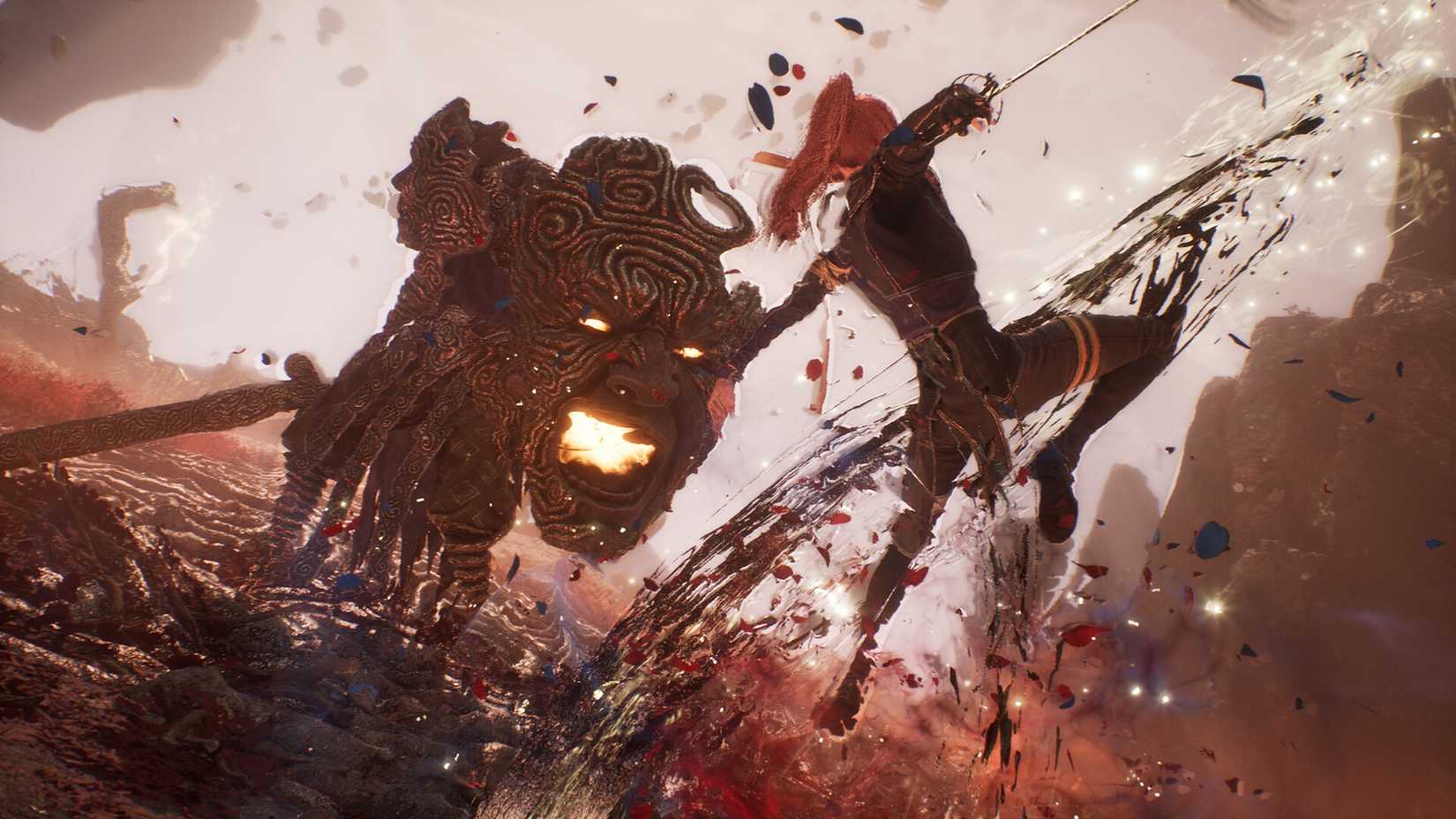
‘Member what I said before about scope not being synonymous with quality? If you want definitive proof of that in regard to modern JRPGs, look no further than Clair Obscur: Expedition 33, the game that utterly dominated the 2025 Game Awards from almost every conceivable angle despite being smaller in scope and budget than just all of its bigger-name competitors.
Much like a great work of art, Expedition 33’s design ethos is all about doing more with less. The critical story path is laid out pretty clearly for you, and while there are optional areas to visit on the world map, a lot of them consist of single areas with no combat encounters. Aside from some infamous superbosses, most of the game’s most memorable story and gameplay beats occur within the critical path, and trust me when I tell you that you’ll want to keep pushing down that path just to see what happens next.
Honestly, the only real problem with Expedition 33 from this perspective is that you might want to spend more time with the game than it actually allows. That’s another way in which it’s like a great work of art: it always leaves you wanting more.
Next



![ELDEN RING NIGHTREIGN: Deluxe Edition [FitGirl Repack]](https://i5.imageban.ru/out/2025/05/30/c2e3dcd3fc13fa43f3e4306eeea33a6f.jpg)
 English (US) ·