.png)
.png) 5 months ago
109
5 months ago
109


Published Feb 27, 2026, 2:23 PM EST
Daniel has been playing games for entirely too many years, with his Steam library currently numbering nearly 750 games and counting. When he's not working or watching anime, he's either playing or thinking about games, constantly on the lookout for fascinating new gameplay styles and stories to experience. Daniel has previously written lists for TheGamer, as well as guides for GamerJournalist, and he currently covers tech topics on SlashGear.
Sign in to your DualShockers account
Following the video game crash of ‘83, the Nintendo Entertainment System all but single-handedly rescued the floundering industry, cleverly sidestepping consumer concerns by not overtly referring to itself as a video game console. It’s one of the most enduring legends in gaming history, and rightfully so. We would not be where we are without the NES, though in addition to the importance of the console itself, I think its games should also be praised for what they’ve contributed.
Related
Obviously, the NES had plenty of certified banger titles that made huge stacks of cash and sparked off some of the most objectively profitable IPs in modern entertainment. I’m not just talking about games being good, though, I’m specifically talking about what they brought to the table, the concepts large and small that set the stage for advancements and norms in the industry today. The NES led the charge of the third console generation, and its weapon of choice was its revolutionary games.
10 Tecmo Bowl
The First Sports Game to Use Real Players

These days, every major sports video game that releases is positively swimming in league iconography. Every subsequent NFL game, for instance, has all the current teams, players, and their associated stadiums, logos, and so forth. Back in the earlier days of gaming, though, sports-themed games didn’t have any of that. Sporting teams are major brands, after all, and they don’t license out to just anyone. The first game that successfully bridged that gap was Tecmo Bowl.
Originally released in arcades in 1987, the 1989 port of Tecmo Bowl to the NES was the very first console game to cut a deal with the NFL, specifically the NFL Players Association, in order to use the names and… very, very rough likenesses of actual footballers. Of course, Tecmo only got the license from the Players Association, not the League Association, so they couldn’t use the team names or logos.
Even without the iconography, though, every town and city’s team is completely identical to the NFL lineups of the time, with the properly-named players in their respective positions. It was an incredibly successful game, which prompted the NFL to read the writing on the wall and start leasing out team names in the future.
9 Gradius
The First Appearance of the Konami Code

|
Konami |
|
NES |
|
April 1986 |
When you think of the legendary Konami Code, what’s the first game that comes to mind? Probably Contra, right? Well, while Contra’s use of the code is undoubtedly its most popular example, it technically isn’t the first. The very first appearance of the Konami Code, and indeed, one of the earliest examples of cheat codes in games period, was in Gradius.
The original Famicom release of Gradius in 1987 incorporated the Konami Code, allowing you to enter it in while the game was paused to activate all of your ship’s weapons and options. It was a convenient way to get your ship back up to fighting strength after getting blown up and losing everything, and a handy crutch for players who weren’t as good at high-intensity action games.
Following the Konami Code’s appearance and prevalence in Gradius and Contra, input cheat codes became a semiregular staple up until the sixth generation of consoles, after which they were gradually phased out. It’s a shame, but that code made for a very important part of gaming’s overall identity in its teenage years.
8 Kirby’s Adventure
Designing for Replay Value

Compared to the games of today, games in the NES era weren’t really designed to be replayed, at least in any meaningful capacity. You could play a game you’ve already beaten just for the fun of it, but your experience probably wouldn’t be notably different. There was one game, though, that was designed to facilitate a bit of variance between playthroughs: Kirby’s Adventure.
The second game in the Kirby series, Masahiro Sakurai specifically worked to overhaul the formula of Kirby’s Adventure after receiving complaints that Kirby’s Dream Land was too easy and simplistic. Rather than just making things arbitrarily more difficult, Sakurai chose to introduce a very particular X-factor, the Copy Ability. The inherent instability of Kirby’s Copy Abilities ensured that no two playthroughs would ever be completely identical, which made replaying a little more engaging.
I won’t go as far as to say that Kirby’s Adventure pioneered the concept of replaying games, but it was a big step in diversifying a game’s formula enough so that you could squeeze a little extra playtime out of it after crossing the finish line.
7 Dragon Quest
The Progenitor JRPG

The game you personally consider to be the progenitor of all JRPGs probably depends on where and when you grew up. Here in the states, the game that immediately springs to mind is Final Fantasy, but over in Japan, the grand daddy of all JRPGs was, is, and shall remain Dragon Quest.
The original 1986 Dragon Quest was designed by Yuji Horii, who drew heavy inspiration from western PC RPGs like Ultima. Since Ultima was a PC game, though, something exactly like it wouldn’t work on a console like the NES. So, Horii designed his game to be more paired-down and accessible, something that wouldn’t require a frame of reference in concepts like Dungeons & Dragons. Dragon Quest was the result, and boy howdy, did it do gangbusters.
Dragon Quest didn’t come westward until three years later in 1989, renamed Dragon Warrior. Final Fantasy had already been released on the NES by this point, which is why it’s more of a point of reference for western retro gamers. Make no mistake, though, Dragon Quest did it first, and all other JRPGs, Final Fantasy included, bow down before it.
6 Tetris
The Original High-Speed Puzzler

High-speed puzzle games are a common stocking-stuffer genre these days, but prior to the 80s, puzzle games were generally much slower, more contemplative affairs. It was the release of the original Tetris, the brainchild of a Russian computer engineer, that started to pump the gas, and it was its NES port that aided greatly in that pursuit.
The NES version of Tetris is a bit of an outlier amongst its contemporaries, as it becomes exponentially faster in pace in a shorter timeframe, effectively forcing you to play better or go bust. This breakneck approach has helped to popularize the high-speed puzzle framework, with Tetris in particular becoming a poster child for competitive gaming.
While Tetris is best-known for its Game Boy port released in June 1989, the console port technically came first, releasing one month prior. There’s a whole complicated legal story to it, but the short version is that Atari made the original version, which then got pulled from shelves due to a legal kerfuffle, and then Nintendo released the one we all know a few months later.
5 Super Mario Bros.: The Lost Levels
The First DLC

Super Mario Bros.: The Lost Levels
In 1986, the Japanese counterpart to the NES, the Famicom, received its first official expansion module, the Famicom Disk System. This gadget was mounted onto the bottom of the console, and allowed it to run games off of floppy disks instead of cartridges. One of the earliest Disk System games was a direct sequel to Super Mario Bros., aptly named Super Mario Bros. 2, though rather than a sequel, it could be more easily likened to a DLC pack.
Super Mario Bros. 2 used the same engine and most of the same tileset as the original game, but offered a series of completely new levels designed specifically for players that had definitively mastered the original game. Unfortunately, this meant the levels were exceptionally difficult, too difficult for western players, according to Nintendo devs, so the game wasn’t brought west. Not that it could’ve anyway, since the NES didn’t get a Disk System.
Related
Best Platformer From Every Console Generation
From Pitfall to Donkey Kong Bananza, these are the best platformers from every console generation.
It’s a bit of a roundabout example, but Super Mario Bros. 2 is technically the first expansion pack to be released for a console game. It did eventually make its way westward, albeit in the form of Super Mario Bros.: The Lost Levels on Super Mario All-Stars, as the Super Mario Bros. 2 we got in the States was just a reskin of the game Doki Doki Panic.
4 Excitebike
One of the Earliest Console Level Editors

In the early 80s, it wasn’t out of the question for people to make their own homebrew video games. That’s a big part of what drove the burgeoning home PC culture, after all. Within the realm of console games, though, that was a bit of a taller order, especially since Nintendo was fiercely protective of its hardware copyrights. Still, we did still get a degree of customizability on the NES, courtesy of Excitebike.
Excitebike, on the surface, was a fairly simple motocross racing game where you tried to outrun and out-stunt other bikers on the track littered with hurdles and obstacles. That was all well and good, but what was really cool was the game’s Design Mode, in which you could create your own track with custom-placed obstacles, then either race your friends or against CPUs.
Today, it’s pretty easy to load up an emulated NES game and tinker with the levels, and some newer titles have their own in-built level editors for easy customization. Excitebike did all of that on cartridge, on console, before the practice became normalized.
3 Metroid
Planted the Seeds of a Genre

Did you know that “Metroidvania” actually has a second, more official-sounding name? They’re called “search action” games, meant to emphasize both their action-platformer elements and non-linear map-based exploration. While games like Super Metroid and Castlevania: Symphony of the Night brought this now-massive sub-genre to the forefront, it was the original Metroid that planted the seeds.
By NES platformer standards, the original Metroid was absolutely massive, with five distinct sectors and a multitude of mandatory and optional power-ups to collect. It was an adventure that, even by the standards of the time, was exceptionally hands-off, encouraging you to map out your progress and retrace your steps entirely of your own volition. The game used a password system to keep your power-ups saved, but you always had to start from the beginning of an area when loading up, so a map was vital.
Side note, Metroid was also one of the first games to encourage speedrunning with multiple, slightly varying endings, the best of which revealed one of gaming’s most shocking secrets-but-not-actually, that Samus was a woman.
2 Super Mario Bros.
Pioneered Scrolling Graphics
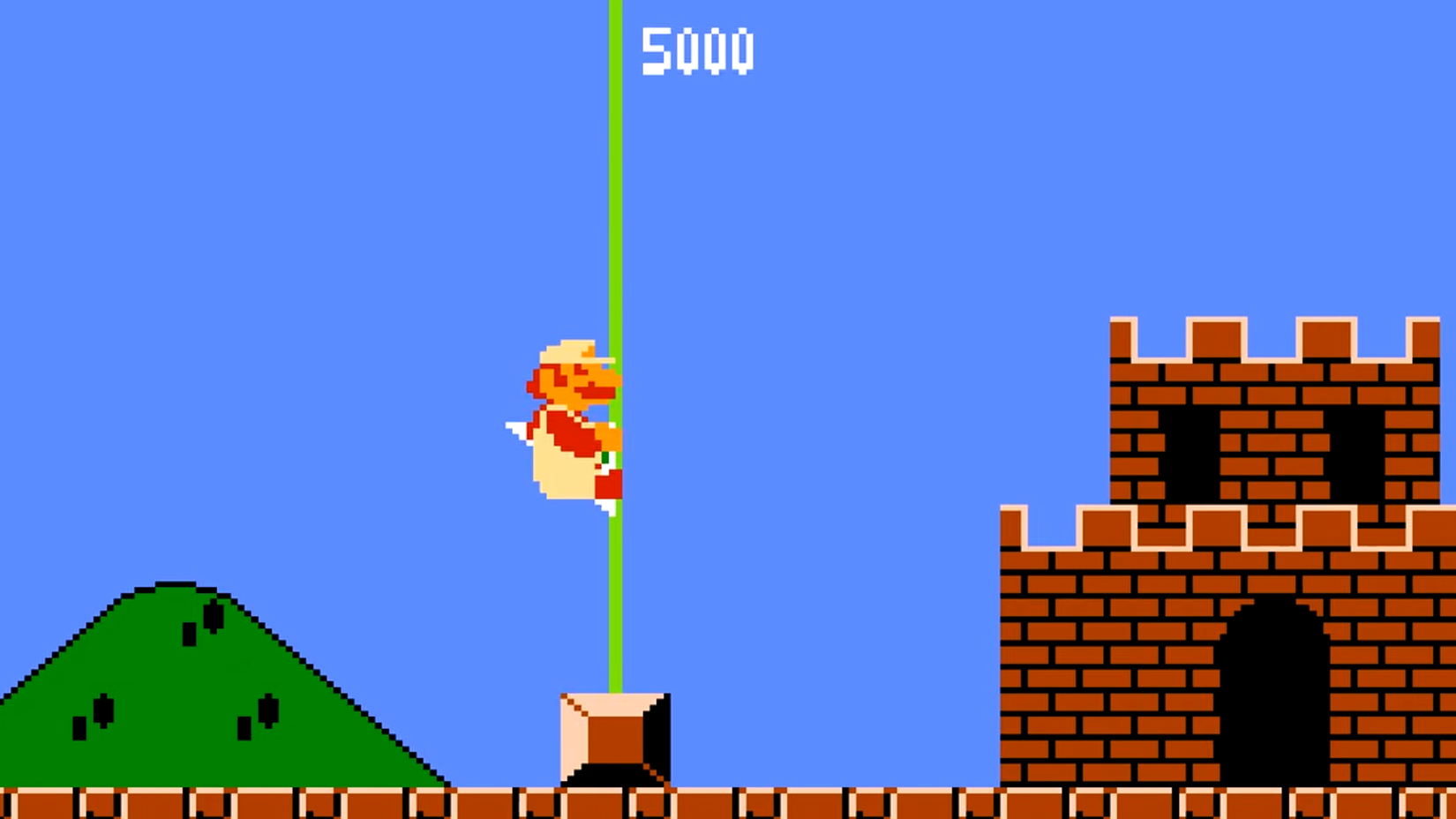
While Super Mario Bros. is considered one of the patron saints of the platformer genre, it’s not the first platformer ever made. Even back in the Atari days, there were plenty of titles that involved jumping over stuff. However, Super Mario Bros. did have one crucial difference that all of those earlier games lacked: it could scroll, baby.
Super Mario Bros. on the NES was the first platformer game to incorporate horizontally-scrolling graphics, as opposed to keeping the entire game on a single screen or loading an entirely new screen every time you walked over the edge. Mario could just keep on walking right forever, with new enemies and obstacles loading in on their own. It was a vital component of the game’s signature quick pace, not to mention the source of its signature level layouts.
Fun fact, after Nintendo released Super Mario Bros., homebrew game designers went bonkers trying to copy its scrolling capabilities. One of the first games to actually crack the code was shareware classic Commander Keen.
1 The Legend of Zelda
Gave Us the Gift of Saving

The earliest days of gaming, including those of the NES, were most arcade-style in their progression. You had to beat the whole game in one sitting, or not at all. Some games used a password system, allowing you to rebuild your progress using numerical or symbol inputs, but this was clunky and inconvenient. One of the first console games to break this norm was also one of the biggest and most important titles on the NES: The Legend of Zelda.
The original Legend of Zelda incorporated a relatively simple, yet positively groundbreaking addition into its cartridge; a tiny SRAM chip powered by a single cell battery. With this single addition, the cartridge became capable of storing data even if the console was turned off and the cartridge removed. In this way, you could save your progress in the game and come back to it later rather than having to beat the whole adventure in one go.
It goes without saying that an in-built save system is standard in just about all games that have been released since. Goodness knows I wouldn’t be able to start every game I play these days completely from scratch.

Next





![ELDEN RING NIGHTREIGN: Deluxe Edition [FitGirl Repack]](https://i5.imageban.ru/out/2025/05/30/c2e3dcd3fc13fa43f3e4306eeea33a6f.jpg)
 English (US) ·