.png)
 5 months ago
61
5 months ago
61

12 Monkeys may not be the most iconic Gilliam movie, but it might be his flat-out best
 Image: Universal Pictures
We haven’t quite caught up with the future of 12 Monkeys just yet. The Terry Gilliam-directed movie extends as far as around 2035, 40 years after its Dec. 29, 1995 release, and still another decade off from this, its 30th anniversary. But maybe we’ll catch up soon. In 12 Monkeys, a virus is strategically released in 1996 and quickly wipes out much of the world’s population. Survivors are forced underground, sending imprisoned “volunteers” to the uninhabited surface to collect samples. Our closest equivalent is the COVID-19 pandemic that began in 2020 and has since been mitigated but not exactly beaten. Given the speed of its spread, the next one probably still has time.
For all of its present-day eeriness, however, 12 Monkeys isn’t really about a global pandemic the way that, say, Steven Soderbergh’s Contagion is. It’s about a pervading sense of uncertainty and modern-world disorientation. To this end, this time-travel story intentionally elides key scenes and details, starting with how, precisely, its system of time travel works. The scientists, or authorities, or whoever else is peering at James Cole (Bruce Willis) through a series of ramshackle Gilliamesque screens, imply they cannot alter the overall trajectory of the past; they can only send people back to gather information. In Cole’s case, he is charged with finding out precisely where the virus originated, in hopes that it might offer clues to a cure. For his cooperation, he may receive a reduced sentence.
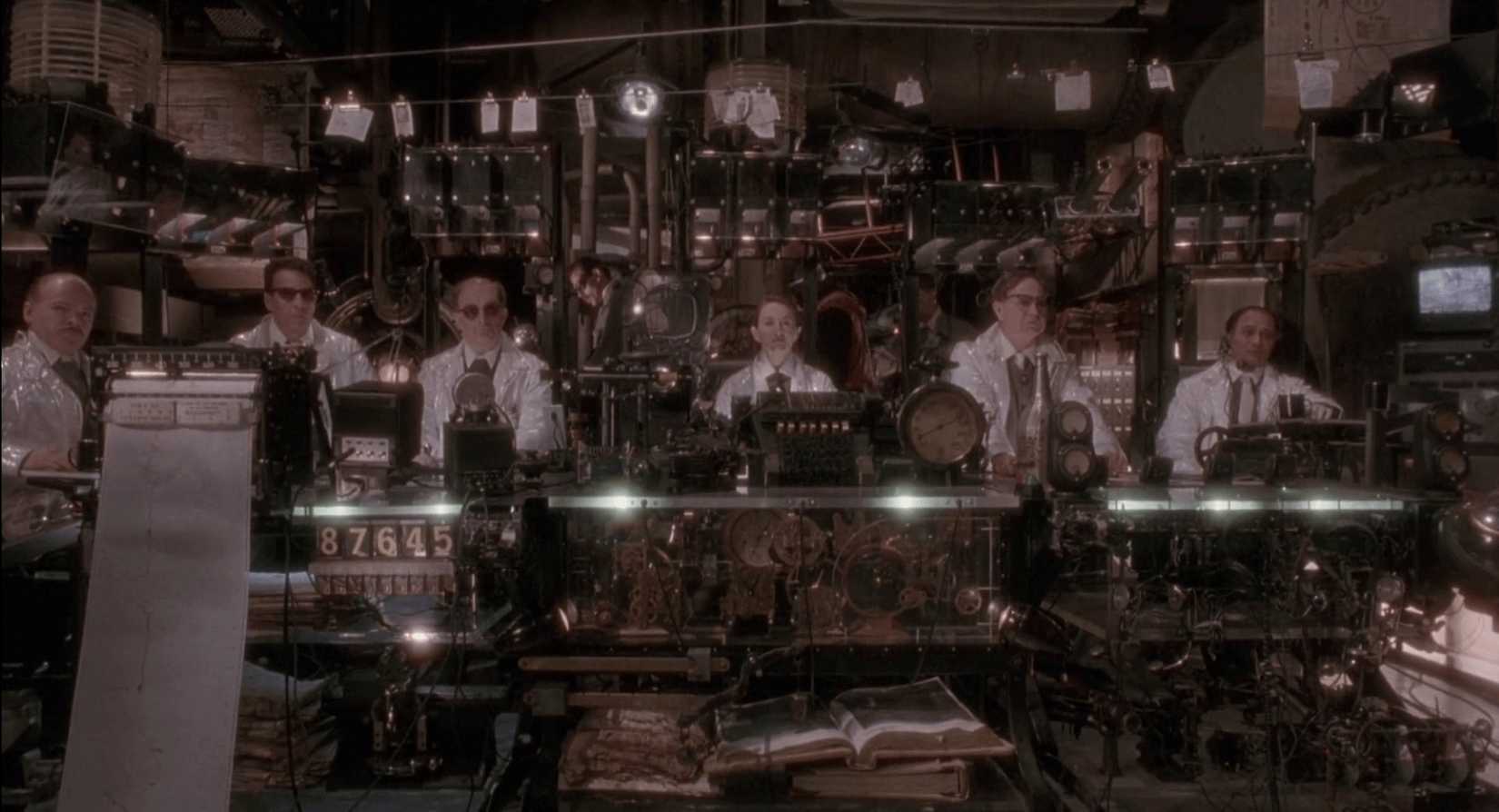 Image: Universal Pictures
Cole’s status as a prisoner is itself an intriguing notion. What was he imprisoned for? Are there particularly vicious crimes in this shambles of a society, or do the authorities cut a wide swath in determining who should be placed in cages and offered the opportunity to “volunteer” for various grunt-work missions? Gilliam leaves this information out in a way that compounds the film’s casual mysteries. The first time Cole travels back in time, we don’t see how it happens, and he makes several more off-screen trips. The time-travel device, seen only briefly, is also Gilliamesque, recalling the ductwork of Brazil. It looks unreliable.
Indeed, we see primarily that the process is imprecise when Cole lands in 1990, rather than 1996. He still manages to meet Jeffrey Goines (Brad Pitt), the institutionalized leader of the so-called “Army of the 12 Monkeys,” a radical group that future scientists have connected to the virus. He also meets Dr. Kathryn Railly (Madeleine Stowe), a psychiatrist who tries to help him. When Cole finally does land in 1996 (after a detour to World War I — again, unexplained but for the system’s general clumsiness), he encounters both figures again. As Railly becomes gradually convinced that Cole may be telling the truth about the future, Cole himself becomes open to the idea that he may be crazy. It’s a more comforting thought than the idea that he’ll witness the world ending all over again; he was a child when the plague began, and periodic dream/flashback sequences reveal mysterious figures he remembers seeing in an airport at that age.
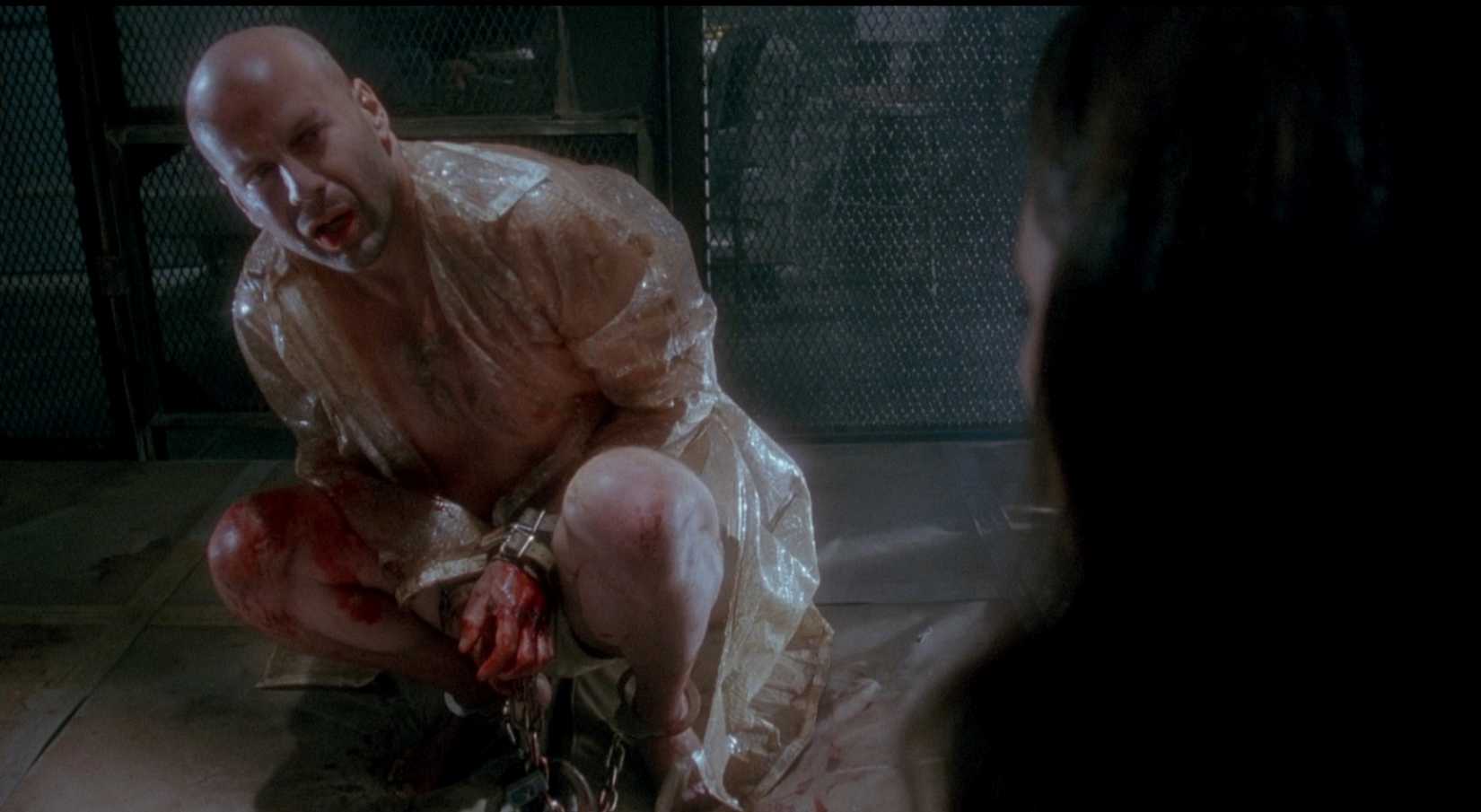 Image: Universal Pictures
This is one of Willis’s best performances. His history as an action hero — Die Hard with a Vengeance came out the very same year — is used primarily as shorthand, making it believable that a disoriented Cole could pose a physical threat to those who try to subdue him. (Most of the violence is off-screen, though there are some brutal flare-ups.) What comes through in Willis’s performance is an aching vulnerability. There are hints of it in many of his best films, but here, Cole has an open-nerve quality that’s heartbreaking, as in the scene where, in the midst of kidnapping Dr. Railly, he’s moved to tears hearing a familiar song on her car radio.
Gilliam never really creates plausible suspicion that Cole may be crazy. By any available evidence, the world of 2035 is real, and Gilliam’s fish-eyed, Looney-Tunes style (one of Pitt’s scenes is diegetically scored with cartoon sound effects) creates no sense of differentiated realities or perspectives. The greater ambiguity is whether Cole’s return trips to 1996 will have any effect on the outcome, despite the scientists’ vague assumption that it won’t, and whether he’ll be able to get his bearings in whatever world he winds up living in. Toward the end of the movie, he and Railly hide out in a theater playing Alfred Hitchcock’s Vertigo. Cole sorts through a memory of having seen the film before, and how “every time you see it, it’s different, because you’re different.” (Because Gilliam is not a particularly subtle director, he then makes multiple visual and aural Vertigo quotations, most noticeably by outfitting Stowe in a blond wig.)
There are other, less intentional connections to famous films. At one point, Willis, on the streets of Philadelphia, declares that “all I see are dead people,” bringing to mind his first film with M. Night Shyamalan that would release less than four years later. (Is Haley Joel Osment’s character in The Sixth Sense named Cole as a tribute?) Another famous movie from the same year is pre-visioned by a gesticulation-heavy Brad Pitt performance where his character rants about people numbing themselves with consumerism. They may not have had 2020 in mind, but Gilliam and invaluable screenwriters David and Janet Peoples seem to be anticipating 1999 — not just through these coincidental pre-shout-outs, but in the movie’s sense of millennium-era unease over whether we can trust the world we see around us, or trust ourselves to navigate through it.
 Image: Universal Pictures
The prescience of 12 Monkeys extends beyond that immediate future, too. The way it pointedly avoids too much exposition about the hows and whys of time travel, and the way no one can convincingly assure Cole he is or is not losing his mind, feels like a pre-digital manifestation of internet-era disinformation. Though relatively straightforward for a Gilliam movie, the plot as the characters understand it is a cocktail of rumors, guesses, contradictions, and bleakness. It’s not unlike scrolling through social media as a news story is breaking, only this is how Cole seems to live most of his life.
Maybe the relatability of that overload is why 12 Monkeys was the peak of a brief ’90s period of surprise commercial viability for Gilliam, following his Oscar-nominated hit The Fisher King. (Fear and Loathing in Las Vegas brought that to an abrupt end.) Gilliam may have directed movies more visionary or challenging than this one, but 12 Monkeys may be his most powerful form of outreach, drawing the audience into a fragile, unsteady world we recognize all too well.





![ELDEN RING NIGHTREIGN: Deluxe Edition [FitGirl Repack]](https://i5.imageban.ru/out/2025/05/30/c2e3dcd3fc13fa43f3e4306eeea33a6f.jpg)

 English (US) ·