.png)
 3 months ago
26
3 months ago
26

Published Apr 26, 2026, 5:00 PM EDT
In Mother Mary, David Lowery seems fixated on the less horrific dimension to ghost-like entities
 Image: A24
“This is not a ghost story,” says on-screen text in the middle of the trailer for David Lowery’s strange new movie Mother Mary. It’s a catchy line. It’s also a little bit strange when that trailer is for a movie whose director made a movie literally called A Ghost Story. (We get it, Lowery’s fans might say to themselves. This is not a Pete’s Dragon, either.) Actually watching Mother Mary in the context of Lowery’s other work, however, clarifies that sentence, even if it’s ultimately just good marketing. At this point, Lowery has made several movies that feature ghosts without resorting to many familiar trappings of haunting narratives. He may be the most ghost-fixated filmmaker who has yet to make an actual horror film.
Mother Mary comes closer to the genre than anything Lowery's done so far, trailer protestations notwithstanding. The set-up initially resembles the dynamics of a stage play, with estranged besties Mother Mary (Anne Hathaway) and Sam Anselm (Michaela Coel) reuniting unexpectedly and chatting, mostly alone in a cavernous farmhouse on Sam’s property. The twist in their relationship is that Mary, as you might guess from her lofty moniker, is actually a globally famous pop star. Sam, a fashion designer, was her creative collaborator until Mary abruptly curtailed their partnership years ago. Now, Mary has turned up on Sam’s doorstep, desperate for a new dress to wear for her comeback concert.
The horror accumulates gradually. There’s an element of psychological duel in their reunion, and eventually it turns into a kind of exorcism (hence the trailer’s “this is a prayer,” presumably) as Mary and Sam each recount their experiences with some kind of ghostly entity, depicted as a writhing stretch of red fabric. (These passages are increasingly visual, though it’s still easy to picture a version where they would just be monologues on a stage.) Sam has seen this apparition separately from her friend, and Mary’s encounter with it caused a public accident at a concert that left her scarred, physically and mentally.
These moments are not traditionally frightening. Mary doesn’t appear to be in immediate danger, nor does she appear to be driven mad through doubting her own eyes. She's quite sure the entity really does exist, and the movie indicates little to no distrust of her account. But there is an uncanny eeriness to the shared experiences of these two women, and Lowery uses the image of this free-floating ghost/scarf to evoke a number of things at once: Their private personal bond, the nagging doubts that accompany creative inspiration, and the way that memories can be as haunting as any actual spirits.
This isn’t the first time Lowery has leaned heavily on this kind of imagery. In addition to A Ghost Story, his medieval fantasy The Green Knight also dramatizes an encounter with a ghostly figure. While on his wandering quest to fulfill a promise made to the enigmatic Green Knight (who himself has a supernatural aura), Sir Gawain (Dev Patel) encounters Saint Winifred (Erin Kellyman), a shadowy young woman who asks him to retrieve her body’s head from a nearby body of water and reunite it with her other remains. Gawain is confused, because she seems full and able-bodied standing in front of him. “Are you real or are you a spirit?” he asks her. She replies curtly: “What is the difference? I just need my head.”
 Image: A24
He dutifully dives into the water (which turns red-lit, like the fabric in Mother Mary) and retrieves a skull. When he returns it to Winifred’s home, he regains the ax that thieves had taken from him earlier. It just appears, and Lowery shoots Kellyman similarly. The only continuous movement she makes is in a wide shot, as the camera follows her and Gawain from a distance. In closer shots, she appears less continuous: She gets closer to Gawain within the space of a cut (rather than moving within the frame), and when they share a frame, she is often out of focus despite appearing in the foreground.
Lowery’s earliest foray into the world of ghosts was, yes, A Ghost Story, wherein a young, unnamed couple (Rooney Mara and Casey Affleck) are separated by the man’s accidental death, after which he reappears as a figure beneath a sheet, looking like a child’s drawing of a ghost. Invisible to all but other ghosts (and the audience), he lingers at the site of the couple’s home, experiencing his partner’s grief from a distance. He cannot quite push through to communicate with the world of the living, and spends a lot of his time looking for a way to read a note that his partner leaves in the house after moving out. Like Winifred, he wants something from the material world that he, as a spirit, can’t quite get his hands around.
While waiting, the ghost experiences the fullness of time: Observing later occupants of this house, witnessing changes that occur in the distant future, and finally looping around to the beginning of time. Eventually, he is able to watch himself in his now long-ended relationship. That’s the only way he’s able to see his partner again (and get another crack at that message left in their home), at least as far as we can see. Where he goes after he reads the note and promptly disappears, leaving his sheet behind, is uncertain. There’s something serene about the ghost bearing witness to so much — and upsetting, too, with that long-term emphasis on how the world spins on without us. But it’s a different sort of scary than what you get from a traditional haunted house.
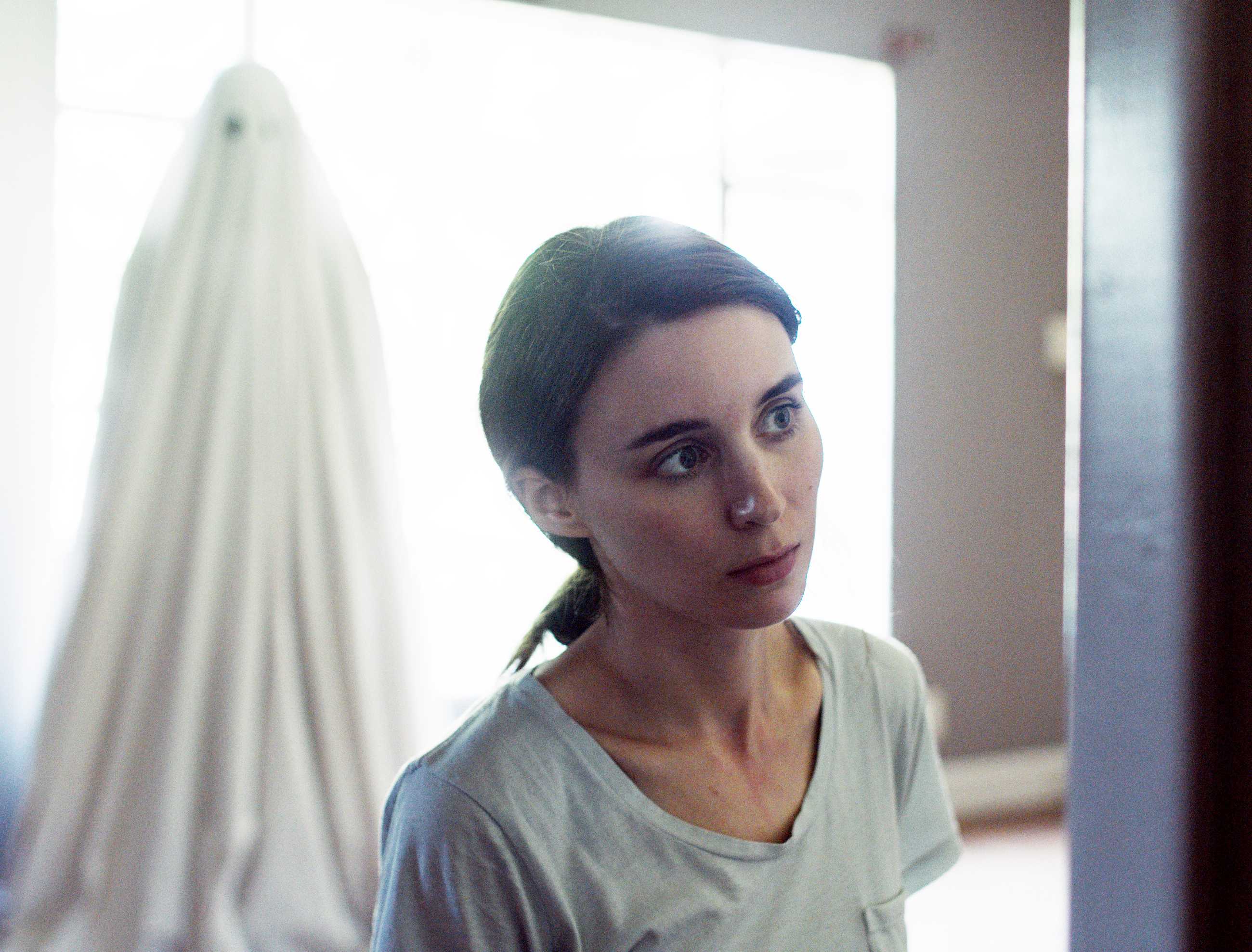 Image: A24/Everett Collection
Throughout these three films, Lowery depicts ghosts as an intersection point between the fleeting physical body and the lingering nature of whatever it leaves behind. In The Green Knight, Winifred observes her own remaining skeletal form, lingering in parallel with her spirit. In A Ghost Story, the man in the sheet is tactile to the audience (and presumably himself), but invisible purely representative in the “real” world, where his spirit lingers more symbolically in his partner’s grief. These are conceptually neat tricks, because ghosts, in whatever form they take, are both a liminal, temporary echo of a physical existence, and quasi-living entities that exist beyond the confines of a normal lifespan.
In Mother Mary, Lowery incorporates elements of both previous films. The ghostly entity centers on a bond between two people, just as in A Ghost Story, though it’s not clear Sam and Mary have a truly romantic connection. At the same time, it’s given a solid form, with billowing fabric as a more lively counterpart to the common bedsheet. That fabric is a half-ethereal, half-hellish red, like the glow of the otherworldly water in The Green Knight, and receives a matter-of-fact treatment similar to Winifred’s impatience with the question she refuses to answer about her state.
If anything, Mother Mary is also more overt about the idea of a ghost, even though the ghost doesn’t take human form. There’s a flashback to a séance, and a present-day ritual Sam performs on her ex-friend, hoping to expel the entity. The movie comes right up to the knife’s edge of horror without taking the plunge. Though his ghost stories aren’t aggressively frightening, Lowery stops short of implying that ghosts are nothing to fear. It’s more like ghosts are a fact of this weird, expansive, scary life.
Mother May is now playing in theaters. The Green Knight is streaming on HBO Max. A Ghost Story is available to rent or purchase on Amazon and Google.




![ELDEN RING NIGHTREIGN: Deluxe Edition [FitGirl Repack]](https://i5.imageban.ru/out/2025/05/30/c2e3dcd3fc13fa43f3e4306eeea33a6f.jpg)
 English (US) ·