.png)
.png) 7 months ago
161
7 months ago
161
If you have seen any modern discussion about JRPGs, you have definitely heard plenty of people talking about how Clair Obscur: Expedition 33 was innovative and brought mechanics never before seen in a turn-based game.
Hear me out: I love Expedition 33, but my JRPG portfolio keeps me level-headed and from getting carried away by the experience it delivered, let alone downplaying titles that came before it and offered that same kind of innovation regarding timed inputs. Still, to be fair, the way parries work in Expedition 33's turn-based combat is quite a novelty.

Related
10 JRPGs That Take Forever To Complete
I really want to emphasize the “forever” in the title.
Because of that, I want to highlight several games that came before Clair Obscur: Expedition 33 and already featured some form of reactive feedback during battles, whether for attacking, defending, or a mix of both.
This is not to diminish the accolades of Expedition 33, which are more than deserved, but to praise those who came before, like Lost Odyssey, a game the director Guillaume Broche often cites as a reference for Expedition 33.
9 Super Mario RPG
The Pioneer

I will start with the JRPG, which was either the pioneer of the system or, at least, the most famous example of turn-based combat featuring timed inputs. Released in 1996 for the Super Nintendo, Super Mario RPG is the result of a partnership between Nintendo and Squaresoft, which was easily recognized as the monarch of RPGs at the time.
The result of this partnership was a traditional turn-based game with a brilliant twist: timing in attack and defense. Whenever we attack, pressing the button at the exact moment increases our damage. On defense, the opposite happens, since hitting the timing reduces incoming damage and sometimes even nullifies negative effects.
What is really cool is that each character and each weapon has its own timing. Mario's punch is faster, the hammer has a slight delay, and jumping requires double precision. This mechanic makes every battle far more interactive, and its influence was so strong that many future JRPG releases drew inspiration from it.
8 Cris Tales
Time and Timing

Cris Tales is an indie JRPG centered around time travel. This theme is used both in the story, which drives the narrative across multiple time periods, and in gameplay, including exploration, puzzles, and, most importantly, combat.
Once combat begins, Crisbell can use her powers as a Time Mage to manipulate enemies. She can send enemies on the left side of the screen to the past and those on the right to the future, affecting their abilities and even altering their age, making them old and slow or young and fragile (which is pretty nasty, thinking about it in hindsight).
More importantly, there are timed inputs. They are the simplest form of inputs, as seen in Super Mario RPG, but they still count. If the player presses the button right before an attack connects with the enemy, there is a chance to increase damage.
The same applies defensively, since hitting the timing on defense can reduce incoming damage. It is straightforward, but enough to keep us on our toes, especially when we accidentally send an enemy to a different time period, and they end up stronger than expected.
7 Magna Carta: Tears of Blood
Being a Good Leader

Magna Carta: Tears of Blood
I played Magna Carta: Tears of Blood back in the PS2 era, and while I enjoyed the game, I never got too far because other RPGs at the time grabbed my attention. Still, right from the tutorial, the game showcases its combat system featuring the Trinity Ring with timed inputs to unleash attacks.
When approaching an enemy, the Trinity Ring appears along with the required commands to land an attack. If you miss the inputs, the attack does not happen, and the leadership meter is slightly reduced. You can try again, but if you keep missing, the meter depletes, and the character has to stand still until it recharges, leaving them vulnerable to enemy attacks.
It's possible to increase the leadership meter as party members trust Calintz, our protagonist, more, which in turn allows more attacks with a given character. To speed up the meter recharge, you need characters with higher charisma, which can be achieved with certain equipment. Plus, landing multiple Great results on the Trinity Ring fills the Trinity Drive bar, and using the Drive allows you to deal double damage.
It is a battle system that feeds on itself. At first, landing the timing can feel slow and annoying, but once you get the hang of it, it becomes far more rewarding and engaging, especially when factoring in the Chi mechanic and which character is most effective against each opponent.
6 Lightning Returns: Final Fantasy XIII
Fighting Alongside Lightning

Lightning Returns: Final Fantasy 13
Lightning Returns: Final Fantasy XIII presents a different take on timed inputs, as they are more tied to defensive commands than to offensive ones. Still, it qualifies as a reactive system since it relies on player feedback and constant attention during combat.
Lightning can equip different garbs, which effectively change her class. Different garbs have different abilities, and the ones that matter here are guard and evade skills. While all guard abilities reduce enemy damage if used before an attack connects, hitting the correct timing results in a perfect guard, completely nullifying the damage.
It is also possible to evade and counterattack, but those are fixed abilities tied to specific garbs. All in all, the reactive system in Lightning Returns: Final Fantasy XIII reinforces the feeling of a hybrid between ATB and real-time combat, forcing players to stay on the edge of their seats in every battle.
Related
10 JRPGs Reviewed Better Than Final Fantasy VII
Final Fantasy VII paved the way for the genre, and these JRPGs made the most of that opportunity.
5 The Legend of Dragoon
Burning Rush

At the tail end of the original PlayStation era, Sony invested heavily in its own JRPG, The Legend of Dragoon. The game featured traditional turn-based combat, but with a very relevant twist to basic attacks. Basic attacks are called Additions, and they are essentially command sequences that require pressing the button at the exact moment two squares align on the screen.
It sounds simple, but as characters evolve, these Additions become longer and faster, demanding focus even against common enemies. And that is not all, since there is also a catch where some Additions can be counterattacked mid-sequence. If you fail to press the correct button to avoid the counter, you take damage and lose the combo.
Additionally, when transforming into Dragoons, this QTE changes into a rotating ring where you must hit the correct point multiple times to deal maximum physical damage. This mechanic creates the feeling that you are almost playing a rhythm game within an RPG, and it has become so iconic that fans still ask for a remake or sequel.
4 Shadow Hearts
Judging Your Reaction Skills
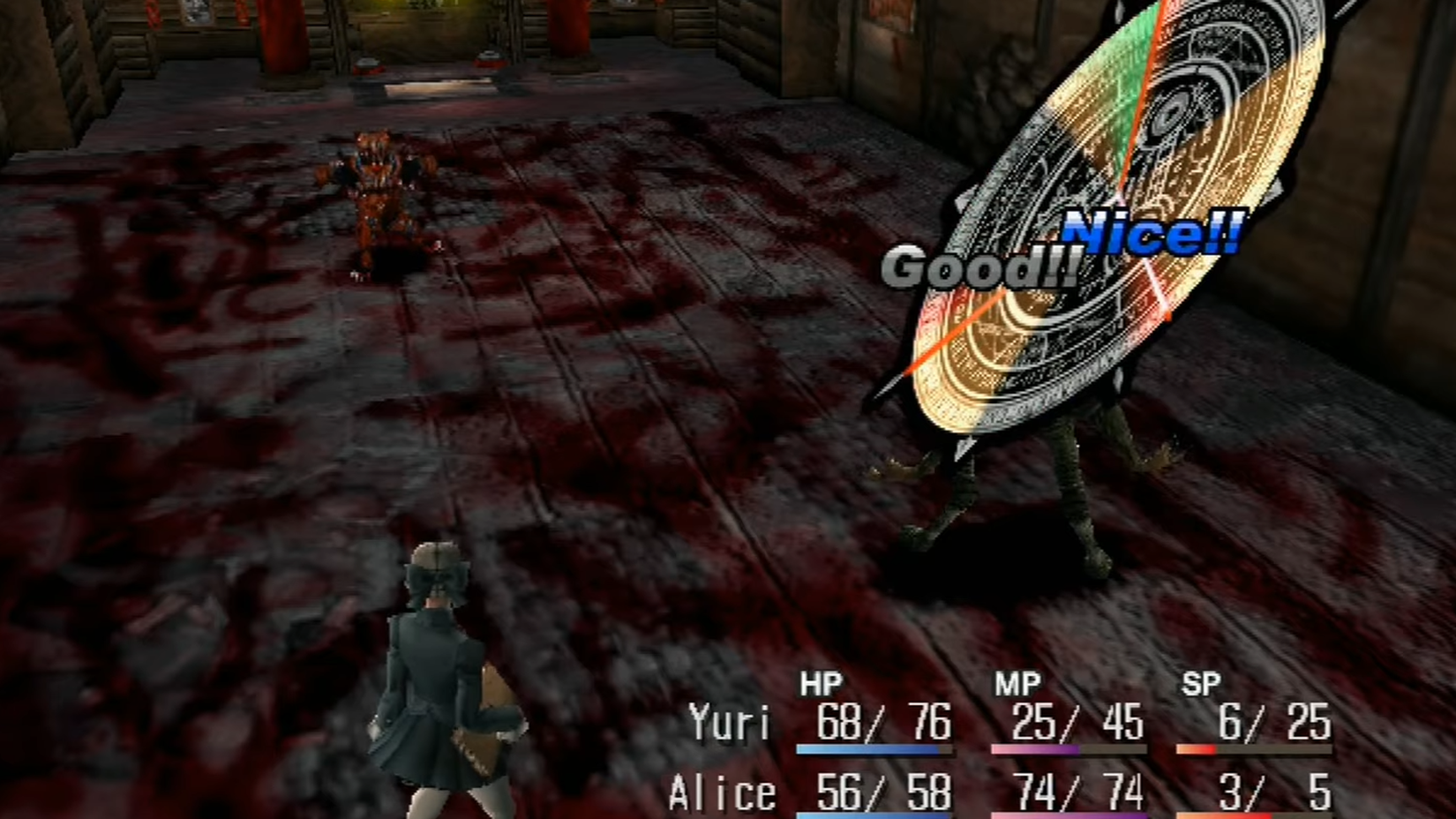
The PlayStation 2 continued to push innovation in turn-based combat, as seen in the Shadow Hearts series. Its system, called the Judgment Ring, relied heavily on timed inputs, requiring player precision for every action, whether attacking, casting magic, healing, or even using items. If the player wants the best possible result, they must press the button as the pointer passes through the colored areas of the Judgment Ring.
The more precise you are, the better the effects of the action. Some tiny zones on the ring guarantee the best results, functioning like critical hits. However, attempting to land a critical is difficult, and if you miss the timing, you lose the entire turn, creating that satisfying risk-and-reward feeling.
The Judgment Ring can also be affected by buffs and debuffs, with some buffs enlarging the hit zones or slowing the pointer, while debuffs do the opposite by shrinking the zones and speeding up the pointer. It is a system that keeps you alert even in the simplest battles, turning every turn into a reflex test and rewarding you the more accurate you are.
3 Sea of Stars
Inspirations on the Sleeve

Sea of Stars is one of those gorgeous indie JRPGs inspired by 16-bit era classics, drawing on Chrono Trigger's visuals and Illusion of Gaia's exploration cues. Meanwhile, its combat system is clearly inspired by Super Mario RPG, since pressing the button at the right time increases damage when attacking and reduces damage when defending.
What interests me the most, however, are the special abilities of certain characters, which completely change how we interact with the game. Some require holding the button for the right amount of time to deal maximum damage, and holding it too long or too short results in subpar results. Others require watching the attack trajectory and pressing the button at the right moment to bounce it back as many times as possible while the projectile speeds up.
Without a doubt, this is a system that forces us to stay alert and think fast to achieve the best results. This attention is also required on defense, since every enemy has distinct behaviors and attacks. Sea of Stars also joins the ranks of games that cannot be cleared by playing on autopilot, and I didn't even mention the lock system.
2 Mother 3
Please Don't Stop the Music

One of the greatest crimes in JRPG history is that Mother 3 is still stuck on the GBA and relies on a fan translation, which is fantastic, by the way. Beyond its mature, dark, and emotional story, the battle system in Mother 3 is highly reactive, turning physical attacks into a clever rhythm-based minigame.
Each enemy you face has its own music, and if you press the action button in the exact rhythm of the track, you can increase the number of hits in your attack, reaching up to a 16-hit combo.
Some enemies have calm music, while others change the rhythm mid-battle to throw you off. There are ways to make timed inputs easier, such as putting enemies to sleep, which lets you hear the beat more clearly. It is one of the most curious mechanics on this list, and it perfectly matches the humor and creativity of the Mother series, making even the most fodder fights incredibly fun.
1 Lost Odyssey
Even More Rings

It is funny how many developers named their timed input systems after some variation of a ring, right? Lost Odyssey's turn-based combat features the Aim Ring System. When using a normal attack, a ring appears at the center of the screen while an outer ring closes in. Depending on how precise your timing is, you earn a rank between Perfect, Good, or Bad.
Your accuracy rank determines whether the ring's additional effect is applied. Perfect applies the full effect, Good applies part of it, and Bad results in a basic attack only. For example, the Flame Ring deals fire damage, while the Jamming Ring deals extra damage to mechanical enemies. However, if you miss the timing and get a Bad result, the additional effect is not applied.
Lost Odyssey's attack system ties closely into its progression system, reinforcing strategic thinking in combat. Even if you equip a ring that targets an enemy's weakness, it will not matter if you miss the timing. Luckily, there are Ultra Rings, which widen the central ring area and make it easier to land a Good or Perfect rank.

Next
8 Most Revolutionary JRPGs Every Fan Needs to Experience
These are games for those who want to dig deeper into the genre.




![ELDEN RING NIGHTREIGN: Deluxe Edition [FitGirl Repack]](https://i5.imageban.ru/out/2025/05/30/c2e3dcd3fc13fa43f3e4306eeea33a6f.jpg)
 English (US) ·