.png)
 3 months ago
67
3 months ago
67

Published Apr 10, 2026, 1:32 PM EDT
Bungo Stray Dogs reinterprets literary geniuses as flashy, eccentric personalities
 Image: Bones
If you look up “Osamu Dazai,” the prominent Japanese novelist is not the only search result that comes up. Between entries focused on the author of No Longer Human, you’ll glimpse an anime character with messy brown hair sporting a beige trench coat and heavily bandaged arms. This anime counterpart, also named Osamu Dazai, is the most recognizable character from Kafka Asagiri’s ongoing manga, Bungo Stray Dogs. Its five-season-and-counting anime adaptation by Bones (the studio behind Fullmetal Alchemist) completed its 10th anniversary on April 7, which means it's time for every bookworm and literature enthusiast who hasn’t seen it yet to catch up.
While anime-Dazai is only an abstract representation of the real Osamu Dazai’s literary ethos, Bungo Stray Dogs uses this unique convention to create a fascinating world rife with mystery and intrigue. To commit to this central conceit, Asagiri bases every Bungo character on a real-life literary genius. Everyone from H.P. Lovecraft to Fyodor Dostoevsky comes to life with hair-raising supernatural abilities in a gorgeous blend of grounded and fantastical elements.
Bungo Stray Dogs opens with a young boy named Atsushi Nakajima weeping after being kicked out of his orphanage. The distressed Atsushi sees a man floating in the river and instinctively saves him from drowning. This man, Dazai, casually reveals that it was a suicide attempt, which Atsushi had inadvertently thwarted. You would expect this to be a somber reveal, but Bungo plays it off as a darkly comic tidbit about Dazai and moves on to lighthearted comedy.
 Image: Bones
This tonal whiplash is the cornerstone of an anime that leaps from one genre to the next, as we soon learn that a berserker white tiger has been terrorizing the city of Yokohama. Dazai asks Atsushi to help, promising to provide food, shelter, and a steady source of income in exchange for joining the Armed Detective Agency — an organization that covertly subdues high-level threats that the police cannot handle.
The Armed Detective Agency includes members such as Doppo Kunikida and the Sherlock Holmes-esque Ranpo Edogawa, who go on to become staple characters. These literary namesakes possess unique abilities that help solve cases and protect the nation from formidable enemies. For instance, Kunikida’s ability, The Matchless Poet, allows him to materialize objects out of thin air after he writes them into existence. This is especially handy during fights, where Kunikida has willed pistols, flash grenades, and tear gas bombs into doing his bidding. As for Dazai, his ability No Longer Human can nullify the unique powers of anyone Dazai touches. While this is the definition of an overpowered move, Dazai cannot cancel out innate powers, such as Guild member H.P. Lovecraft’s eldritch form, where he transforms into a Cthulhu-like beast.
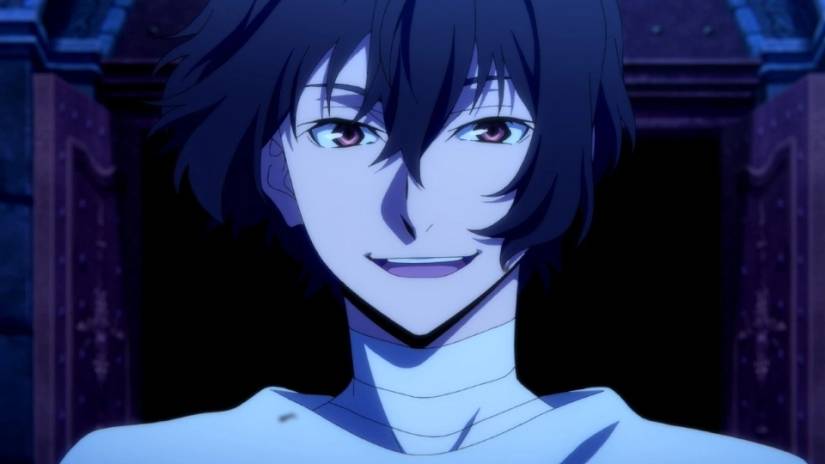 Image: Bones
After Atsushi activates his ability and joins the agency, he learns about Port Mafia, an underground criminal organization that uses legal means to operate in Yokohama. Asagiri’s knack for complex world-building shines here, where Port Mafia is evolved into an intricate machine that carries out organized crime with the aid of supernatural abilities. Port Mafia member Ryūnosuke Akutagawa assumes center stage, tearing the city apart with his ability named Rashomon, which allows him to extend dark tendrils that can consume or cut through anything, including space. A complicated dynamic between the compassionate Atsushi and the ruthless Akutagawa takes shape, fueling one of the most compelling aspects of the evolving story.
Both Atsushi and Akutagawa were orphaned at a young age, but developed conflicting views of the world and the people inhabiting it. Akutagawa’s survival-of-the-fittest instincts lead to a limited perception of human relationships, where he’s incapable of recognizing one’s innate value. Atsushi, on the other hand, wears his heart on his sleeve and throws himself into danger to aid strangers. Although drastically different, these two boys are unified by trauma. Both of them battle feelings of low self-esteem: While Atsushi internalizes it with soul-crushing guilt, Akutagawa externalizes it by using apathy like a sharp blade.
 Image: Bones
These intimate character moments are often juxtaposed against dramatic spectacle that rivals power systems in battle shōnen or seinen. The heightened stakes go hand in hand with hidden character anxieties, which are best understood during battle. Take Port Mafia Executive Chūya Nakahara as an example, whose ability, For The Tainted Sorrow, allows him to manipulate gravity. Every Chūya-centered fight scene is beautiful to behold, with gravity altering and reversing as per his whims until it builds up to a stage called Corruption, which causes him to spiral out of control. Although Chūya cannot tame it, Corruption allows him to increase his own density and crush massive structures with his bare hands.
Similarly, every ability granted to a literary namesake is based on their respective works, even though the intent and destructive might are reinterpreted according to the rules of this eccentric world. With that logic, it makes perfect sense that Guild member John Steinbeck’s ability is called The Grapes of Wrath, which lets him sprout grapevines from his body and use them for stealth and defensive purposes. And when we finally meet Guild architect Edgar Allan Poe, he uses Black Cat in the Rue Morgue to transport (and trap) readers into the setting of any novel they are currently reading.
Bungo Stray Dogs is meant to be relished as a slow burn. It is an action-heavy mystery that mimics a case-of-the-week format while fleshing out the most prominent players at a languid pace. Laugh-out-loud humor melts into tense, exciting battles, which quickly give way to devastating personal crises that weigh upon every character. As the seasons weave fascinating tales about literary namesakes and their spine-chilling exploits in Yokohama, you might be left with a newfound appreciation for reference-heavy storytelling and its power to reignite the flame of nostalgia.
Bungo Stray Dogs can be streamed on Crunchyroll.




![ELDEN RING NIGHTREIGN: Deluxe Edition [FitGirl Repack]](https://i5.imageban.ru/out/2025/05/30/c2e3dcd3fc13fa43f3e4306eeea33a6f.jpg)
 English (US) ·