.png)
 4 months ago
28
4 months ago
28

Published Mar 30, 2026, 3:45 PM EDT
The controversial change may have caused a major accident at the Japanese Grand Prix on March 29
 IMAGE: Polygon
A speed boost might be appealing in a racing video game, but Formula 1 drivers are struggling with the real-life equivalent.
Formula 1’s 2026 regulations introduced a feature that the world’s best drivers are comparing to using a mushroom in Mario Kart. It’s a controversial change that may have inadvertently been the cause of a major accident at the Japanese Grand Prix on March 29.
The “mushroom” speed boost is a completely intentional part of race strategy. In 2026, the FIA introduced new regulations for Formula 1. Among these are some changes intended to keep F1 in line with its goal to go Net Zero and dramatically reduce the sport’s emissions by 2030 — a steep challenge for a sport that ships machinery and personnel all over the globe for more than 20 races a year.
One glaringly obvious source of carbon emissions is fuel, and fittingly this new generation of cars rely even more on electric power than the previous hybrid generation. The new engines have a 50/50 split between internal combustion and battery power. Throughout the race, drivers are continually charging and deploying energy from the car’s battery. This part is relatively straightforward: going flat-out consumes power. Braking or lifting off the throttle (among other things) will harvest power for the battery.
But drivers have some choice in how all that harvested energy is deployed, and that brings us to the mushroom. Or, as it’s officially called, the “boost” button. This is a literal button on the steering wheel that a driver can push to deploy all that built up electrical energy, giving the car a speed boost.
“This is like a mushroom in Mario Kart,” Ferrari’s Charles Leclerc said on the radio during the season-opener Australian Grand Prix.
The boost can be used in attack or defense, and the driver could choose to spend it all in one glorious push, or mete it out throughout a lap. So far, it’s been controversial at best.
A divisive change
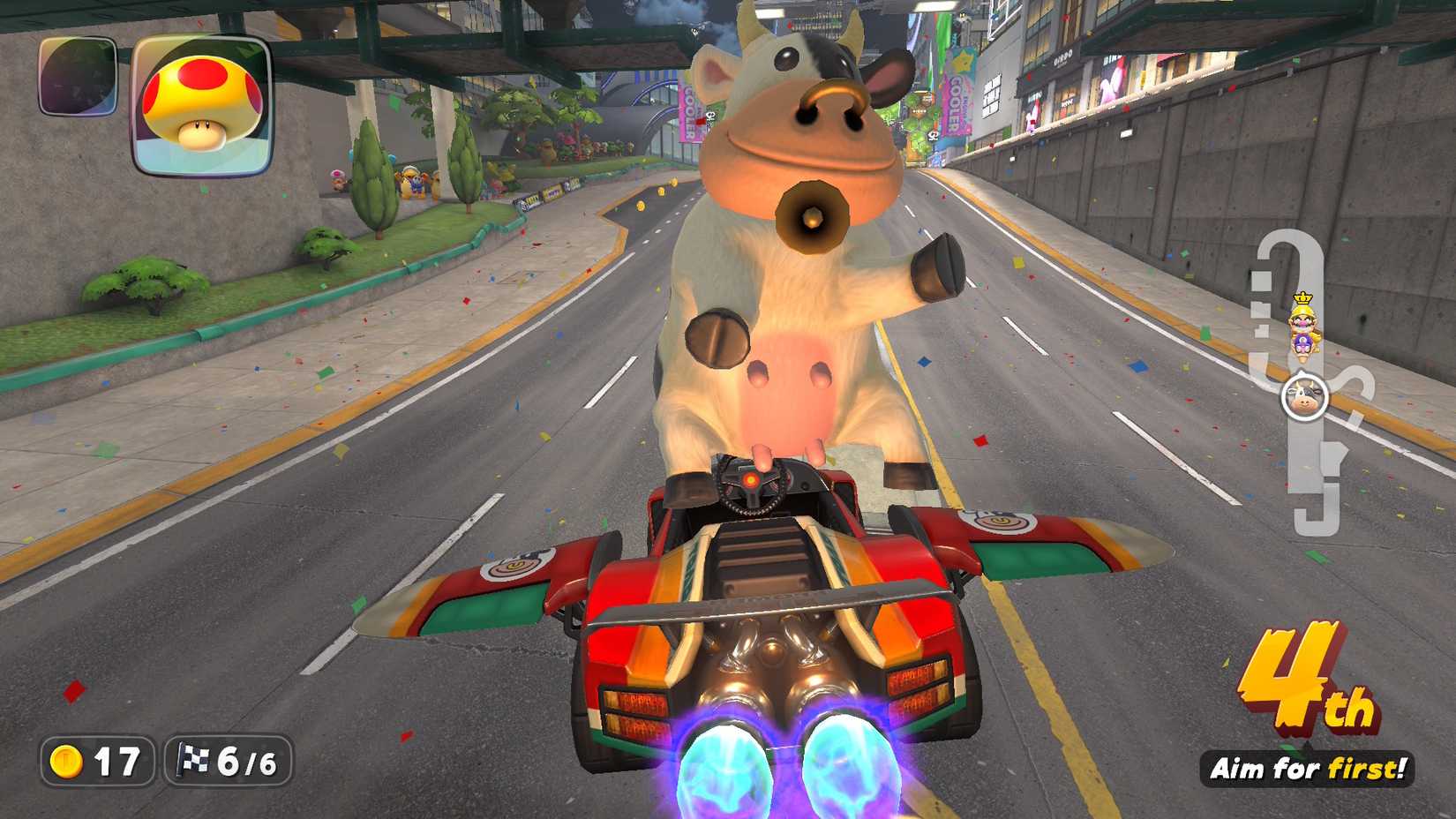 Image: Nintendo EPD/Nintendo via Polygon
"I found it very fake, to be honest," Sergio Perez told SkySports F1’s Martin Brundle. “You overtake, and then you get overtaken. Mario Kart style."
Many of the drivers are on-record complaining about moments when they did not have enough battery power to attack or defend on track in the way they’re accustomed. The season-opening race in Australia on March 7 featured a battle between George Russell and Lewis Hamilton, where the two drivers repeatedly overtook each other, back-and-forth.
This kind of battle should be thrilling, and there is always a huge element of skill in high-speed exchanges like this. But there’s also the reality that the drivers were taking turns using these new power-ups, and it saps a lot of tension out of a race when you know that a brilliant overtake comes at the cost of — well, that same car being brilliantly overtaken, because now it’s out of power.
“I swapped the simulator for my Nintendo Switch,” four-time world champion Max Verstappen told the media pen before the Shanghai Grand Prix on March 12. “I'm practicing with Mario Kart, actually. Finding the mushrooms is going quite well, [finding] the blue shells is a bit more difficult.”
Verstappen, an avid gamer who willingly spends his free time sim-racing, has been one of the most vocal critics of the new regulations. He more or less threatens to walk away from the sport every weekend. This is typical of Verstappen, who has a lot of opinions — and a lot of power to make change in the sport. But it’s also looking increasingly more realistic, as he made his GT3 debut last year and will race the Nurburgring 24 Hours this May.
The crash that could change everything
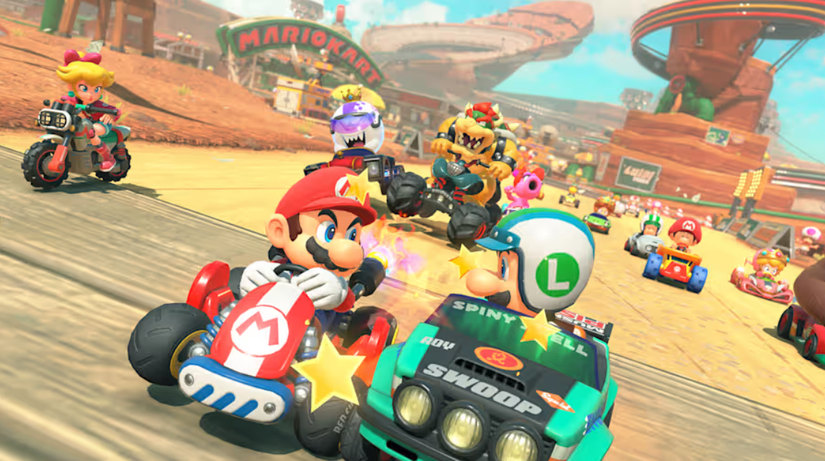 Image: Nintendo / Nintendo EPD
“I see what you mean about the mushroom,” Oscar Piastri told Charles Leclerc in the cooldown room after Formula 1’s Japanese Grand Prix on March 29.
The drivers were watching the race’s highlight reel, which included footage of a startling high-speed collision for Haas’ Ollie Bearman.
Bearman had been preparing to pass Franco Colapinto in a part of the track where Colapinto was consistently slow, because he was harvesting energy. Bearman hit the boost, and flew towards Colapinto with an additional 45 KPH of speed, according to post-race analysis from the FIA.
Bearman took evasive action onto the grass, blew through several signs, and finally whipped across the track and into a tire barrier at 50Gs. The car was crushed, and Bearman was seen hobbling, supported by marshalls, after the incident. The team later confirmed he had a knee contusion, though fortunately no more serious injuries.
"It was a massive overspeed, 50 KPH, which is a part of these new regulations that I guess we have to get used to," Bearman said. "But also I felt like I wasn't really given much space given the huge excess speed that I was carrying.” Colapinto appeared to have moved off the racing line to the middle of the track as Bearman approached. F1TV commentators noted that even a small, instinctual defensive move makes a big difference on the narrow, winding Suzuka track.
“That is basically what you get with these things, I mean, one guy is completely stuck with no power, and then the other one uses the mushroom bolt," Verstappen told reporters after the race. “If it is all about safety, then it is easy to fix things. You can use 'safety' for a lot of stuff, so maybe we should use the word 'safety' for it, and finally make some changes.”
The incident immediately went under review, and neither driver was found at fault. Haas team principal Hayao Komatsu said he even hesitated to call it an error on Bearman’s part.
“This is only the third race in this regulation, so that's something he's never experienced,” Komatsu said.
The crash accelerated drivers’ objections to this Mario Kart style of racing. As the sport takes an enforced hiatus thanks to the cancellation of races in Saudi Arabia and Bahrain, the FIA says it will hold meetings to “assess the operation of the new regulations and to determine whether any refinements are required.”







![ELDEN RING NIGHTREIGN: Deluxe Edition [FitGirl Repack]](https://i5.imageban.ru/out/2025/05/30/c2e3dcd3fc13fa43f3e4306eeea33a6f.jpg)
 English (US) ·