.png)
 3 months ago
26
3 months ago
26
Pokémon Pokopia is, by pretty much all accounts, a hit for Game Freak, Omega Force, and Nintendo, and one of the things we like to do here at Kotaku’s Pokémon column Exp. Share is look at the butterfly effect of something small from the series’ beginnings leading to developments we’re seeing now, in the franchise’s 30th anniversary. Ditto’s appearance as a protagonist of one of the best games of 2026 would likely never have happened had it not been for one episode of the original anime. If you’ve never seen “Ditto’s Mysterious Mansion,” it’s a fascinating time capsule depicting The Pokémon Company’s efforts to figure out a monster’s identity in real time.
You can watch the full episode above, courtesy of the Pokémon TV YouTube channel. In it, Ash, Pikachu, and their friends hide out from a storm in a seemingly abandoned theater. Once inside, they meet another Pikachu, but something’s off. Instead of Pikachu’s usual brown eyes and curled mouth, this little guy has beady eyes and a straight line for a mouth. It turns out, this isn’t a Pikachu at all, it’s a Ditto. These pink blobs are one of the only Pokémon (alongside Mew) that can learn the move Transform, which lets it shapeshift into an opponent and copy their moves.
The problem here is that this Ditto, owned by an impressionist named Duplica, can’t quite get its transformations right. Most Ditto are able to completely replicate their target down to the finest details. This should include their face, but Duplica’s Ditto can’t quite seem to get this one thing right, and it’s leaving their variety show’s audience dissatisfied. By the end of the episode, Ditto learns how to replicate faces and the pair’s show is able to finally go on.
 © The Pokémon Company
This inability to get faces right was presented as an oddity unbecoming of most Ditto, but the look has stuck with Ditto over the years across games, anime, merchandise, and even the live-action movie Detective Pikachu. Even though Ditto is supposed to turn into a perfect copy, the series has never stuck with this idea, instead portraying Ditto in a few different ways over the years that always suggest that something is slightly off, whether that be with a slightly discolored sprite in some instances, or leaning into the anime interpretation of its blank face in others. As time has gone on, the latter imperfect transformation has become the character’s default setting.
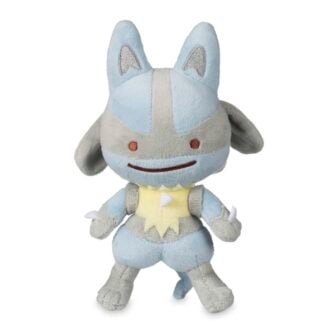
Ditto now has its own merch line, with The Pokémon Center selling plushes and other items that, at a glance, look like a bunch of other Pokémon, but sport Ditto’s beady eyes. Ms. Norman, a character in the live-action Detective Pikachu movie, is revealed to be a Ditto in disguise, transforming into humans and Pokémon to serve the film’s antagonist, Ryme City founder Howard Clifford. Her true identity is revealed when she removes sunglasses she had been wearing the whole film to show she has the same Ditto eyes underneath her shades, and it’s kind of horrifying.
Howard’s Ditto is shown to be a more than capable impressionist, so the only real explanation for her having the iconic blank stare is that The Pokémon Company has just decided this is Ditto’s default look.
Not all the games have included Ditto’s imperfect mug in its transformations. Most mainline games don’t use it, likely to simplify the animation process, as that would double the number of 3D models Game Freak would have to develop for what is ultimately a very niche use case. But now, Ditto isn’t just a niche gimmick or a baby-making machine you use to breed Pokémon, it’s a Pokémon protagonist in its own right.

Welcome to Exp. Share, Kotaku ’s Pokémon column in which we dive deep to explore notable characters, urban legends, communities, and just plain weird quirks from throughout the Pokémon franchise.
Ditto transforms into its trainer in Pokémon Pokopia, and while you can customize its skin tone, clothes, and hairstyle, you can’t do anything about that featureless face. It maintains it when it changes into Dragonite or Lapras to travel through the air and water, and when it uses moves like Strength and Cut to help build new habitats and structures, it keeps the closest facsimile it can to its long-lost trainer it can muster, Ditto face and all.
 © The Pokémon Company / Kotaku
Fans like to hypothesize that the Ditto in Pokopia may keep its own face because after so many years, it’s forgotten its trainer’s face. That’s a deliciously tragic interpretation, and I love that this game taps into some of the angst the series only sparingly leans into. But it’s also entirely possible this is just how The Pokémon Company portrays Ditto after all these years. Ditto’s broken transformation is basically as iconic as the pink blob itself, and it has kept the shapeshifter from losing its own identity over 30 years as it took on the form of everyone else. Ditto’s everchanging form makes it the perfect player character for a game like Pokopia, and it likely wouldn’t have happened without “Ditto’s Mysterious Mansion.”




![ELDEN RING NIGHTREIGN: Deluxe Edition [FitGirl Repack]](https://i5.imageban.ru/out/2025/05/30/c2e3dcd3fc13fa43f3e4306eeea33a6f.jpg)
 English (US) ·