.png)
 4 months ago
46
4 months ago
46
It’s like something out of Space Jam: NBA icon Michael Jordan versus Pikachu, Pokémon’s iconic electric rat.
Since Professional Sports Authenticator (PSA) was founded in July 1991, the third-party collectible verification company has graded more than 1.6 million Michael Jordan cards — by far the most of any human athlete. Jordan is also featured alongside Kobe Bryant on a signed basketball card that sold for $12.93 million in 2025, which at the time broke the record for the most expensive trading card ever sold. (Shark Tank star Kevin O’Leary recently wore it around his neck at the 2026 Actor Awards, because that’s something that people do now.)
“Previously, Michael Jordan was kind of our most graded athlete slash character of all time,” Elizabeth Gruene, PSA’s head of pop culture, told Polygon during a call. “We graded 1.5 million Pikachu cards just last year.” In other words, Pikachu nearly matched in one year what took Jordan 35 years — and that was before Logan Paul sold his Pikachu Illustrator for $16.49 million in February of this year. 2025 also marked the first time ever that trading card games surpassed sports cards for number of cards graded at PSA, with Pokémon representing roughly 90% of all TCG cards graded.
In the midst of the Pokémon franchise’s 30th anniversary, these sensational numbers tell us a lot about how the Pokémon TCG, once dismissed as a kids’ game, has become the dominant force in the world of cardboard collectibles. Tracing the history of grading Pokémon shows us how the market has evolved over the past three decades — and how Pikachu came to defeat the greatest basketball player of all time.
1999: The playground economy
When Wizards of the Coast launched the Pokémon trading card game in North America in January 1999 — just months after Pokémon Red and Blue and the anime hit the U.S. — it spread like a virus. Within a year, schools across the country were banning trades after disputes, thefts, and lopsided deals turned recess into a chaotic free-for-all market.
 Image: The Pokémon Company
I was nine years old at the time. Like millions of other millennial kids, I was captivated. Gruene remembers it the same way.
“I'm almost 35, and I love Pokémon because I grew up playing it and collecting it,” Gruene said. “I graded a bunch of my childhood cards, which was really fun. And my favorite Pokémon character is Budew. I just really like him and think he's really cute. But it's also a really good card for gameplay.”
From the start, Pokémon functioned less like a competitive card game and more like a character-driven collecting engine. We didn’t chase cards to win tournaments. We chased Charizard because it was a cool firebreathing lizard who was the bad boy of the anime. Everybody said it was the rarest card in existence. Even if you preferred Blastoise, you wanted Charizard. When my uncle drew one out of a booster pack at my local game store, the store’s owner offered him $100 on the spot for it and then raised the offer to $120 after a moment’s hesitation. I almost burst into tears. They both looked at the ground, probably feeling a bit ashamed, and my uncle handed me the card. Somehow, I have no idea what ultimately happened to it. That really stinks because it’s probably worth thousands of dollars today.
Unlike sports cards that derive value from the real-world performance of talented athletes, Pokémon cards get a lot of their value for being cute little guys. We form emotional attachments to them. Pikachu doesn’t need to win championships to matter. (In fact, he probably never will! Pikachu kind of stinks as a Pokémon.) But as the mascot of a brand approaching a lifetime worth of $147 billion this year, he’s basically the most powerful symbol to ever exist.
That early “playground economy” laid the groundwork for something much larger. Many of the kids like me who snuck Game Boys and Pokémon cards into recess would grow up to become the adult collectors fueling today’s grading boom. The mania of 1999 may have initially felt like a fad, but it was just the first wave.
2003-2010: The evolution
When Nintendo assumed control of English-language card distribution in 2003, the Pokémon TCG stopped feeling like a late-’90s phenomenon and started operating like a core part of the brand. Under Wizards of the Coast, Pokémon had been explosive but chaotic in America. By the mid-2000s, The Pokémon Company began releasing new card sets with each and every video game generation: Ruby and Sapphire in 2003, FireRed and LeafGreen in 2004, Diamond and Pearl in 2007, Platinum in 2009, and HeartGold and SoulSilver in 2010.
“The video games are really where it all starts with the genesis of any new character,” Gruene observed. “Any new set of cards that comes out is based on the video games, so that’s where it all begins.”
That synergy still matters. Every new generation of games introduces new Pokémon and often new mechanics, and brings new waves of players into the franchise. Meanwhile, the TCG follows suit. The Pokémon Company also formalized organized play by launching the Pokémon TCG World Championships in 2004. This legitimized it as a competitive trading card game beyond its initial reputation as more of a collector’s hobby.
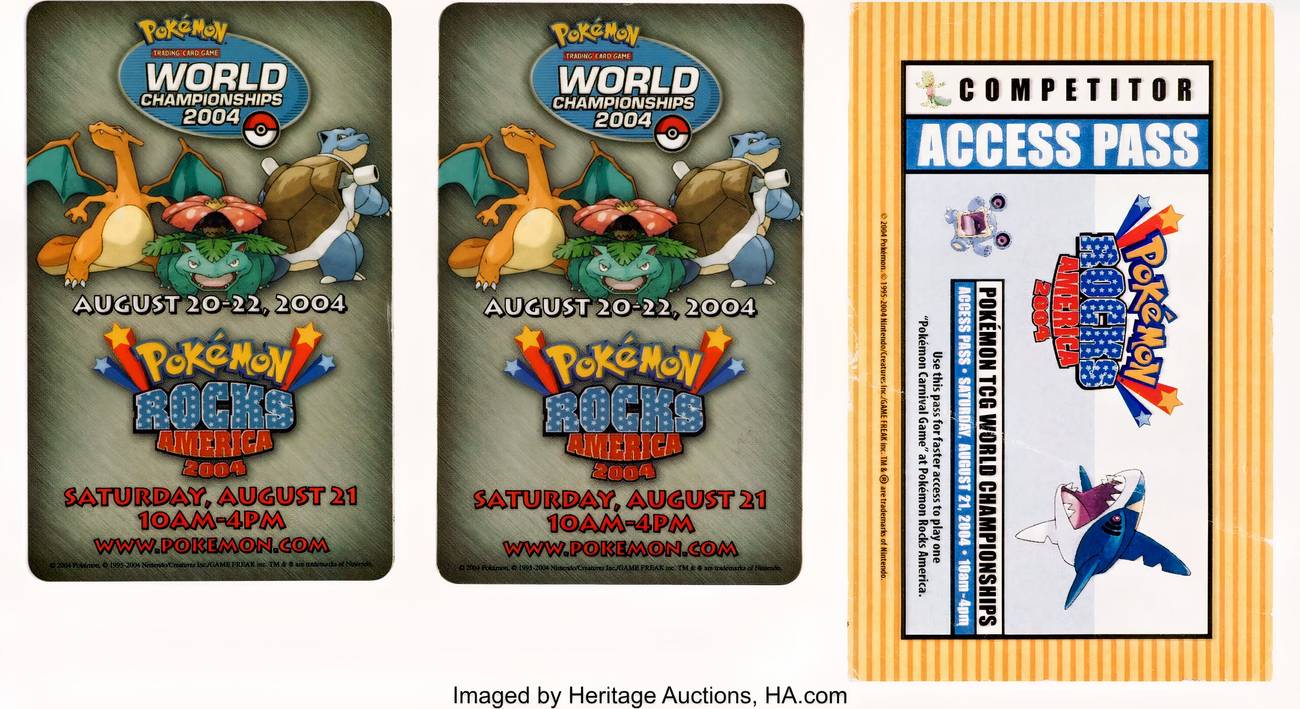 Heritage Auctions often sells all sorts of vintage merch from the early days of the Pokémon pro scene.Image: Heritage Auctions
The secondary market wasn’t yet explosive in this era. Attention drifted to other games like Yu-Gi-Oh, and grading remained relatively niche. PSA graded only 757 Pokémon cards in 2008, 1,060 in 2009, and 1,842 in 2010. By this time, the millennials who had traded cards in 1999 were aging into high school and college. I played Pokémon Black and White toward the end of my senior year of college while my old cards collected dust in the attic.
“I've re-engaged with that childhood passion,” Gruene said of her own experience. “Then I also have my own children who are young, and they love Pokémon, too. It's something we can kind of do together as a whole family.”
For streamer luckycarderik, commonly known as Gold Suit Man, a passion for Pokémon was inherited. “I’m a Zoomer, so when it comes to the cards, I had a three-ring binder handed down to me,” he told Polygon. A number of younger Pokémon fans likely had a similar experience sometime around this era.
All the while, the collector market was quietly picking up steam. The PSA received a total of 18,874 Pokémon grading submissions in 2013 — roughly 10 times the amount it had just three years prior.
2016: Time for Pokémon to Go
 Remember one blissful summer when everybody was bumbling around outside looking for Pokémon?Image: Niantic/The Pokémon Company
When Pokémon Go launched in July 2016, it didn’t just dominate mobile gaming — it reintroduced Pokémon to millions of lapsed fans overnight. Parks filled with adults chasing digital creatures they hadn’t thought about in years. We touched grass. We tasted fresh air. The franchise suddenly felt omnipresent and cool again. And the Pokémon brand had a new tentpole that forced us to pay attention to the others. I tried to find some of my old cards just to look at them. I even bought Pokémon Sun just to feel young again.
Google search interest in “PSA Charizard” saw a massive spike. Vintage card prices began creeping upward. The Holy Grail of Pokémon cards, that Base Set Charizard, started rising steadily in price above its previous stagnation to hit around $5,000. PSA submission numbers ticked upward as former kids — now adults — started taking a second look at the cards in their closets. Plenty of them probably got back into the card game, too.
Gruene noted that based on PSA trends, similar upticks typically happen with new Pokémon releases, particularly the October 2024 release of Pokémon Pocket, the digitized version of the TCG.
2020: The millennial-driven pandemic boom
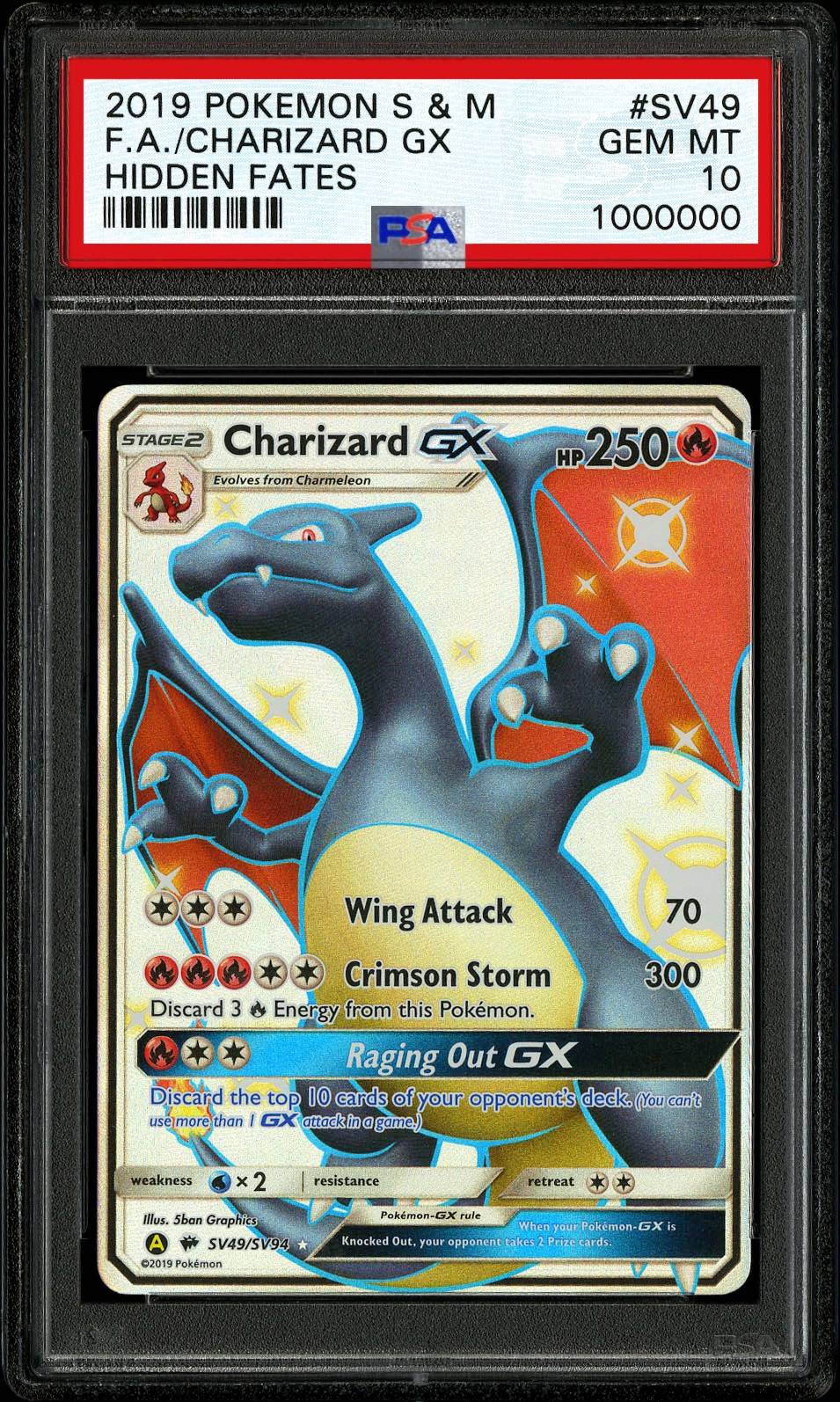 The one millionth Pokémon card that the PSA graded was this PSA 10 Charizard GX.Image: PSA
The PSA graded its one millionth Pokémon card in October 2019. “Every generation defines what is nostalgic to them,” Collectors Universe CEO Joe Orlando said at the time. “Today, the young people who were playing the classic game then are now well into adulthood. As a result, the game has enjoyed a kind of rebirth in the hobby.”
Little did Orlando know that a few months later, as the pandemic forced everyone indoors, those millennials would return to the hobby to purchase new cards — or at least watch others do it online. YouTube box breaks began going viral regularly. “Pokétubers” like Leon Hart, Poke Rev, and Randolph Pokemon took off. Together, they boast more than 5.8 million subscribers today. In Oct. 2020, Logan Paul opened up a first-edition box of Pokémon cards worth $200,000, which racked up 11 million views in a matter of months, singlehandedly driving the cost of vintage cards through the roof. All of this, coupled with the fact that 2020 marked the 25th anniversary of Pokémon, made for a perfect storm.
“Nostalgia is a powerful driver in collectibles, and during the pandemic we saw many fans rediscovering the joy of the trading card hobby and gaming,” Adam Ireland, VP and GM of Global Collectibles at eBay told Polygon via email. “What’s exciting about Pokémon is that it offers both nostalgia and exciting new releases – the franchise has continued to evolve, and has a multigenerational collector base. On eBay, we see fans shopping everything from vintage ‘90s holos to modern chase cards and Japanese exclusives.”
Grading became increasingly more common as collectors saw the opportunity to increase the value of their cards. According to Gruene, grading’s main purpose is twofold: verify the authenticity of a card and to offer a 1-10 grade based on its overall quality, with 10 being the very best. As such, grade 10 versions of any card fetch the highest price at auction. By the one-year anniversary of the pandemic, the PSA was receiving more cards every five days (more than 500,000 per business week) than it previously had received every three months.
“I think with grading and actually rating the cards, it takes something that anyone might have and elevates it,” content creator Yunaverse TCG told Polygon at a 30th anniversary Pokémon celebration. “Anyone can have a base set Charizard, but only a couple can have PSA 10. That's what really drove the secondary market to be more than just trading one-to-one values. All of a sudden, these cards become worth a lot more, even though they're the exact same card.”
As Yuna observed, people began seeing Pokémon cards as a lucrative investment, and card grading became a way to confirm that investment. `
2023-2026: A return to the 151 and a major anniversary
If the pandemic reignited nostalgia, Scarlet & Violet-151 tossed some fuel on that fire just as it began to wane. Released in September 2023, the set focused exclusively on the original 151 Pokémon and seemed targeted at millennial collectors. If demand had waned at all in the post-pandemic era, this set singlehandedly triggered a surge in retail demand. Resellers saw an opportunity and took it. By late 2025 and early 2026, Gruene said that the market shifted — or perhaps more accurately, exploded.
From the 1990s through 2010s, PSA data indicates that Charizard had been the most collected card, but in the contemporary era, the grading and collector market has become increasingly more defined by flashy new promo cards rather than vintage classics. “The 2025 McDonald’s Pikachu and 2023 Van Gogh Pikachu have each individually been collected more than the combined totals of the top 10 most-collected cards from prior decades, reshaping what ‘valuable’ looks like for the world’s most-collected card category,” a statement from the PSA reads.
According to data provided to Polygon by eBay, users searched for Pokémon items more than 360 times per minute on average in 2025. From eBay’s perspective, vintage Pokémon cards still dominate: Five out of the top 10 highest-value trading card singles sold on eBay in 2025 featured Charizard, and Pikachu searches were up more than 120% compared to 2024. More broadly, “Pokémon PSA 10” ranked among the top 10 most-searched collectibles terms on eBay across all categories.
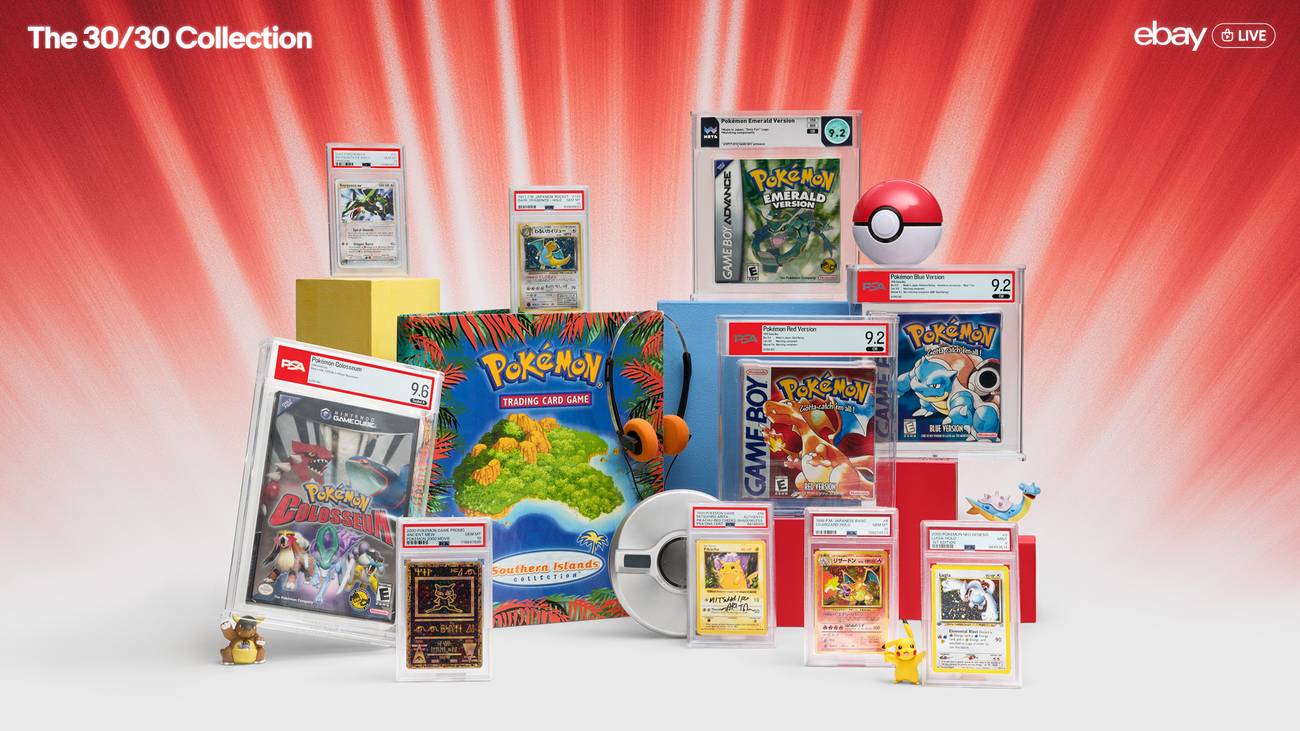 Just a portion of eBay's 30/30 Collection meant to celebrate Pokémon's 30th anniversary.Image: eBay
“Nowadays there's a lot more of the younger community getting into the game, and we're kind of building the next generation of collectors and people who love the hobby,” content creator Scotts_PC told Polygon at a recent anniversary event. “So I think it's taking a good turn.”
Gruene believes that we’re only at the “tip of the iceberg” right now when it comes to enthusiasm for the Pokémon TCG — she doesn’t see the market taking a downward turn anytime soon. “The 30th anniversary is a big moment, but I'm sure there's going to be an exciting product right around the corner,” she said.
Among the 20 million cards graded by the PSA in 2025 (up 26 percent from the previous year), the top five most frequently graded were all Pokémon. Furthermore, one out of every 15 cards graded in 2025 was a Pikachu.
Michael Jordan isn’t even part of the conversation anymore. And Pokémon feels bigger than ever with room to grow.







![ELDEN RING NIGHTREIGN: Deluxe Edition [FitGirl Repack]](https://i5.imageban.ru/out/2025/05/30/c2e3dcd3fc13fa43f3e4306eeea33a6f.jpg)
 English (US) ·