.png)
 3 months ago
28
3 months ago
28

Published Mar 5, 2026, 8:00 AM EST
It's time to revisit 1988's iconic Gundam feature while it gets a limited revival screening in Japan
 Image: Sunrise
If you’re new to the world of Gundam, Yoshiyuki Tomino’s Mobile Suit Gundam: Char’s Counterattack probably isn’t the best entry point. The 1988 anime film, which is also the first original theatrical outing for the popular mecha franchise, plunges headfirst into an ongoing intergalactic conflict that escalates into a genocidal war. But with a special double feature of Char’s Counterattack and The Sorcery of Nymph Circe (the second film in the Mobile Suit Gundam: Hathaway trilogy) screening at select theaters in Japan for a limited time later this month, there’s never been a better time to experience (or revisit) this beloved Gundam film.
[Ed. note: This article contains spoilers for Mobile Suit Gundam: Char's Counterattack]
Jumping right into the chaos of 1988’s Char’s Counterattack is an ill-advised move without proper context. The Gundam saga began with the Mobile Suit Gundam anime, which was followed by two sequels: Mobile Suit Zeta Gundam and Mobile Suit Gundam ZZ. These entries revolve around a battle for independence known as the One Year War, in which a cluster of Space Colonies (the Principality of Zeon) repeatedly clashes with the Earth Federation, a global government formed to resolve Earth’s resource crisis.
Zeon gains the upper hand with high-performance mobile suit prototypes known as Gundams, but the cost of all-out war is that half of humanity perishes within the first week of the conflict. When teenage mechanic Amuro Ray discovers the Federation’s prototype — the RX-78 Gundam — it shatters the fragile post-war status quo.
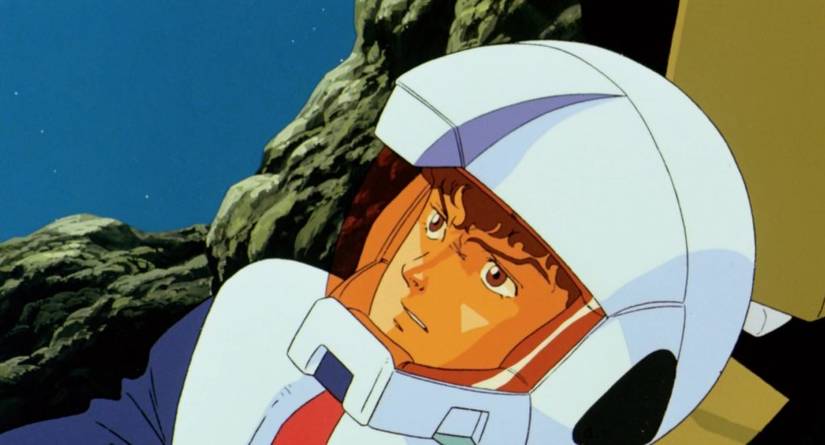 Image: Sunrise
Meanwhile, Zeon Lieutenant Commander Char Aznable is more concerned with enacting personal revenge than with fighting the Federation, and this path inevitably leads him straight to Amuro in the midst of ever-escalating war. As the title suggests, Char’s Counterattack is the culmination of this sprawling saga, in which we see Char Aznable’s attempt to wipe out life on Earth, with a determined Amuro trying to prevent this global catastrophe.
Gundam’s primary draw has always been its bombastic mobile suit sequences, but the franchise has perennially framed these clashes as a desperate effort to either save or doom humanity. War and its arbitrary casualties contextualize these frenetic fights, making it impossible to get caught up in the exaggerated aesthetics for too long. This doesn’t mean that Char's Counterattack isn’t beautiful to look at. This is a breathtaking vintage anime, and the first franchise production to use computer graphics for a brilliant five-second shot of the Sweetwater colony rotating in space. Yutaka Izubuchi’s dynamic mech design also brings an element of fluidity between the film’s quieter moments and the bouts of flashy spectacle.
Char’s motivation is to use the Neo Zeon asteroid base, Axis, to cause a nuclear winter on Earth. While Char wishes to trigger a forced evolution for humanity in space, he is also driven by revenge and disillusionment. His longstanding rivalry with Amuro fans the flames of his obsession, as he views this decisive fight as the culmination of his ideological manifesto. While Amuro’s actions align with traditional definitions of heroism, the Earth Federation isn’t blameless when it comes to institutional corruption.
 Image: Sunrise
At the same time, the tyrannical Zabis, who are the founding royal family of the Principality of Zeon, are among the most despotic forces shaping the fate of the world. While the Federation emerges as the lesser of two evils in this particular story, taking sides without suffering a moral crisis is borderline impossible. Even the proverbial “good guys” treat civilians and soldiers with callous indifference, with their lives being reduced to the inevitable fallout of war.
It might be tempting to dismiss this nuance at the heart of Char’s Counterattack; Gundam has come a long way in its critique of armed conflict in the 21st century. The Mobile Suit Gundam: Hathaway trilogy marks a shift in perspective, as its dystopian geopolitics now come with a ghoulish serving of post-capitalist impulses. Our protagonist, the enigmatic Hathaway Noa, is as disillusioned as Char, but he seems more emotionally closed-off and world-weary than his predecessor.
Char’s vision, while extreme, was built on a shrewd understanding of global politicking. In contrast, Hathaway’s desperation is the product of trauma — he is actively shaped by the events of Char’s Counterattack and haunted by the prospect of living in a world that thrives on exploitation. Char and Amuro’s ideals feel easier to grasp in comparison, but raise complex questions about binary thinking and mutual self-destruction by the time the credits roll. This is a premise worth revisiting time and again, as Char’s Counterattack never loses its charm as the epic conclusion to an (almost) world-ending 14-year rivalry.
Mobile Suit Gundam: Char's Counterattack is available to stream on Crunchyroll.


![House of the Dragon season 3 episode 2 ending explained: Let's talk about [SPOILERS] big death](https://static0.polygonimages.com/wordpress/wp-content/uploads/2026/06/emma-d-arcy_0.jpg?w=1600&h=900&fit=crop)

![ELDEN RING NIGHTREIGN: Deluxe Edition [FitGirl Repack]](https://i5.imageban.ru/out/2025/05/30/c2e3dcd3fc13fa43f3e4306eeea33a6f.jpg)

 English (US) ·