.png)
 4 months ago
43
4 months ago
43

Published Feb 4, 2026, 9:00 AM EST
Bigger, better, and bolder
 Image: Koei Tecmo
Sign in to your Polygon account
As soon as you're through Nioh 3's tutorial, Tokugawa Takechiro — the game's protagonist and soon-to-be shogun — emerges into a world with an ominous red hue across the sky and a colossal, demonic eye with descending claws, evidently the source. It's stunning, but it's clear at this moment that this is to the Nioh series what Elden Ring is to the Souls games: a bigger and bolder sequel that, for better or for worse, is a clear imitation of FromSoftware's magnum opus.
Everything you know about Soulslike games is true here in Team Ninja’s latest action RPG. Periodic checkpoints (shrines, in this case) where resting at them respawns enemies, brutal combat that can result in your death if you misstep just once against the wrong foe, and unforgiving sections with cleverly placed fights to both trick and reward you for exploration. It stands on its own two feet perfectly well, though, and is deserving of the chance to go toe-to-toe with some of the best in the genre.
 Image: Koei Tecmo via Polygon
The most obvious Elden Ring inspiration comes in its map design, as for the first time in series history, Nioh 3 is now open-world. Well, "open-field," if you listen to the marketing, which essentially means there are four huge open worlds that aren’t connected like The Lands Between. But the premise is the same: You can freely explore maps as soon as you unlock them, which are categorized not just by region, but also by time period.
Set in 1622, your younger brother, Tokugawa Kunimatsu, is consumed by jealousy of your imminent ascent to the throne, and commands a horde of yokai (evil spirits and demons in Japanese folklore) to prevent it. This sends the world into turmoil, as you travel to four different time periods to end Kunimatsu's — and Hiruko, the being that has possessed him — rampage.
As is usually the case with a Soulslike, the story is merely a framework for justifying why there are a bunch of grotesque beings inhabiting the visually stunning lands Nioh 3 takes place in. While it's beautiful and exploration is initially rewarding, it eventually runs dry because good lord does this game have a lot of loot. Too much, one could argue, especially since most of it consists of duplicate weapons and armor you already have, with slightly different effects or abilities.
 Image: Koei Tecmo via Polygon
Subsequently, you'll spend a lot of time in menus, comparing two pieces of similar equipment before either selling or scrapping the rest. It hinders the flow, and while you could choose to only sift through your haul at the start or end of your session, you risk sitting on powerful gear when it could come in handy. This is one area where other Souls games, which make each piece of loot meaningful rather than inundating you with two or three pieces per enemy killed or chest opened, feel more rewarding and useful.
Nioh 3 is certainly a Soulslike, but it's by no means a difficult one, and not every change weighs it down. That's because it takes somewhat of a Ubisoft-esque approach to its open-world, for lack of a better term, and this approach helps it carve out its own space in a crowded genre. Elden Ring is intentionally obtuse with its quests and mysteries. Information about the world around you is hidden from the in-game map. You're left to figure everything out yourself. Not with Nioh 3. Each subregion of the map is annotated with a recommended level, and as you complete more objectives and tick off tasks within them, everything remaining gradually shows up. As a result, leveling up is easier, to the point where the only actual challenge comes whenever there's a boss. Fodder enemies are a walk in the park if you take the time to explore, because you'll earn enough XP to significantly outlevel them.
Bosses, on the other hand, can be a severe pain in the backside. Most have fascinating, creative designs, ranging from the hulking Baba Nobuharu with his unwieldy greataxe, golden antlers, and sea monster-esque skin, to Ryomen Sukuna, a seemingly mechanical, dual-bodied centaur of a creature, while the blue side fires icy arrows and the red swings a fiery axe. Each boss is unique but they're all equally unforgiving and often hard to read… although none are as relentlessly difficult as some of Elden Ring's toughest.
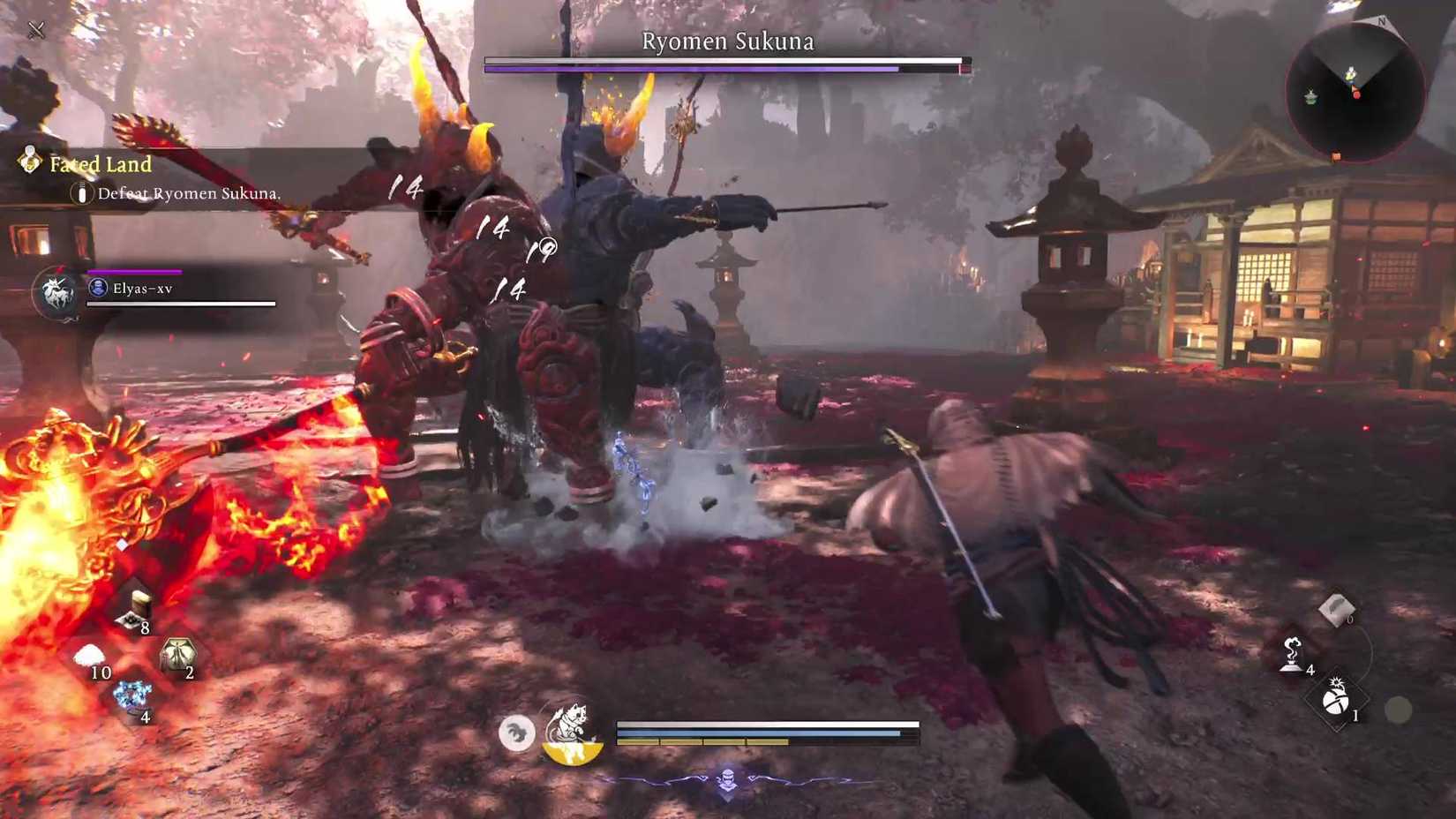 Image: Koei Tecmo via Polygon
To counter their difficulty, Nioh 3 employs a system that allows you to summon the avatar of other players to fight alongside you. Where FromSoftware games usually allow the summoning of a single NPC, placed strategically before some boss fights, this approach gives you the pick of the bunch, provided other players have used their Righteous Jasper item in the right place. Usually though, they have; boss room entrances are often swarmed with blue swords in the ground, indicating there's a tough fight coming up.
Where having an ally will make the fight tougher in a Souls game, though, usually by giving the boss more health, that doesn't happen here. Some bosses will still have you pounding your head against the wall, but they very rarely feel unfair, and that's because you'll almost always be able to take them on two-against-one. In fact, the toughest boss of the game in my experience was the very first, during the tutorial, when I was still learning the ropes and hadn't unlocked most abilities, nor could I use many health-restoring elixirs.
Alongside the open-world, combat is where Nioh 3’s Elden Ring-sized expansion has benefited the series most. For instance, you can now fight like the developer's namesake: as a ninja. While the second game had ninja skills, now you can truly embody one, with a style focused on ranged attacks, dodging, and faster, agile movement. This complements the samurai style, which is all about heavy weapons and stances.
 Image: Koei Tecmo via Polygon
You can switch style mid-fight at the press of a button, and the first step to mastering this game will be learning when and where to use each one. It's a steep learning curve though, and I quickly found myself leaning far more into the ninja style, to the point where I rarely switch back. I've dedicated most of my level ups so far into the skill attribute, which strongly favors the ninja style, and combined with my plethora of kusarigama abilities, it's been my go-to throughout.
Thanks to the two styles having a vast array of weapon types each, there are tons of weapon combos and ways you can play, even if it doesn't quite compare to the arsenal available in Elden Ring. Each weapon has myriad martial arts — attacks, essentially — so mastering every weapon takes time, and is exactly why I rely upon my trusted kusarigama. As a ninja, you also have access to "ninjutsu" — extra ranged abilities such as a lightning bolt or poison shuriken — and both styles can use "onmyo magic," which offer active and passive bonuses from the souls of enemies you've killed.
 Image: Koei Tecmo via Polygon
All of this is to say there are a lot of different mechanics at play in Nioh 3. Were I not reviewing it, I think I may have bounced off it quite hard at the beginning, in the same way someone might with a Souls game if they've never played one before. I'm glad I had to stick with it though, because after around 10 hours, give or take, something clicked. Team Ninja's third entry to the series is a more accessible open-world Souls game that, at least combat-wise, has more in common with Sekiro than anything else, and is simultaneously a great entry point to the series. Even though it wears its Elden Ring inspiration on its sleeve, it finds its own identity along the way, as a Soulslike that, I suspect, may eventually boast a higher retention rate of players new to the genre.





![ELDEN RING NIGHTREIGN: Deluxe Edition [FitGirl Repack]](https://i5.imageban.ru/out/2025/05/30/c2e3dcd3fc13fa43f3e4306eeea33a6f.jpg)
 English (US) ·